Yesterday, I crossed part of Havana under a relentless sun and in a city with hardly any public transportation to pick up a book I had managed to order. I discovered it in one of the groups on platforms like this one that allow me to find copies I don’t have or, as in this case, that I wanted to recover after losing them. Humidity and insects, among many other things, ravage our libraries. Added to this is the increasingly frequent gesture of those who dispose of family libraries after the death or absence of those who organized them for years, and which are now offered for sale, like shreds of a history in which each cover allows us to recognize not only a book read or desired, but also the moments when we had them at hand, or the faces of those who once brought them to us.
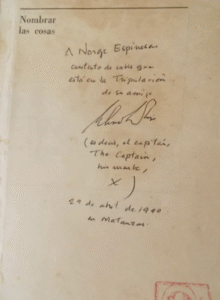
I had a copy of Nombrar las cosas, dedicated by Eliseo Diego, which succumbed to an invasion that devoured other beloved books with astonishing literary “taste.” Over time, along with those I was able to save in time, some of those I lost have reappeared thanks to these buying and selling maneuvers. All that remains of that copy is a photograph of the dedication, and finding another one allows me, now, to return it in a way through this volume to the space that Eliseo’s poems, in that edition designed by Fayad Jamís and Darío Mora, occupy in my memory, not just as a piece returned to a shelf. I confess that Lezama’s books are now a collector’s obsession, and this time I couldn’t resist buying another copy of his Poesía completa, in the edition prepared by Emilio de Armas and published in 1985. I can’t resist; sometimes I think it’s better to buy them without thinking about the price, because I prefer to have them close at hand, as if saving them from moths or from ending up in the trash, as I’ve seen so many do. And I’m not just talking about Lezama’s books.
Libraries are also falling apart as a symptom of other things in the country, and of the relief that some ignorant people create to fill those places of culture and memory with other needs, of space and economy, which are blurring the hopes and relationships that culture itself once founded among us. It’s the harsh summer, it’s the heat, it’s the unease that is sweeping away so many things. But I trust that in the midst of all this there are others who, like me, when they discover the cover of a book and a beloved author, rush to get it, without caring so much about these other forms of national suffocation, to have it, to recover it, to know it is safe, and to wait for someone to whom they can bequeath it when the great wave also sweeps us away. In that copy I now have, Eliseo’s signature does not illuminate a page, but in my memory it does, like someone who knows that they have recovered not a book, but an image of who I was when I learned to name things with those verses.