
Against the notion of capitalism, Julio Lorente refuses to validate its ideologization from ancient trade; but this ideologization, which is also modern, does not refer to that ancient mercantilism, but to its theologization. The reference to ancient trade is to mercantilism, and that as a determination of the entire cultural structure; therefore, it is not an ideological organization, later projected into a teleology, but rather a nature; which is precisely what is ignored in the process of ideologization, when it is described as a virtue, even a teleological one.
As a modern concept, the ideological question has the flaws of neoclassical thought, including the idea of nation, to which the process of ideologization of capitalism also responds, as can be seen in Adam Smith, who developed it. Precisely, the expansion of Renaissance trade—in Italy and the Low Countries—responds to its relative political anarchy; in a recurring situation that reproduces that of Phoenician trade in the Mycenaean area after the Minoan cataclysm.
The repetition of this cataclysm is not gratuitous; it is due to its exemplary nature as an organization of cultural dynamics, which are even repeated in other structures, such as the imperial disorganization and reorganization in China (Zhou) or Louis XIV’s control over the French nobility by contracting it with the elimination of its economic autonomy. The function of the market as an economy lies in the reflection of the formal determinations of reality; that is why it fails in its ideological process since Smith, later taken up by Max Weber in the same theological sense.
Of course, the problem is the ideological critique of ideology, which creates the same logical loop of universals, making the conflict unsolvable because, ultimately, its arguments become moral, like transcendentalists. There is no doubt that the original problem stems from attributing an object to reality, even if it is human; since in this case, as culture, it is still the current realization of certain relational functions, without an object.
It is, of course, objectivity that imposes a human character on reality, but always as an artificial nature; which is what makes culture susceptible to distortion as reality, due to this formal reflection of yours. In fact, the very definition of the economy as capitalist—or socialist—is reductive and ideological; which is why, since Smith, it has led to the emergence of the socialist model in utopians, as its greatest contradiction.
As such, in its own factuality, the modern economy is industrial, and its ideological organization is only that projection; which, by assigning it an object—be it capital or society—makes it teleological, with its proportional distortion. This is also natural and logical, insofar as the objectivity of the human is also the partiality of the real, while the claim to universality is what introduces contradictions, as in medieval conflict.
This is not gratuitous either, but is due to the local—specific and exceptional—nature of reality, even as nature; which always manifests itself in concrete phenomena, as epiphenomena of the relationships in which that nature is structured. Therefore, these references are not about episodic phenomena, but about the systemic functions in which reality is structured; thus resulting—due to their formal nature—in an artificial nature, as a reality of strictly human value.
In this sense, given the punctuality of these phenomena, they are historically organized into singular processes; which allow them to be differentiated from each other, as developments of diachronic—not synchronic—function, in eventual collision. Such is the exemplary development of English capitalism, which redirects the political flexibility of Renaissance mercantilism when there has already been a complete transfer of value from the New World to the Old World, promoting that expansion.
This is another overlooked peculiarity of modern capitalism, in its definition as mercantilist and not just industrial, which places the emphasis on capital, allowing for its subsequent ideological distortion, as in Smith’s example. This explains the drive for modern productivity, in its industrialization, due to the pressure of consumption capacity; due to that transfer of value, even if unevenly distributed in the cultural structure.
It would be in this last contradiction—in fact marginal—that the contradictions of society arise, which become structural precisely to the extent that commerce appropriates the superstructural function of religion. However, the latter does not occur in the process of the ideologization of capitalism, but in its practical and immediate reality; given the oligarchic nature of the democratic structure, also from its origins in Phoenician… and Venetian mercantilism.
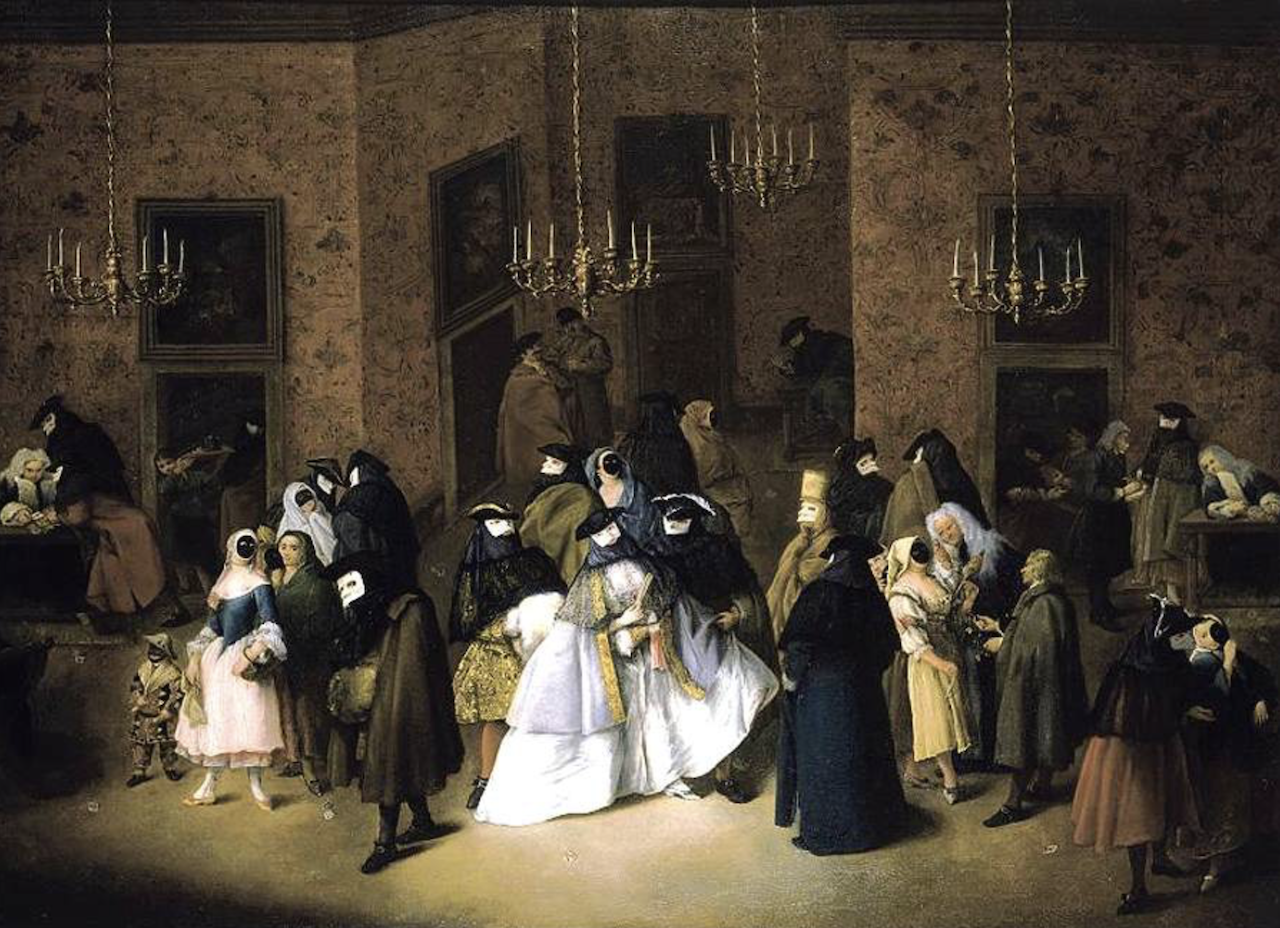
Image: The Ridotto in Venice (c. 1750), de Pietro Longhi.


