
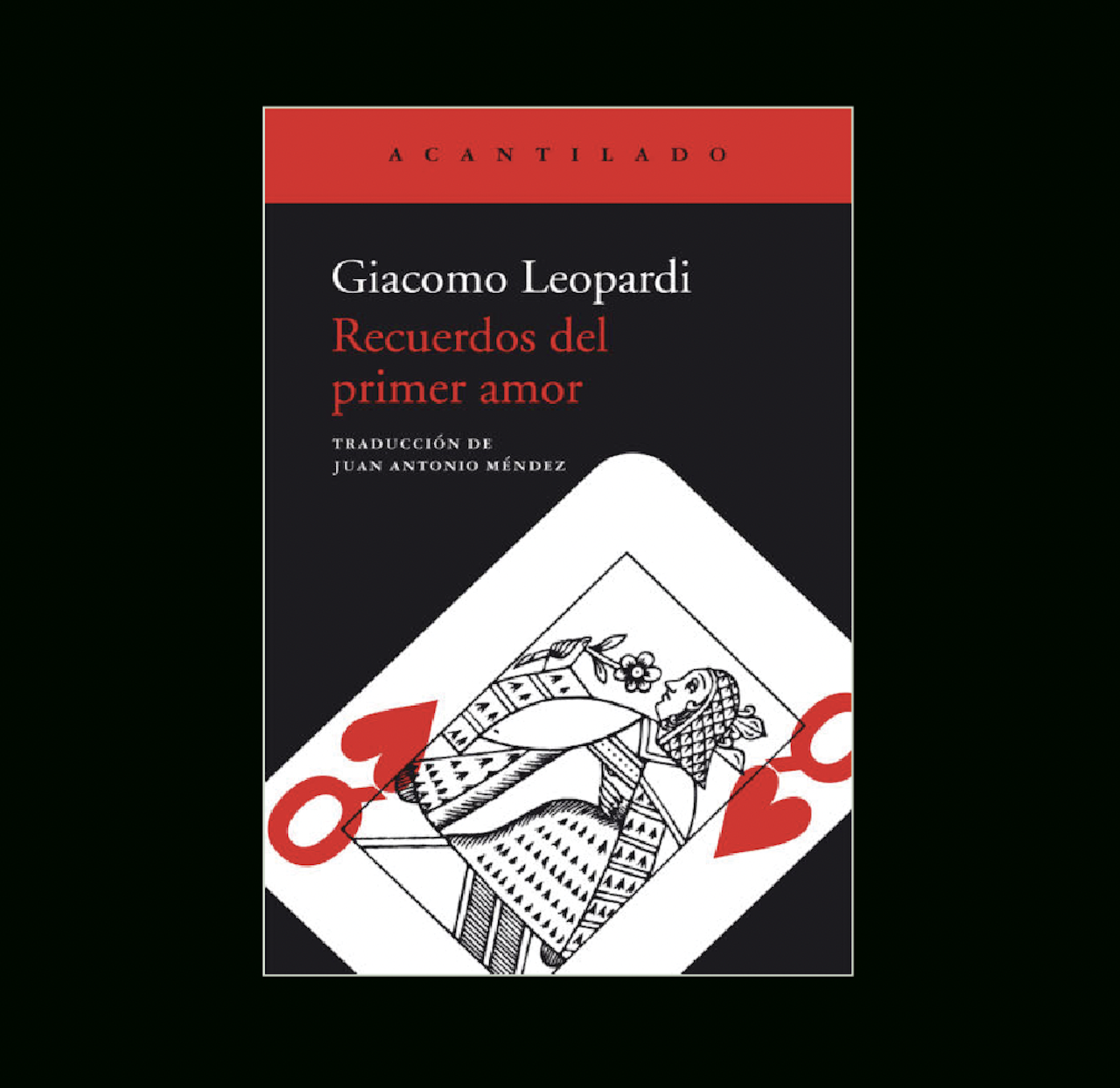
Some twenty-five years ago, this text by Giacomo Leopardi became known in Spanish under the title Diary of First Love, in a translation by Jorge Salvetti with a prologue by Luis Gusmán, who at the time was still identified—rightly so—as one of the historic members of the Literal group. That Argentine edition introduced many Spanish-language readers to a singular piece within the Leopardian corpus: brief, intense, situated on the margins of the major work, yet decisive for understanding the affective and reflective economy of the author of The Songs and the Zibaldone of Thoughts. The current version in Spanish, Recuerdos del primer amor (Acantilado, 2018), translated by Juan Antonio Méndez, returns to that text and brings it back into circulation with a sober, restrained prose that preserves the classical pulse of the original without forcing it toward a contemporary sensibility.
The book may be read, without excessive interpretive strain, as a treatise on melancholy—or, more precisely, as an intimate epilogue, displaced toward autobiographical experience, to Robert Burton’s monumental The Anatomy of Melancholy. Where Burton systematizes, classifies, and dissects the melancholic malady through encyclopedic erudition, Leopardi offers a concentrated psychological document: the meticulous record of an almost morbid state of longing, affective fixation, and extreme self-observation. There is no will toward doctrine or consolation; instead, there is a form of writing that accompanies the movement of the spirit—its oscillations, its withdrawals, its relapses.
The object of this affection—her name is Geltrude, she is older than he is and married—matters less than the inner mechanism activated by remembrance. Love is not, here, a story or an intrigue; it is a state of the soul, a persistent disturbance that reorganizes the perception of time, body, and world. Leopardi writes from youth, but not from naïveté: there is in these pages a precocious, almost cruel lucidity that turns the amorous experience into material for analysis without depriving it of intensity. Memory is not idealized; it is examined.
In this sense, the text shares certain folds with Casanova, though the kinship is strictly historical rather than methodological. Both write from an era in which the self begins to assume itself as a legitimate territory for literary exploration. But while Casanova advances through accumulation, adventure, and exteriority, Leopardi withdraws: he does not narrate conquests but anticipated losses; he does not celebrate desire, but its painful persistence once the object has vanished. The century is the same; the approach, radically different.
The singularity of the book also lies in its ambiguous status. It is not a diary in the strict sense, nor an essay, nor an orderly confession. Rather, it is a border piece—a writing that vacillates between memory and reflection, between concrete evocation and moral abstraction. This ambiguity partly explains its rarity within Leopardi’s work and, at the same time, its power. Here we do not yet find the metaphysical poet of The Songs nor the systematic thinker of the Zibaldone, but both are present in embryo: the obsessive attention to pain, the awareness of illusion, the impossibility of reconciling desire and world.
Leopardi’s prose in Recollections of First Love is classical, precise, measured, analogous—without forcing the comparison—to that of Jan Potocki: a language that never abandons itself to effusion, that always maintains a reflective distance from what is narrated. Yet this restraint does not cool the text; on the contrary, it intensifies its effect. The writer’s eye is fixed on the modulations of the soul, on the imperceptible changes of mood, on the way a memory reappears, deforms itself, and acquires new meanings over time. In this attention to interior detail, Leopardi follows a path opened earlier by Montaigne, another giant of the spirit, for whom self-observation was already a form of knowledge of the world.
Far, however, from the metaphysical disquiet of Pessoa, Leopardian melancholy is of a different nature. There is no fragmentation of the self here, no multiplication of masks. The subject is one, recognizable, continuous, and his pain does not stem from an ontological impossibility but from an affective hyper-consciousness. Leopardi does not doubt his identity; he doubts, rather, the promise of happiness that love seems to formulate and that experience is charged with disproving. The melancholy is not nihilistic: it is, if one wishes, enlightened—traversed by a reason that does not console but does not dissolve either.
It is not surprising that reading this text evokes cinematic images. Some passages seem to unfold like the tracking shots of Barry Lyndon: slow, retrospective movements that traverse the past with a mixture of distance and contained emotion. Kubrick, a voracious and meticulous reader—had the director of The Killing read Leopardi? The question remains open, but the affinity exists: the same taste for classical form, for rigorous composition, for a melancholy that does not overflow but is administered with surgical precision.
Written in the author’s youth, Recollections of First Love occupies a discreet yet fundamental place in Leopardi’s oeuvre. It is not a minor text: it is an intimate laboratory in which themes, tones, and obsessions are tested that will later find broader and more abstract formulations. Read today, in the light of The Songs and the Zibaldone, the book acquires retrospective value: it allows us to observe the moment when personal experience begins to transmute into thought, into form, into style.
Juan Antonio Méndez’s translation accompanies this movement with sobriety and respect. Without exhibitionism or unnecessary archaism, the version maintains the balance between clarity and conceptual density—an indispensable condition for the text to preserve its character as both a psychological document and an autonomous literary piece. In times prone to the spectacularization of the self, Recollections of First Love proposes something else: a writing of melancholy without emphasis, in which pain is not declaimed but thought. That is, perhaps, its most enduring relevance.


