
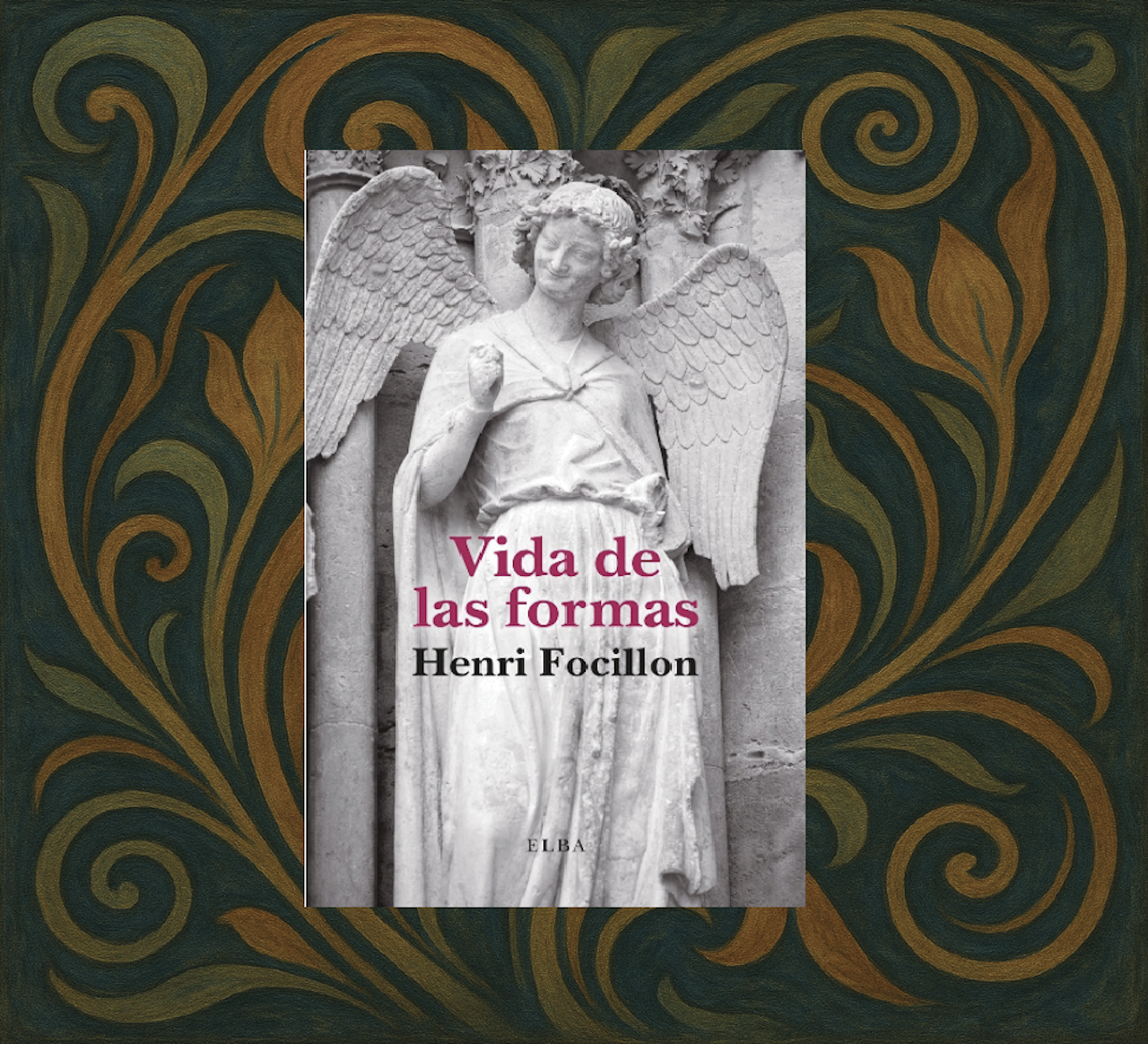
The Delphic Course had Henry Focillon among its essential essayists. What did José Lezama Lima find in his work? Why, almost a century after the first edition of Life of Forms, does that essay remain indispensable among art critics, including those of literature? What does it mean to me—even today—to have read it fifty-five years ago?
Now that another edition of Life of Forms—which includes In Praise of the Hand and In Praise of Lamps—has been published by Editorial Elba in Barcelona, in a new translation by José Ramón Monreal, I will try to recall some happy metaphors—relationships that are not only analogical—between them, presided over by Lezama’s affiliation with intuition—the center of his imago—as a timeless and ahistorical phenomenon, which he fed with the arguments—among others—of the French essayist.
I review, by way of setting the scene, that both the dialecticians of form who flee from deterministic positivism and other forms of historicism, including Marxists, and those of the brilliant Geneva School—where the author never dies—are inexcusable in the modulation of the erudite and eclectic literary theory that serves as the basis for Lezama. At least to mention some of the exegetical guidelines of many of his essays; such as the pursuit of the “unitive form,” which includes what Irlemar Chiampi called “plutonism” within Lezama’s baroque sphere (Cf. Irlemar Chiampi, Baroque and Modernity, FCE, Mexico, 2000, p. 23).
In my diary of El Curso Délfico, the main reference to Henri Focillon appears on Friday, February 27, 1970, when I returned Vida de las formas, his essential book first published in 1934 (Paris, Presses Universitaires de France). I don’t remember the volume Lezama lent me, and I made the mistake of not writing down the details. But I do remember—as always after other readings—the “exam” he gave me. I note that if I failed that kind of Platonic dialogue, he would return the book to me for a second critical “conversation” with him.
That conversation must have centered on the phrase: “The work of art only exists insofar as it is form.” I noted: Lezama is enthusiastic in explaining Focillon’s lucidity to me. And below: Life of forms. Value of the sign. Forms in space, in matter, in spirit, and in time. The sign: it signifies. Form is signified. Influences as a vehicle for affinities. Forms behave like living entities. Formal experimentation close to archaism; formal stability close to classicism; formal liberation close to baroque.
Reading Life of Forms, and especially the pages where he delineates the baroque attitude—“form of the entrails” for Lezama—provides much clarity on the formation of the poetics of the author of the unfinished Paradiso-Oppiano Licario. With her usual sagacity, Irlemar Chiampi refers in this regard to the concept of retombée in Lezama and Severo Sarduy. She quotes—although Lezama did not get to read it—Edouard Glissant’s Poetique de la relation (Poetique de la Relation, Gallimard, Paris, 1990). Where he says that the Baroque is “une maniere de vivre l’unité-diversité du monde” (Op. Cit., p. 93). It is clear that Lezama would have loved Glissant’s statement, but it is obvious that he takes it from the text of Henri Focillon, that precursor who is gradually receiving the recognition he deserves.
Focillon was—hence his enormous relevance today—far ahead of his time in what would become fashionable several decades later with structuralism, semiotics, and deconstruction, based on his studies of forms rather than referents. Lezama studied and palatably incorporated the characteristic phenomena of signs and symbols outlined in Life of Forms, knowing how to bake them to transmute them into part of his arrogant individuality, into treasures of his aporetic gallery. The parallel between Focillon’s aesthetic formulations and Lezama’s poetic disquisitions magnifies—precisely, separates—the strong relationships between French essay writing in the first half of the 20th century and that of the brilliant Caribbean author (Cf. José Lezama Lima et La France, L’École Normale Supérieure, Ed. Rue d’Ulm, Paris, 2024, p. 55 et seq.).
This invitation to read or reread that essay should note the hypothesis that Lezama also paid tribute to Focillon when he wrote the paragraphs on the phases of the Delphic Course—The Palatal Overture, The Transmutative Furnace, and The Aporetic Gallery—and set them in Paris, the city he traveled to through novelists such as his beloved Marcel Proust. When Ricardo Fronesis listens to Editabunda in chapter IX of Oppiano Licario, it seems that behind it all is also The Life of Forms.
Because there is consensus that few 20th-century Ibero-American writers like Lezama reflected and wrote so much about their authorial poetics and their relationship to aesthetics and philosophy. His views extolled the independence of the work of art, as can be read in his essays characterizing himself, of what for him was artistic creation, as an offering to the Holy Spirit—given his Catholicism—but always free, autonomous. Hence, he joyfully emphasized how Focillon confronted the causalist schools, for which the artistic work is determined by its context. The Life of Forms argues with convincing force that artistic forms have an existence of their own, almost as if they were alive: they evolve through cycles that are independent—though of course related—of the historical or social context. There we read that artistic forms are not mere reflections of their time, they follow internal rhythms of transformation, that form goes beyond visual reception, because it is a kind of tunnel between it and ideas; it involves rhythm, volume, but also time. The receptions of this decisive text in the history of Western art agree that it defines art “as a sensory and spiritual experience, not just an intellectual one.”
This key idea is what writers like Lezama perceive and incorporate as part of their poetics. A poetics that, like “forms,” is always transforming, performing the movements we read in each of his works, especially in his poems, from Muerte de Narciso to those grouped in Fragmentos a su imán.
With what joy Lezama must have read this wonderful book for the first time, his communion with statements such as this: “The formal relationships within a work and between works constitute an order, a metaphor for the universe”; or his agreement with this quote from Balzac: “Everything is form, and life itself is a form”; which supports that of Focillon: “Life is form, and form is the mode of life.”
“Sympathetic magic, copying the rings of snakes, has invented laceration,” wrote Focillon, to fill the imago in the house at 162 Trocadero, where Lezama always kept the book that structuralists and poststructuralists would greatly admire and quote more than a quarter of a century later; not only linked to the magazine Tel Quel (1960-1982). One quote suffices: “The sign signifies, while form signifies itself.” And on the following page: “The sign signifies, but, converted into form, it aspires to signify itself, creates its new meaning, seeks its content, and confers a new life on it through associations, through the dislocations of verbal molds.” Doesn’t it seem as if Julia Kristeva or Roland Barthes are writing?
Lezama—who possessed a memory worthy of the magicians who supposedly guess objects in circuses—rightly laughed at the mockery of the “furor of similism” in the Baroque period, but he recalled that “Rembrandt’s sketches swarm in Rembrandt’s painting. The sketch calls for the masterpiece.“ And not literally, but with the same idea, that ”The logic of sight, its need for balance, for symmetry, does not necessarily go hand in hand with the logic of structure, which is not the logic of reasoning either.”
The same cognitive and emotional empathy can be seen in relation to Elogio de la mano (1934), an essay that appears as an appendix to the first edition, which extols the relationship between the body and art. With more lyrical prose, Focillon enchants us with his praise of hands, a thematic motif that Lezama recreates in several poems. Because “they are almost animated beings,” he says. And further on: “… it is a unique landscape, with its mountains, its great central depression, its narrow river valleys, already cracked by incidents, chains and intertwined, already pure and fine as writing.” Then he asks himself, so that I now think of my friend Alfredo Triff: “Is it not she who plays the notes on the violin by directly striking the strings, while, through the bow, the right hand only propagates the melody?”
I fulfill my desire to look at myself and look at hands after reading this masterful essay, which shows how artistic sensibility was combined in Focillon with his erudition and critical sagacity, as Lezama captured when he recommended it, not only to me but also to Umberto Peña and Reinaldo Arenas, which the three of us discussed one night in the Central Park, when I don’t know which one returned the book to him. From Rodin to Gauguin, the essay moves through hands to the solitude of Degas and the inks of Hokusai drawn “with the tip of an egg or a finger.” Its paragraphs are magnetic, making us go back to the previous ones, reread them with delight, and enjoy a pleasure that is uncommon in studies of this kind, in didactic texts of this nature.
Precisely with Hokusai Katsushika (1760–1849) and his woodblock prints in the ukiyo style—which means “images of the floating world”—the sources of chance create another area in Elogio de la mano, which Lezama knew how to diversify with his own mysteries. Focillon refers to an “impossible-to-compare manual sorcery. The hand seems to leap with freedom and delight in its dexterity: it exploits with unprecedented confidence the resources of a long science, but it also exploits that which is unpredictable, which lies outside the realm of the spirit: accident.” He extols accident as “an unknown form of life, the encounter of dark forces and a clairvoyant design.” And we immediately think that no small amount of chance surrounds Ynaca Eco Licario in Paradiso. Her clairvoyance is also evident in her hands on José Cemí, when the sexual act spreads the Icarian grace she imprints, like a sponge that unintentionally throws itself onto the canvas.
These accidents—forms of chance—unite the poetics of the two authors, as can be seen in the pages Focillon devotes to Victor Hugo or in Nerval’s final memory, where he tells “the story of an enchanted hand that, separated from its body, travels the world to carry out a singular work.” The hand: “It measures itself against the matter it metamorphoses and the form it transfigures. Educator of man, the hand multiplies him in space and time,” concludes the French essayist who brought prestige to Yale University from 1939 until his death in 1943.
After my fourth reading of The Life of Forms, I recognize once again how much it has helped me to understand that artistic work must be contextualized—situated with multicultural tools—but only as a complement to aesthetic evaluation. Writers may not respond freely to our time and space, but our creations do. And with autonomy from history, challenging the multiplicity of receptions they promote. Hence Focillon’s final sentence: “…form, through the play of metamorphoses, perpetually moves from necessity to freedom.”


