
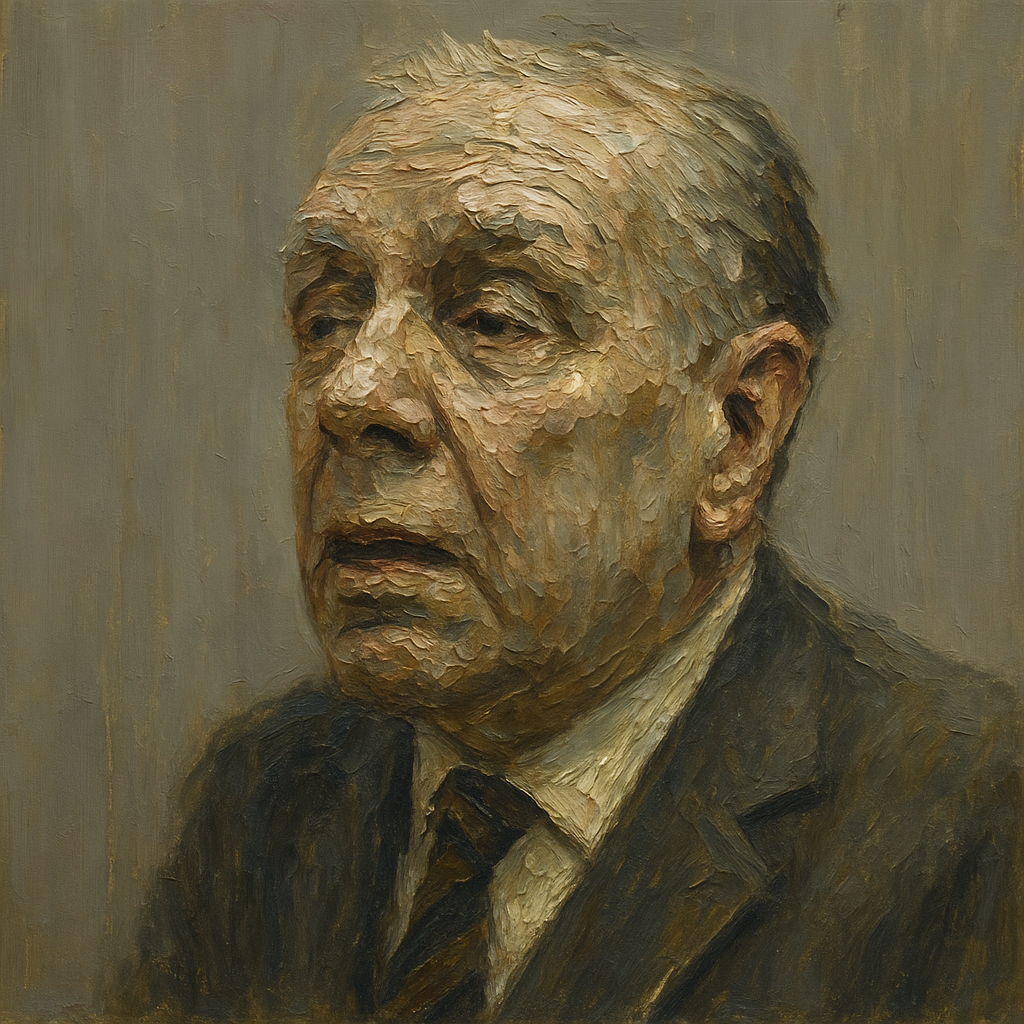
Citario. Derived from the Latin “citāre” (to quote) plus the suffix “-ārium” (repository), similar to “bestiary.” A 21st-century neologism, it emerged among Spanish-speaking scholars at Bookish & Co., with roots in ancient anthologies and florilegia. “Citario” is related to medieval books of commonplaces (such as Erasmus’s) and proto-examples from the 19th century, such as “Familiar Quotations.” This “Citario Borges” celebrates the 126th birthday of the writer who made the labyrinth, the library, and the mirror the emblems of a literature capable of infinitely multiplying reality.
In a dense little book (Kafka, Ed. de Minuit, 1975), Deleuze and Guattari developed the theme of small literature, finding its key characteristic in the abandonment of individuality in favor of what they call “a collective device of enunciation.” Anyone who has read Borges knows that this is nothing else: a device for undoing the writer in the reader, and vice versa (Pierre Menard, Funes, Dahlmann, Américo Castro, Isidro Parodi…), an elegant theorem that demonstrated the social reversibility of the writer. Borges himself has been turned upside down: it is no coincidence that, in many novels written today, he is just another character.
César Aira, “Who is the greatest Argentine writer?”
♣♣♣
In that Pythagorean-visceral square, I thought of Borges: of his hierophantic gesture repeating that of the figurative man, as he himself recounts on the Gnostic map; one index finger pointing to the sky and the other to the earth. I remembered the anguished and impassive words with which he perhaps sealed the lips of contemporary poetry for many centuries, just as the Magic Door was sealed one day: “Every language is an alphabet of symbols whose use presupposes a past shared by the interlocutors.” (Who shares that past today? Who shares that alphabet of symbols? Does a past exist? Are there symbols? Where, then, is our language?). Not unlike the small Magic Door, blind and almost imperceptible in its lost alphabet, was the princely Borges: the walled center of a “circular ruin” that the eye, now reduced to a single dimension, brushes against without imagining it.
Cristina Campo, “Tribute to Borges”
♣♣♣
Beyond the orthographic disorders of the time and the name of the translator, Borges hints at two constant ghosts: history and time. It is not a question of dissecting a metaphysical elegy in a suburb on the map, but of assigning to something peripheral all the relevant significance of a program. Literalism does not mean the same thing if we change the historical context; if we change it, Borges and Menard, who write the same thing in the same language, say different (distinct) things. A novelist of the Golden Age and a gentleman of the Parisian literary salon take it for granted that truth is above historical meaning. Thus, translation is above the linguistic process. That is why, when forced to choose a translation, Borges chooses the one that is closest in time. That is why, when it comes to the Homeric versions, Borges does not hesitate to incorporate them, translated by himself, as examples. Chapman’s, a contemporary of Shakespeare who led Keats to idolatry and error, is one of the most beautiful: in terms of the term, the definition.
Luis Chitarroni, “Las palabras y las cosas”
♣♣♣
Since you are interested in knowing what I appreciate most about Borges, I will answer without hesitation that it is his ease in tackling the most diverse subjects, his ability to speak with equal subtlety about the Eternal Return and tango. For him, “everything goes,” since he himself is the center of everything. Universal curiosity is a sign of vitality only if it bears the absolute imprint of a self, a self from which everything emanates and in which everything ends: a beginning and an end that can be interpreted according to the most capricious criteria, the sovereignty of the arbitrary. Where is reality in all this? The self, the supreme farce… The playfulness in Borges recalls romantic irony, the metaphysical exploration of illusion, juggling with limitations. Friedrich Schlegel, today, finds himself attached to Patagonia… Once again, we can only deplore the fact that an encyclopedic smile and a vision as refined as his elicit general approval, with all that that implies… But, after all, Borges could become the symbol of a humanity without dogmas or systems, and if there is a utopia to which I would gladly adhere, it would be one in which everyone would imitate him, one of the least serious spirits who ever lived, the “last delicate one”…
Emil Cioran, “The Last Delicate Man. Letter to Fernando Savater”
♣♣♣
In 1955, in Italy, Ficciones appeared under the title La biblioteca di Babele in the “Gettoni” collection published by Einaudi. It was recommended to Einaudi by Sergio Solmi, a great poet whom I loved very much, also because of an essay on science fiction as a form of fantasy that he had written a few years earlier. You see how the Zeitgeist works: Solmi discovers Borges while reading American science fiction authors who write (perhaps without being aware of it) in the tradition of the utopian story that began in the sixteenth and seventeenth centuries. Let’s not forget that Bishop Wilkins also wrote a book about the inhabitants of the moon, and therefore he, like Godwin and others, was already traveling to other worlds. I think it was around 1956 or 1957, Solmi, walking through Piazza del Duomo, said to me one afternoon: “I advised Einaudi to publish this book, we haven’t managed to sell even five hundred copies; read it because it’s very good.” And that was when I first fell in love with Borges, and I remember that, as the sole owner of a copy of the book, I would go to my friends’ houses and read them passages from “Menard.”
Umberto Eco, “Borges and my anguish of influence”
♣♣♣
You mention it by its title, assuming that it is as universally known as it is here, and then you discover that in any other language, even in its original language, it is considered a rarity. In our pampas, on the other hand, there is no library that does not have a copy of Marcel Schwob’s Vidas imaginarias. I have come across some in the most unexpected places: in summer homes, with pages stuck together from humidity, in a dentist’s waiting room, in a mountain refuge, in schools, in neighborhood clubs, in libraries of avid readers and on the shelves of casual readers, and in almost every discount bookstore and street bookstall I’ve ever browsed in my life. It’s Borges’ fault, obviously. He made it so natural to our reader DNA through his own books that sometimes it seems as if the copies of Imaginary Lives found in so many Argentine homes belong to Borges, not Schwob. Something similar happens with Melville’s Bartleby: in our mental library, we have it closer to Borges or Kafka than to Moby Dick, but the difference is that Melville is much more the author of Moby Dick than of Bartleby; Schwob, on the other hand, is Imaginary Lives above any other book he wrote. All his work is contained there, just as we could say that all of Borges (the mischievous use of erudition, the wonder contained in precise language, the pearls dropped as if in passing, the beautiful idea that everything is in books and that literature “is written by reading”) is essentially in Historia universal de la infamia, the book in which he copied, “paid homage” to Schwob’s Vidas imaginarias.
Juan Forn, “Rey de reyes”
♣♣♣
The monstrosity that Borges circulates through his enumeration consists, on the contrary, in the fact that the common space of the encounter is itself in ruins. The impossible is not the proximity of things, it is the very place where they could be neighbors. The animals “i] that thrash about like mad, j] innumerable, k] drawn with a fine brush made of camel hair”—where could they be found, if not in the immaterial voice that pronounces their enumeration, if not on the page that transcribes it? Where could they be juxtaposed except in the non-place of language? But language, in unfolding them, never opens up anything but an unthinkable space. The central category of animals “included in this classification” indicates sufficiently, by its explicit reference to well-known paradoxes, that it will never be possible to define a stable relationship of content to container between each of these sets and the one that brings them all together: if all the animals distributed are without exception included in one of the cases of the distribution, are not all the others in it? And this, in turn, in what space does it reside? Absurdity ruins the “and” of the enumeration by filling with impossibility the “in” in which the enumerated things would be distributed. Borges does not add any figure to the atlas of the impossible; he does not make the lightning bolt of poetic encounter spring forth anywhere; he merely sidesteps the most discreet and most pressing of needs; he removes the setting, the silent ground where beings can juxtapose themselves. This disappearance is masked or, rather, laughably indicated by the alphabetical series of our alphabet, which supposedly serves as the thread (the only visible one) running through the enumeration of a Chinese encyclopedia… What has been removed is, in a word, the famous “dissecting table”…
Michel Foucault, The Order of Things
♣♣♣
To these readers who act as potential critics, because they subordinate emotion to the impostures of a knowledge they consider specialized, Borges opposes the fiction of an irresponsible reader, who has learned not to overlook the signs of mystery that sometimes appear in a text and to methodically renounce any certainty that might obstruct or weaken that uncertain manifestation. If the literary fact is, perhaps a promise of meaning that lives on its postponement, the “imminence of a revelation that does not occur,” Borges’s idea of the “innocent” reader suggests that only those who can lighten their discourse of theoretical or historiographical certainties and detach it from consensual and intimidating assessments will participate in this paradoxical event.
Alberto Giordano, “Borges the essayist: the ethics of an innocent reader”
♣♣♣
1981. Italian newspaper Il Messaggero: a large photo of Borges, with the headline: “The non-existent.” The author of the article was none other than the writer Leonardo Sciascia. The news, sourced from the literary supplement of the French weekly L’Express, was that Jorge Luis Borges had been invented by a group of writers, including Adolfo Bioy Casares, Leopoldo Marechal, and Manuel Mújica Láinez. To bring this collective work to life, they had resorted to the services of a second-rate actor named Aquiles Scatamacchia (“What a name from the commedia dell’arte!” exclaims Sciascia). Sciascia wrote: “In a certain sense—in a sense that is properly Borgesian—Borges brought it on himself. His urge to be forgotten, to cease to exist, his desire to be forgotten, to no longer want to be Borges, in some way and with the winds blowing in journalism, could only generate the news that Borges does not exist.“ According to the Italian writer, this news is ”an invention that is in the order of his own inventions,” a fabrication that could have been authored by Borges himself. An error by the illustrious French publication inadvertently contributed to the Argentine’s “non-existence” by renaming him “José Luis Borges.”
Laura Kopouchian, “Did Jorge Luis Borges ever exist?”
♣♣♣
“The happiness of guessing”: this is the form of pleasure offered by narrative text; but such happiness is reserved only for readers who assume that the play of signs that makes up the text is the cipher of that other order, “secret and growing,” which unfolds beyond them but not without them. There are a thousand figures of this “secretive and growing” order in Borges’ stories, which could be said to consist of a thousand variations on a single plot: in this plot, a retired individual (the individual, let us say, who at the end of “Tön, Uqbar, Orbis Tertius” finds himself in a hotel in Adrogué translating Browne’s Urn Burial) observes the secret growth of an order that initially manifests itself in enigmatic signs (the missing pages, let us say, or the paradoxical objects that announce the advance of the conspiracy in the story itself). In the background of the world, on the other side of the visible, someone is plotting a separate order: this is the universe that the reader must postulate if they want to follow the unfolding of the consequences of the “laconic details.” As for the writer, it is a matter of not letting the game of allusions and references come to a halt.
Reinaldo Laddaga, Espectáculos de realidad
♣♣♣
What really matters is to go into detail. Is there a more Borgesian word? How many habits, how many practices, how many uses does Borges condense? Reading, without a doubt, is nothing more than going into detail; that is, at the same time, breaking down a whole into a series of parts and following step by step the threads of meaning that are woven between the parts. Going into detail is an analytical activity and a movement; it is equivalent to breaking down a whole and tracing a process, segmenting and accompanying, cutting and approaching. And it is also, of course, a taking of a position: against the Big, the Capital Letters, the Whole—serious and rigid, fixed categories. It is about professing the cult of the minor, that is, paying attention to the small, the tremor, the quivering, the dynamics of the minor. And the minor, in Borges, must always be understood in both senses: smaller, yes, but also, and above all, inferior, displaced, marginal. Thus, when Borges “goes into detail,” what he does is change his axis, his perspective, his key to relevance. He reads the greater from the lesser: a few crumbs from Cervantes are enough for him to decipher how all literature works, and a couplet, a dialectal form, or a “prison harshness” suddenly reveal the ultimate secret of poetic reality. He does not read (does not recognize) Argentine poetry in Lugones or Almafuerte, his undisputed heroes, but in a poet “without style” such as Enrique Banchs, whose work “has had no influence” and has the merit of being “unparodied.” He prefers Macedonio Fernández to José Ingenieros, and he also has little regard for the great names in the history of thought: the pre-Socratics (Heraclitus, Parmenides, Zeno) distract him from Plato, Bishop Berkeley and John Wilkins eclipse Hobbes and Locke, and the ascendancy of the great systems pales, undermined by lateral and intermittent thinkers such as Fritz Mauthner and Meinong. He relativizes the great novelistic tradition of the century—always threatened, according to Borges, by allegorical infatuation—replacing its formal experimentation with a cult of genre (especially detective fiction, which in the mid-1940s, when Borges published “Death and the Compass,” was the minor genre par excellence) and his idols Joyce, Proust, and Thomas Mann) with purely “narrative” writers such as Robert Louis Stevenson, Chesterton, and H.G. Wells, who were always threatened by collections of children’s books. Eisenstein and Fritz Lang dazzled him and then quickly disappointed him: too much “visual beauty,” too much pathos, too little faith in narrative persuasion. Instead, he believed in Von Sternberg, gangster films, and westerns, three forms of epic and magic. And when it is his turn to imagine how he, Borges, would like to be read, he does the same thing: he places himself on the sidelines and claims his own periphery. “The Dead Man” should not be taken, as I sometimes fear it is, as a deliberate allegory of human life,” he tells his translator Norman di Giovanni in the late 1960s, in one of the short prologues accompanying The Aleph and Other Stories, the first American edition of his stories: “I prefer the story to be read as a kind of adventure.” And when he presents “Abenjacán el Bojarí, muerto en su laberinto” (Abenjacán the Bojarí, Dead in His Labyrinth), Borges urges his future readers not to take it seriously, to desist from any ‘symbolic’ interpretation and to read the story instead “for its humor.”
Alan Pauls, The Borges Factor
♣♣♣
Reading, books, and libraries always lead to illness and death in Borges’ stories. This is a central element in the construction of the plot. Just think of Borges’ great texts, such as El Sur (The South); the reading of Las mil y una noches (The Thousand and One Nights) that causes Dhalman’s accident always appears at key moments in the story to mark the antithesis with the simple and elemental life that the hero cannot access until the end and at the cost of his life. The same happens with Lînrot in La muerte y la brújula (Death and the Compass). While Treviranus acts as an intuitive decipherer, relying on experience and common sense, Lînrot only believes what he reads, and because he knows no other way of accessing the truth than through reading, he is mistaken and goes to his death. There is a very strong anti-intellectualism in Borges, and the dense and subtle construction of his stories often plays on this tension. This contrast between culture and life, so to speak, maintaining the tension, working out all the nuances of these two worlds, is fundamental in Borges’ writing. Keeping the terms together, always in struggle, I think that is constitutive of Borges, and in the long run, the idea prevails that the library, books, impoverish, and the elementary lives of simple men are the truth. It’s a ridiculous opposition, of course, but very important in the construction of his texts.
Ricardo Piglia, “On Borges”
♣♣♣
That autofiction, like everything else, comes from a book, a book that was missing from “The Total Library”: Robert Burton’s Anatomy of Melancholy, from which Borges takes the epigraph for the story, inscribing it in a series of codified traits of “the sickness of the soul.”. On the one hand, the library is thus transformed into a paradigmatic space of melancholy: a devitalized landscape, pure mental space, a desert of gloom and repetitions without desire or female presence, a dead world on the brink of cataclysm or final collapse. On the other hand, in contrast to what has already been written, to the combination of signs that erases what has been said, a melancholic tone emerges (lamentation, pessimism, images of the endless decomposition of the body, a lucid and painful view of the past). That old man, near the end, half-blind, skeptical, searching in vain for meaning in a universe as chaotic as it is symmetrical, that suffering man before an arbitrary law, that man overwhelmed by everything that has been written and thought before him, is another splendid figure of the modern writer. A figure of infinite reading, of nostalgic self-absorption in the face of inherited knowledge, after long and futile searches for an essential and revealing page, all of which condenses archetypal traits: in the West, the artist is a melancholic. Irony, encyclopedic and skeptical lucidity, modest devaluation of his achievements, thoughtful poses and attitudes, latent nihilism, all traits of melancholy, will accompany the rest of Borges’ work.
Julio Premat, “Borges: Genius, Figure, and Death”
♣♣♣
Borges’ invention is, therefore, that of a language and, through that language, a coherent universe of myths. From 1935 onwards, thanks to him, no one writing in Spanish could continue as before, and, while many stubbornly content themselves with accumulating obscurities and exasperating the reader’s patience, his example frees the best from the prejudices of a completely sterile rhetoric. Borges the poet discovers an Argentine language that is better expressed in the verses of tango and milonga than in cultured poetry, which is more or less indebted to the Spanish of the 1920s. Borges the storyteller marks the end of realism (a heavy convention developed in England in the 18th century and codified by the French in the 19th century to the point of exhaustion) with his return to fantastic literature, full of mystery and intrigue, of unheard-of and unprecedented adventures. With his example, he demonstrates that a narrator is a mythographer, as the Americans have known since the Popol Vuh and the Spanish since the Cuentos del Conde Lucanor. As an essayist, Borges reveals to everyone the futility of “objective” literary criticism, emphasizes the analysis of literary language, explores the unreality and fiction of all stories, and makes the revolutionary claim for his time that the reader writes the work. After Borges, Latin American literature changed.
Emir Rodríguez Monegal, Borges por él mismo
♣♣♣
This may seem like morbid gossip, but it is not; Borges’s love life, judging by the four biographies I have read about him—those by Rodríguez Monegal, María Esther Vázquez, Horacio Salas, and, above all, Edwin Williamson, the most complete—was a complete disaster, one frustration after another. He usually fell in love with cultured and intelligent women, such as Norah Lange and her sister Haydée, Estela Canto, Cecilia Ingenieros, Margarita Guerrero, and a few others, who accepted him as a friend but, as soon as they discovered his love, kept him at a distance and, sooner or later, dumped him. Only Estela Canto was willing to take things to a more intimate level, but in that case, it was Borges who shirked responsibility. It could be said that it was the game of shadows that attracted him in love: hinting at it, never making it concrete. Only in his final years, thanks to María Kodama, did he have a romantic relationship that seems to have been stable, intense, formal, and marked by mutual intellectual rapport, something that allowed Borges to discover an aspect of life that, according to his own terminology, he had been deprived of until then.
Mario Vargas Llosa, Medio siglo con Borges
♣♣♣
Nothing could be further from his poetry than understanding the homeland as the sum of stereotypes or sentimental abstraction. For him, homeland is, together with the living and protective memory, in longing and pride, of his lineage (understood as the flower of his people), the places of birth “where tenderness spreads—and the heart is at peace with itself.” Certainly, some of the most important of his compositions are pages of tender and powerful evocation, dedicated to the flavor of old Buenos Aires, or to the gauchos and caudillos… Borges himself, commenting on the “nationalism” of Don Segundo Sombra, writes: “I want to emphasize that for us to have that book, it was necessary for Güiraldes to remember the poetic technique of the French literary circles of his time, and the work of Kipling, which he had read many years earlier; that is to say, Kipling, Mark Twain, and the metaphors of the French poets were necessary for this Argentine book.” Thus, Güiraldes’ Argentine character, and even more so that of Borges, turns out to be a synthesis, a distillation in which one of the ingredients may be the temperament of British humor and another the universality considered a Gallicism. Let us quote here those supreme vignettes, in robust or affectionate ink, entitled “El General Quiroga va en coche al muere” and “La fundación mitológica de Buenos Aires”. Both are masterful farewells to the clichés of Creole culture, which of course belong to European culture as much as they do to Western culture.
Cintio Vitier, “Los poemas de Borges”
♣♣♣
More interesting is the case of the famous poem “Instantes” (“Moments”), in which a pseudo-Borges claims that in another life he would try to be more foolish, more relaxed and—curiously—less hygienic (the first mention of hygiene being harmful). In 1989, the text was published in the prestigious Mexican magazine Vuelta and presented—without any suspicion as to its legitimacy—as “a purely human approach to this major figure in literature of all time.” Some writers and academics took the bait, but the usual killjoys investigated the misunderstanding and established the true authorship. The issue had already become a headache for María Kodama, who was tired of clarifying that Borges had never written anything so bad (although she may have been excited about the royalties). Admirers of the poem were not satisfied, and still argue that if Borges were alive today, he would undoubtedly agree to write such terrible poems in exchange for watching more sunsets, climbing more mountains, eating delicious ice cream, and never showering. “In case you don’t know, that’s what life is made of, just moments; don’t miss the now,” advises the fake Borges.
Alejandro Zambra, “Coelho and His Precursors”
♣♣♣
Two or three years before Borges’ death, Víctor Massuh defined him with a truly felicitous phrase: “Borges lives in a state of literature.” The definition is not only apt but also true. Beyond his sorrows, his quirks, his inhibitions, the successive servitudes imposed on him by his love affairs, his blindness, beyond old age and loneliness, literature was his perpetual lover, ever faithful, never abandoning him, staying with him and in him from beginning to end.
María Esther Vázquez, Borges. Esplendor y derrota
♣♣♣
If I had to say who has perfectly realized Valéry’s aesthetic ideal in narrative in terms of precision of imagination and language, constructing works that respond to the rigorous geometry of crystal and the abstraction of deductive reasoning, I would say without hesitation Jorge Luis Borges. The reasons for my predilection for Borges do not stop there; I will try to list the main ones: because each of his texts contains a model of the universe or an attribute of the universe: the infinite, the innumerable, eternal or co-present or cyclical time; because they are always texts contained in a few pages, with an exemplary economy of expression; because his stories often take the external form of one of the genres of popular literature, forms that long use has tested, turning them into mythical structures.
Italo Calvino, Six Memos for the Next Millennium
♣♣♣
The perfection of his plots, his relentless logic, and his verbal economy can give the impression of cerebral and dehumanized literature. Nothing could be further from the truth. Borges’ work, although populated by paper tigers, mirrors, and labyrinths, is not a mere intellectual game. It is a passionate meditation on time, identity, memory and, ultimately, on the meaning—or meaninglessness—of the human adventure. His characters, often mere names or pretexts for an idea, embody the great perplexities of man. In his stories and poems, metaphysics becomes narrative material and erudition a form of fantasy. Borges does not tell us stories about men, but rather the story of man confronted with the enigmas of the universe. And he does so with prose of a transparency and precision that are unparalleled in the literature of our language. He is a writer for writers, but also for anyone who has ever felt lost in the labyrinth of existence.
Octavio Paz, “The Archer, the Arrow, and the Target”


