
Zeno’s paradox reads as a question of infinitesimals, but Zeno was not naive, and that rethinks everything; and the problem would not be kinetic, if in practice Zeno knew that Achilles catches up with and overtakes the tortoise. The problem would then refer to the relationship between two reference systems, exemplified by Achilles and the animal; so that both are treated as parallel systems, each with its own particular immanence, in its own consistency.
Achilles and the tortoise are neither synchronous nor diachronic, but asynchronous, each unfolding its own logic; the paradox is the false contradiction that reduces them to synchrony—even as diachronic—without recognizing their asynchrony. From an external point of view, they are measured in linear time as transcendence, and the paradox appears; but from their respective immanence, each trajectory is self-sufficient and they do not cancel each other out, nor are they even related.
Zeno would be pointing to this asymmetry between systems that cannot be reduced to a single framework, even if they intersect; he would do so with the epistemological instruments at his disposal, unaware of their reconciliation from Aristotle to Descartes. Thus, it is understood as a paradox of movement in linear time, but it would be an intuition about the constitution of the real; resolved in its immanent-transcendent tension, problematized centuries later, from Descartes to Kant, through Leibniz.
In this logic, however, Achilles and the tortoise are not opposing rivals on a line, but two fractals of the real; they brush against each other without exhausting each other, because it would not be a physical error, resolved in a logical-rational naivety. The paradox then points to an error of calculation as rational logic, which does not value the relationship between systems; because in fact it starts from a systemic perspective based on the transcendent function of the real, as a universal.
The reality is that both deploy their own frames of reference, of time, continuity, and rhythm; and within each frame, there is no contradiction—nor is it possible—Achilles runs on his own, and the tortoise advances. The paradox arises only when both systems are reduced to a framework of synchronous relationship, even as diachrony, in which they are out of phase because the asynchrony of their respective immanence makes that relationship between them impossible.
The error is thus transcendentalist, imposing an external time as transcendent, which subordinates the immanent; explaining the trialectic function, with the race as a field of infinite possibilities, without synchronous contradiction. Hence the Act, in which that Power is realized, and in which Achilles inevitably catches up with the tortoise; showing that both systems coexist, but fractally, without being reduced to a frame of reference as transcendent.
Hence, this paradox is not a mathematical naivety, but an intuition about the structure of the real; given in the immanent, due to its sufficiency, in the condition of transcendence that this implies, but as its own. The problem is recurrent in political determinism, in its historical transcendentalism, in forcing synchronicity; when the real is immanent-transcendent, causing each phenomenon to function autonomously, albeit fractally.
This would explain the relationships between states, as a projection of personal relationships, which in turn project quantum relationships; and which are always asynchronous and not only diachronic, contrasting the interests of the state with those of individuals. This is what makes the common good improbable, weakening transcendentalism as historical, since Kant, who synthesizes as apotheosis the Christian claim to universality with that fictitious objectivity of the common good.
Of course, the transcendentalist impulse exists naturally, coming from the quantum structure of reality; but it transforms its dynamic relationships, when they reach political expression, into the existential reflexivity of culture. Hence, this transcendent nature loses its original power by deriving its consistency—insofar as it is formal—from culture, which is the change in nature introduced by existential reflection as a particular experience of individuals.
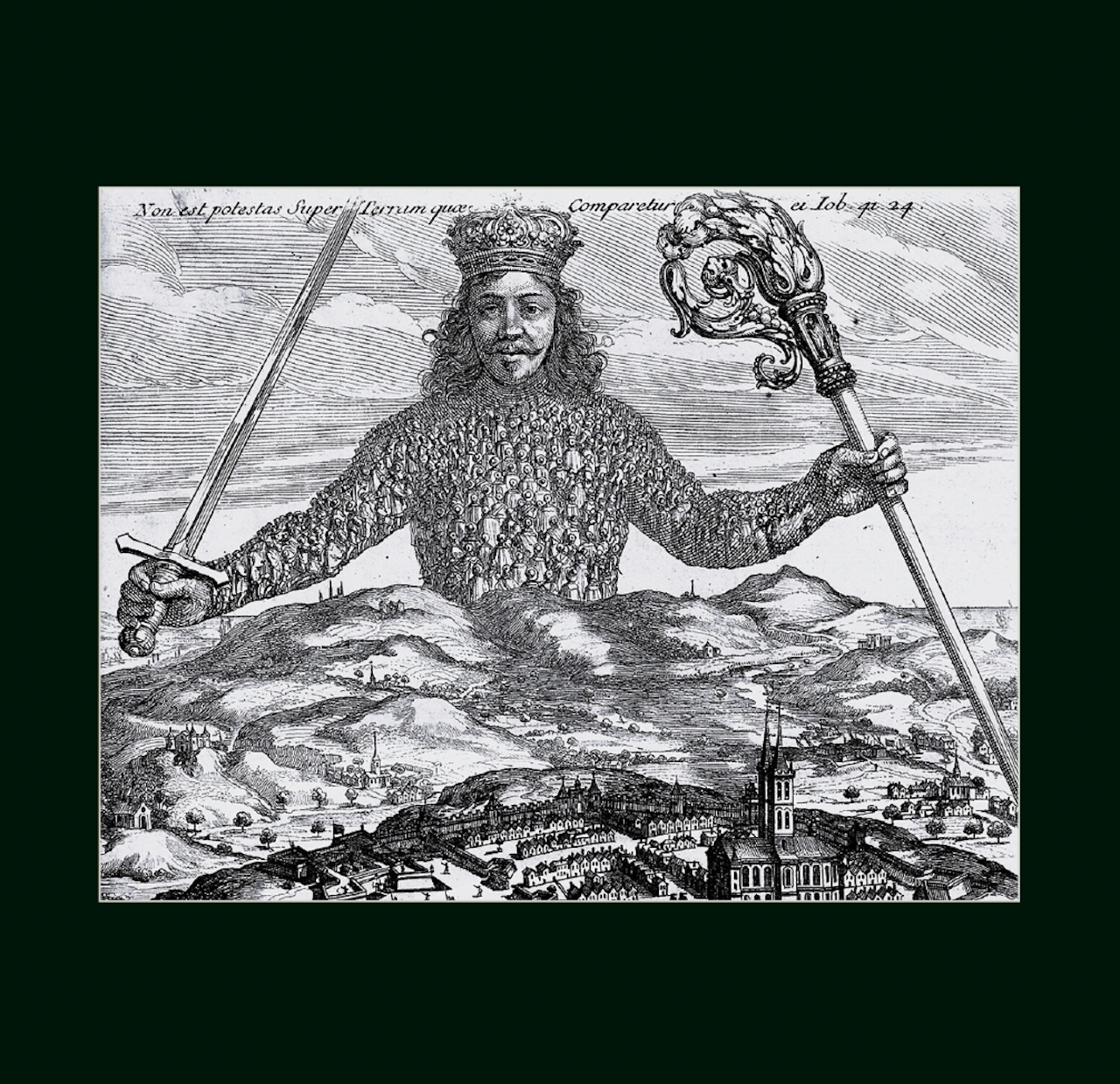
Image: Abraham Bosse, detail from the cover of Leviathan, or The Matter, Forme, & Power of a Common-Wealth Ecclesiasticall and Civill by Thomas Hobbes.


