
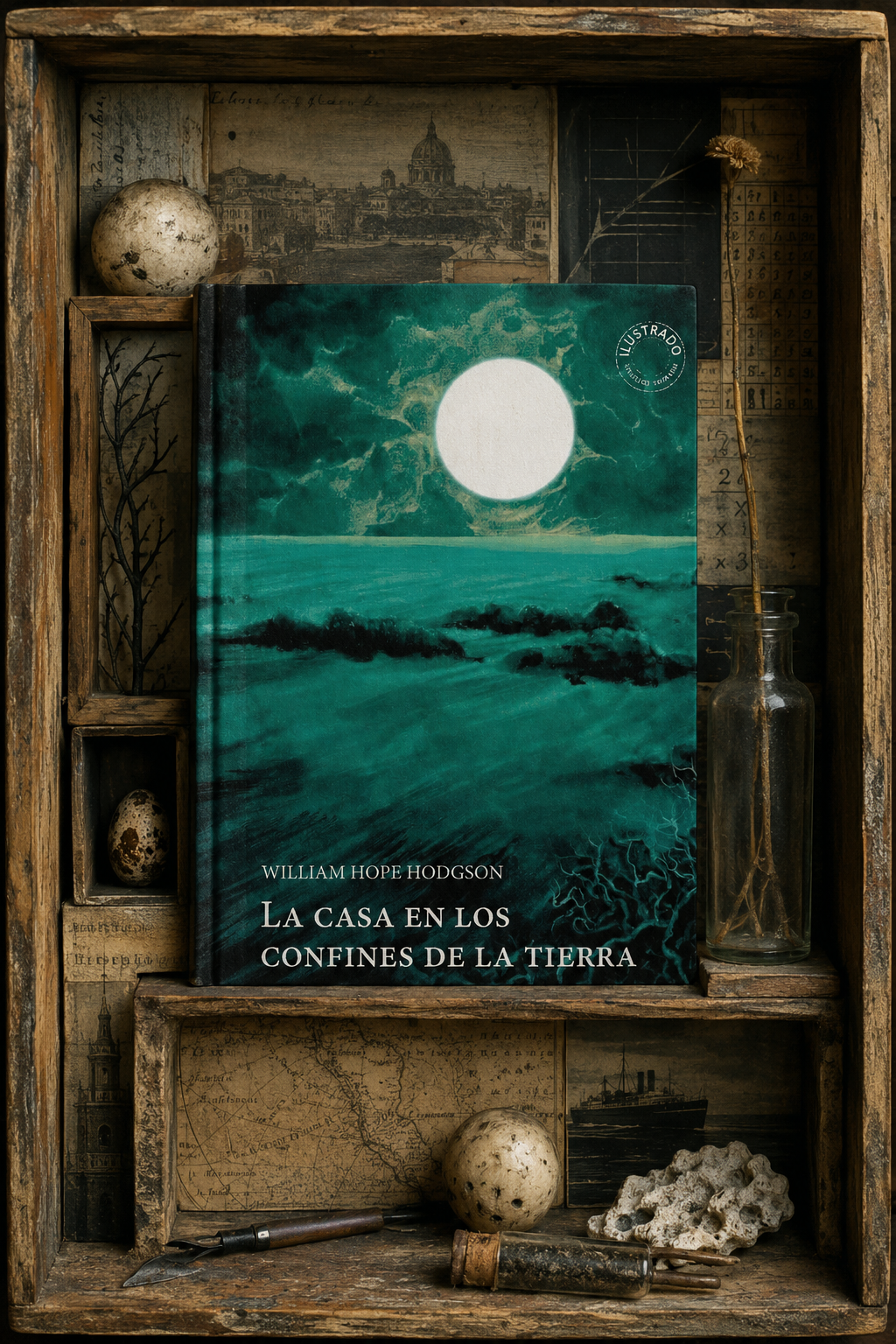
In 1908, the British author William H. Hodgson (1875–1918)—without harboring great expectations—submitted a book of his to the London publishing house Chapman and Hall, Ltd.: The House on the Borderland. For certain connoisseurs of the genre, this unsettling three-hundred-page novel—featuring a story-within-a-story narrative structure—stands as one of the most perfect and influential works ever written. Some regard the book as a piece of horror fiction. Skeptics argue that it is a clear example of fantasy. The author of these lines, however, sees in it a felicitous blend of all these elements: at times it reads like a detective story; at others, passages of extraordinary horror are interspersed; and it soon opens up into a cosmic-metaphysical journey that is striking for the veracity of its descriptions.
Two young hikers, Tonnison and Berreggnog, travel to Ireland for a weekend of fishing. They settle in a remote, desolate village called Kraighten. There, at the foot of a hill—amidst the ruins of what once appeared to be a solitary and dreaded mansion—they discover the manuscript of an old diary penned by the property’s former owner. That very night, they begin to read the account. What it reveals—the author’s dark experiences—forms the heart of the book. The diary chronicles the life of the writer, a recluse, alongside his sister Mary and his dog, Pepper. As the chapters unfold, the narrator—who never reveals his name—realizes that his house is built atop an interdimensional gateway, through which he comes into contact with arcane, unnatural creatures from other dimensions. This is not a ghost story, much less a haunted house tale, but a mind-bending narrative concerning interdimensional beings, parallel (overlapping) universes, and a sort of multiverse traversed by infinite channels connecting the various dimensions or planes of existence (had Hodgson perhaps already read about Einstein’s theory of relativity?).
In an almost dreamlike atmosphere, beyond the bounds of reason, a series of inexplicable anomalies begins to manifest, involving otherworldly forces (the devices employed in the narrative’s final stretch are extraordinary, driving a temporal acceleration that culminates in immensely powerful cosmic vistas capable of challenging even the seasoned reader). Reality fractures; time warps until day and night become indistinguishable, everything mutating into an endless twilight. The narrator’s spirit wanders across boundless light-years of cosmic space and eons of eternity, witnessing the destruction of the solar system—a sequence unique in Edwardian literature.
Hodgson transcends Gothic fiction by introducing visions that are far more scientific, cosmic, and surreal—elements that would forever cement the genre. Centuries dissolve into seconds, and the reader embarks on a phantasmagorical, supernatural journey, witnessing the death of the sun and the universe’s ultimate, final collapse. The description is, quite simply, hallucinogenic. The protagonist drifts through the unfathomable void, observing angelic, human, and demonic forms floating by. The narrative breaks off when he awakens from this psychotropic journey to discover he has fallen victim to a macabre infection; one of those non-human entities has followed him back to our world. It is then that Tonnison and Berreggnog close the book, and “that very day we left the lonely village of Kraighten.” The story ends. The House on the Borderland bids a cold and unforgettable farewell. The incredible astral journey Hodgson proposes in the novel’s concluding sections—that sheer outpouring of visual imagination—stands, inevitably, as a pinnacle of speculative fiction.
In his essay Supernatural Horror in Literature, H. P. Lovecraft deemed the book “perhaps the greatest of all Hodgson’s works” and suggested it “might well be a classic of the first rank.” This claim is not far-fetched. There are no traces of Arthur Machen, M. P. Shiel, or H. G. Wells in its strange and not entirely “resolved” composition. The author eschews the conventional structure of the fantastic tale. Nothing of the sort had been attempted before. One of the great triumphs of The House on the Borderland is its decision to dispense with the genre’s standard tropes—such as robots, aliens, spaceships, or pages detailing the workings of futuristic machinery. The book does not require the reader to possess a heavy scientific background. Nor does it rely on eccentric scholarship or the Theosophy and occultism that were so fashionable at the time.
Regarding style, the book is written in dense—even stifling—prose. Hodgson firmly eschewed sensationalism. Generally, in this type of fantastic tale, style takes a back seat; his writing unfolds through imagery rather than ideas, creating a hypnotic reading experience. There is an almost total absence of dialogue. Furthermore, he rejects logical explanations for the supernatural phenomena he depicts. This is how he embodies the core concept of his aesthetic: cosmic horror—fear understood as an emotional response to overwhelming, incomprehensible elemental forces that man attempts to fathom through a dark, ancestral consciousness or an inadequate faculty of reason. The powerful visual and lyrical elements abounding in his finest passages—those concerning the journey through infinite space—avoid the pitfalls of pulp fiction. Hodgson does not pause to justify the reasons for this cosmic voyage, nor does he sensationalize it; he simply records the events as if in a travel diary. It is a dark, overly ornate narrative (though it must be noted that it contains minor continuity errors).
His ability to meticulously record every effect of light—and the psychological states these effects, in turn, evoke in the narrator—deepens the protagonist’s complexity. Thus, after witnessing and feeling the full spectrum of hues and chromatic gradations emanating from distant, shifting celestial bodies, the experience recalls the narcotic effects of LSD or mescaline—substances later championed, at the height of the hippie era, by American counterculture guru Timothy Leary. It also brings to mind documented instances of astral projection (the projection of consciousness—that is, out-of-body experiences). In this way, the natural and the unreal merge into a singular sensation of uncanny plausibility, much like the awe-inspiring and terrifying nature of astral travel. It is a delirious, impossible journey through time and space—an exploration of the universe’s end as a potential beginning that blends science fiction, extravagant fantasy, and cosmic horror. The author of The Kingdom of Night and The Ghost Pirates did not set out merely to tell a story, but to immerse us in a singular, unforgettable experience. And he succeeded brilliantly.
Hodgson’s life is summarized with a handful of facts. He was born in Blackmore End, Essex, England. As a merchant sailor he circumnavigated the world three times. As an amateur photographer he captured images of hurricanes, lightning, sharks and polar lights (aurora polaris). Years later, in London, he tried his luck as a bodybuilder, but failed. In 1904 he published his first story: The Goddness of death, for the Royal Magazine. Since then, during the last decade of his life, he wrote almost a hundred stories and five novels. He was a volunteer soldier in the First World War, where he died on April 17, 1918, in Ypres, Belgium. Betty Farnworth, his widow, did not remarry. Until her death in 1943, she remained faithful to his memory and doing everything possible so that her husband’s works were republished and did not fall into oblivion. Only in 2003, the North American publisher Night Shade Books began publishing its Complete Works, which make up five luxurious volumes. This translation is by José Luis Piquedo. The illustrations correspond to Sebastián Cabrol.


