
Adjective in crisis: Does it make sense in 2026 to preserve the designation “Cuban” or “Mexican,” or any other label that distinguishes by countries rather than by languages? The sensible thing is to distinguish literature in Spanish, which would comprise only that written in the language of Cervantes. Nothing more, without other denominations that serve only for chauvinistic cobwebs. Or worse, for mediocrities.
Any other qualification diminishes. One begins from the essential one, the one determined by a peculiar vocabulary and syntax, in this case those of a language derived from Latin, expanded from Castile, which we simply call Spanish.
What is not written in Spanish by those born in Cuba or descended from Cubans simply does not belong to the zone that, for geopolitical convenience, we still call Cuban literature.
And do not be deceived. If you do not accept, or if you doubt, the effectiveness of this demarcation, you will fall into the demagogic clutches of the multiculturalists, a species—almost always “Frenchified”—that still perpetrates damage against aesthetics, literary theory, and criticism; above all among sociologists and historians who carry out exegesis according to ideology, gender, race, generation… Currents of what Harold Bloom called the “School of Resentment” (Marxists, feminists, deconstructionists, Lacanians).
The multiculturalist plague evades artistic evaluation, that is, the kind that begins from stylistic and narrative singularities in the Spanish language. I fall into emphasis in order to avoid misunderstandings: if a writer born in Cuba writes in English or French or any other language, that writer does not belong to Cuban literature; if the writer’s texts have gained fame for defending lesbianism, Blackness, Castro-communism, youth, Miami-ism, dissidence, anarchism, and so forth, but lack verbal force, they do not belong to Cuban literature; if the writer has published, or has had published, books of poems, novels, stories, interviews, chronicles, essays…, but each one displays a profound mark of mediocrity, they do not belong to Cuban literature; if the writer is a very good person, a generous cultural promoter, a university professor, the director of some publication or something of the sort, and yet the writings—above all when they are poems—splash about among commonplaces and rubbish that is frankly sentimental, trivial, or pretentious, they do not belong to Cuban literature.
I clarify before moving on to the second note: when I exaggerate by affirming that they do not belong to Cuban literature, I am saying precisely that: they do not belong to Cuban literature because one should believe only in writers who have passed the test of time—also usually called the canon—always polemical and controversial; but it never errs with the great ones, with José Martí, for example. To such a test I add rereading… If a writer does not awaken in me the desire to read them again, it immediately seems to me that something is wrong, that they have been exaggerated, inflated, mediatized.
The rest of us writers—let us confess it before the mirror—are in the races and wagers and fortunes and misfortunes and egos and mockeries. Many mockeries, sarcasms. Fear of ridicule—an amulet that must never be lost—ought to frighten away so many ingenuous frauds.
Although I immediately note that I have just committed a typical error, one that serves for a key observation: Cuban literature—I hammer home that it is nothing special, as ordinary as any other—confuses author with work; just as it usually groups things together without dates or forgets the writer’s sovereign right to change their mind, alter facts, repudiate old publications, correct later editions, suppress even characters or verses or chapters, add a decisive sentence because the writings are their property, try to be—following the wisdom of Elias Canetti—inconsistent.
The same occurs with the author’s life, hence the suggestion that evaluations be improved with the classic questions of journalism, the lead, which answer five questions: Who, What, When, Where, Why (and How). Their variations distinguish them as authors, but do not necessarily correspond to the dates or to their lives when writing and publishing.
The third note is thorny. The convoluted generally accompanies evaluations of literary works of art, beyond latitude and the clock. It gives rank to the receiver, because if not, who… The problem is that after the obvious premise there immediately comes a deceptive relativist flexibility, more common than the political virus inoculated for more than half a century by Marxist-based totalitarianism. Here there are not only political viruses but germs that, when joined with censorship, still somewhat muddy Cuban literature; as happened very much—very much indeed!—with the first edition of the Dictionary of Cuban Literature perpetrated by the Institute of Literature and Linguistics of the Academy of Sciences, by a team—each researcher bears their guilt, whether from cowardice or opportunism—successively directed by two intellectuals of Stalinist bile.
But relativism is a dragon with several heads, not only the one that still sustains the moral and economic ruins of the nation, which barely has a few writers still surviving inside the cauldron, among the blackouts of internal exile; because the few who never played with the monkey and no longer even play with the chain come and go, leave again and leave. Or two or three officialists—fewer and fewer—perform juggling acts to avoid, uselessly, ridicule, when they do not inspire disgust. Meanwhile another small group dances nightmares, tries to escape, regrets having blinked, suffers a day-to-day existence of emptiness and crime.
From that relativism hang, of course, those authors who take refuge in volatile subjective appreciations or in those dependent on publicity, academia, or prizes as devalued as the National Prize for Literature. Associations of mutual praise seem endemic to literary circuits. And Cuba is no exception, if anything a rhizome that shares as many questions as hypotheses of response to today’s phenomena, following the emergence, cheapening, and popularization of electronic formats, not only because of their cost, but also because of their manual convenience for libraries and archives, together with the gradual sinking of paper as a foundation.
A fourth note points, for the authors of current Cuban literature, to a circuit that does not fly from cloud to cloud, from illusions to sophisms… To demand realism—much more so if it is skeptical—reminds Cubans that Babieca asked Rocinante why he was metaphysical; and Don Quixote’s horse answered that it was because he had nothing to eat. I thus summarize the shortages, centered on the ruin of the country, but not excluding situations of poverty among some writers in exile. Here—perceptibly—the analysis must be individual. There is, however, no great bestseller. Barely a small group of fortunate people who, through royalties, collaborations in the media—understood naturally and broadly: television, radio, newspapers, magazines and also, according to the present context, digital media, podcasts, online cultural platforms, and news portals—translations or academic salaries, can write without too much pain in the neck, head, or liver.
I conclude the fourth note with a somewhat rough but forceful, anti-Romantic assertion: the author’s life does not—necessarily—determine the characteristics of what they write; much less the quality of their poems or novels, stories or essays, biographies or dramas… Of course the author has not died, nor is the author excluded, nor do we renounce the reading of the few professional and entertaining biographies of writers we admire. What we do not accept are mechanistic derivations of personal events or economic and social conditions into the characteristics and potential artistic effectiveness of the work; deviations that preside over the abundant—and convenient—confusions between vocation and aptitude.
The “should” and “could” are poisons of literary criticism, administered by university pharmacies—also self-taught ones—that have not demanded prescriptions, mockeries, shrugs of the shoulders in order to smile. How many Cuban writers in Havana, Madrid, Miami, Santiago de Cuba, Barcelona, or Pinar del Río weave their frustrations together with reasons far removed from talent and craft?
Fifth note: The challenges posed by Artificial Intelligence do not, for now, modify literature as the creation of artistic works, although they speed up complementary tasks, from searching for a fact to finding typographical errors. Of course AI represents a revolution in knowledge, one that naturally sentences to death those memory-men who showed off because they could recite the “Ode to Julián del Casal” without skipping a verse and tell you the miracles and the complete life of José Martí. The new encyclopedia—and manuals—so readily at hand is a gift for the writer—even amid blackouts—although poets are, for now, the ones who need it least.
A friend told me that AI had helped him assemble the paragraphs of his book… I told him that then he had ceased to be a writer. Pleasure and work with words—as is well known—are the soul of the writer. If one yields them to an algorithm, one simply leaves the guild. They say there are already detectors of what percentage of the supposedly unpublished text has been typed by an AI. Modern form of plagiarism, act of vandalism, laziness… Using it, however, today is as natural as using the computer. There are scarcely even a few doubts left that this lady ought to be at our side, there where Cuban literature is global; regardless of whom it displeases, even under forms that one or another person—the majority poets—may use out of exoticism or ceremony, with a soft graphite pencil on Arches Vélin paper, where French cotton makes possible a velvety texture.
Perhaps now I should summon pretentious scribblers, rogues, and frauds, who will try to prevent the writing of a sixth note: Cuban literature before—as with the chapbook literature of which Quevedo spoke—today—as with the tripping among book fairs—and tomorrow—as Ray Bradbury predicted—is a victim of bluff, although it is no consolation that all literatures receive similar attacks. Not a few Cuban literary works for sale are considered to be of quality because they come from a false publicity setup; they have been raised to a prestige without foundation, whether by editorial or academic tricks, sometimes even through friendship, sex, philosophy… Some writers are balloons made of pliable and unbreakable plastic, reviewable, prizeworthy… In the Lord’s vineyard—the saying and the biblical recollection are valid (Matthew 20:1–16)—there is everything; why should the same not happen in literature?
The preceding notes do not seem to be commonplaces; they are! The greatest causticity of these paragraphs lay in recalling the phrase falsely attributed to Cicero: “Silence is the greatest eloquence.” I preferred to suppress each of the titles of recent works and the names of living Cuban authors. I thought about it several times until I opted, sanely, hygienically, not to make enemies. My friends know.
But then what are they useful for? The hopeful answer is to have contributed to placing artistic appreciation as the axis. Because at least at the extremes there should be no confusion. Almost nothing should seem murky when the reader identifies the stylistic and narrative virtues that allow them to appreciate more favorably what they have read. Without fear of error. Worse are hypocrisy, benevolence, the altruistic smile. Causticity? Why not?
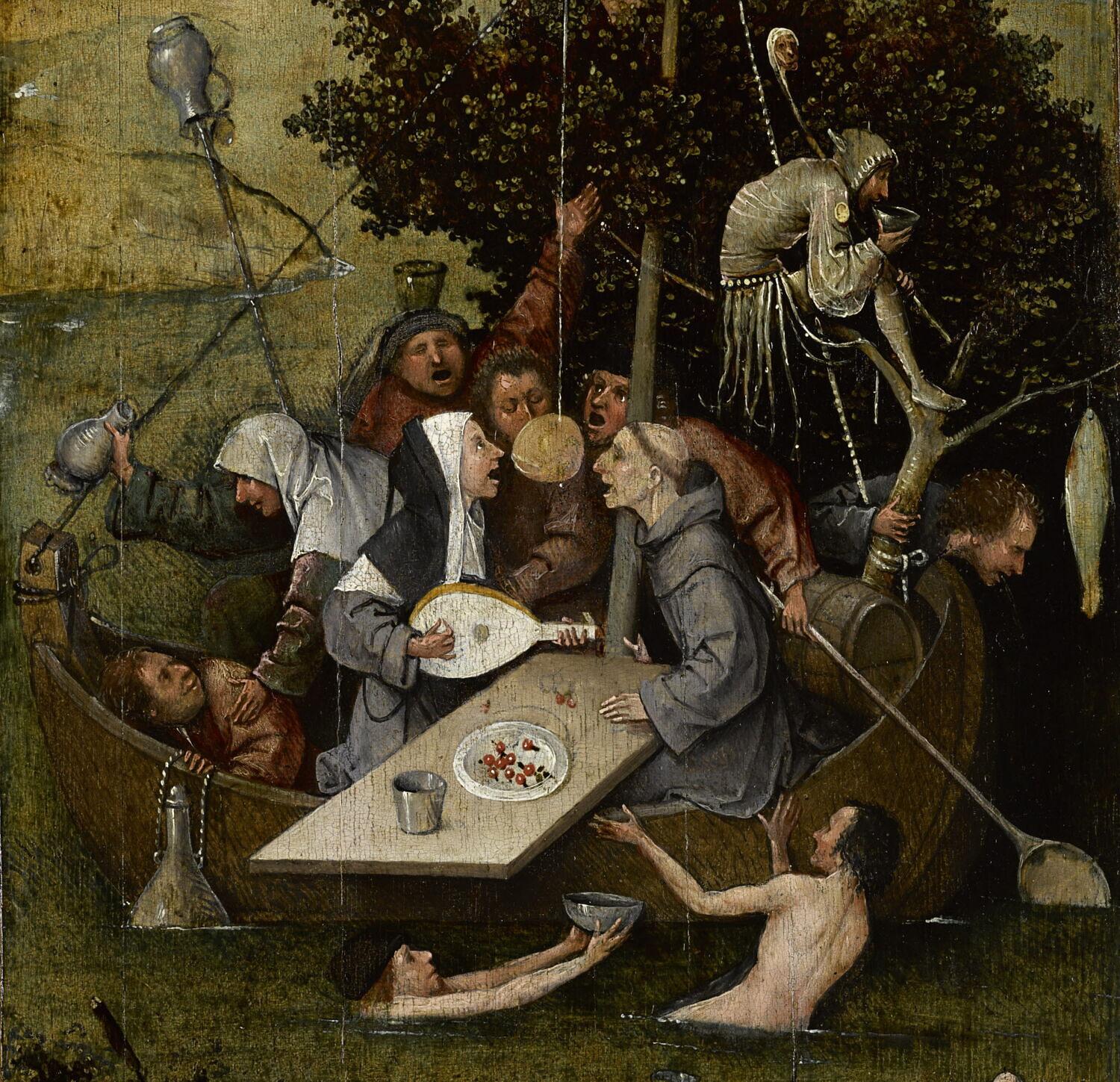
Image: The Ship of Fools (1475–1500), by Hieronymus Bosch. Musée du Louvre.


