
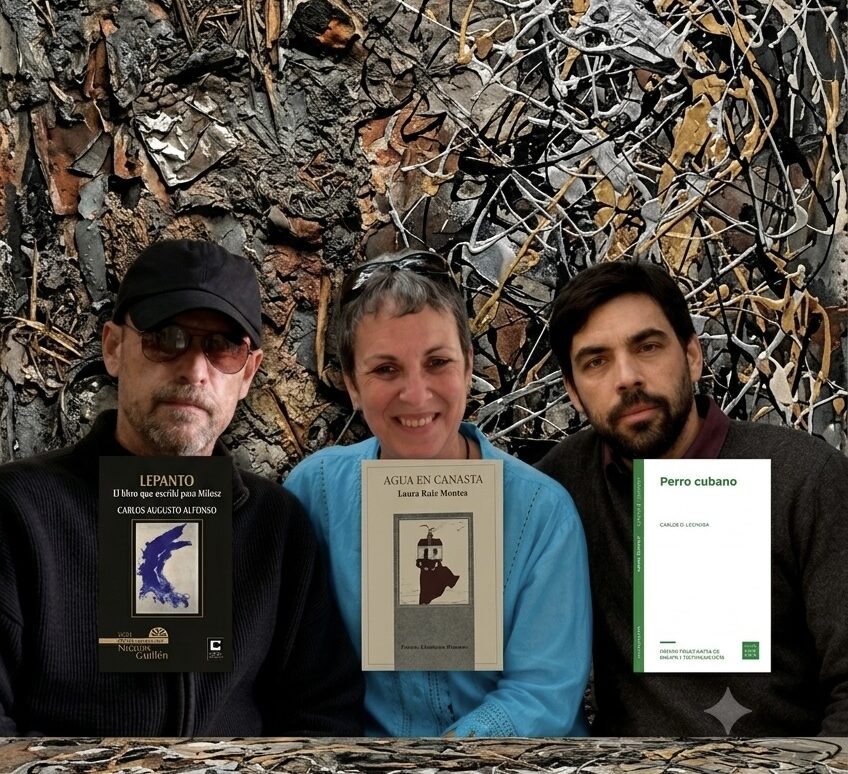
Carlos Lechuga, Perro cubano
Ediciones Incubadora / Libri Prohibiti (Praga), 2026
To go into exile is to go out to find oneself, to position oneself in another reality, to self-expel. It is to inhabit a microplanet where you are nobody. Perro cubano (Cuban Dog), by Carlos Lechuga, is the brief testimony of that journey into the unknown, with the added element that the author, not satisfied with his own path, wants to know about that of another exile: Eddy Campa, a ghost, a Marielito narrator whom we have already known through the various signals given to us by his generational peers, some of whom appear in this book.
Campa returns to this book like that Cesárea Tinajero whom every Bolaño reader confuses or identifies with the device of detective memory. Except there is no crime nor will there be: Campa is the exiled author himself crying out in the desert of the real; nobody is going to stab him because he is visible to no one, he exists no more.
This book shows me a Lechuga who has found a unique, naive voice in which he seems to feel very comfortable. When he approaches a book presentation in Madrid, he claims not to know the presenter. One suspects that if he did know him, he would not say so either, because that is what fits an outsider: not (re)cognizing anyone, not getting involved.
In 1968, another Cuban writer arrived in Madrid: Lorenzo García Vega. The pages he wrote in Rostros del reverso about his departure from Cuba, his ‘living low-profile,’ and his trip on a plane decorated like a luxury brothel are very intense, and the first thing he mentions about the Spanish capital is the smell, many smells. ‘Madrid penetrated by the smell!’ he says.
More than half a century later, Lechuga is in Madrid, debuting as the father of a daughter he cannot see more often—the girl lives in Barcelona with her mother—without a steady job, and living in windowless hovels. The literary strangeness found in Rostros del reverso has now turned into the empty gaze of that newly arrived man whom someone hires under precarious conditions to walk a dog.
García Vega says that the picaresque was still alive in that Madrid that was beginning to open up to the world. In a scene from Perro cubano, we see the exile, reinvented as a rogue, avoiding picking up the animal’s droppings—the smells, the excremental textures, the disgust once again—and being rebuked by a neighbor while he pretends to be distracted by his phone. In the end, he manages to slip away, but he already knows he is marked.
I notice that, for García Vega, Madrid was a stopover on his future journey to settle in New York. His book is peppered with encounters with various people who ask him to talk about the Cuban case, as if looking for clarity. Lechuga might follow that same path, we do not know, but already during his time in this Spain—a refuge for Cubans, Venezuelans, and people from many other Latin American, Asian, and African countries—nobody inquires about Cuba anymore. The island has been left in a limbo, it has disappeared from the collective imagination, or perhaps it only survives in that imagination, but without its weight of yesteryear, already erased from the world’s inquiries.
◾️
Laura Ruiz, Agua en canasta
Ediciones Matanzas (Cuba), 2025
“I am getting used to loving my idea of things,” Laura Ruiz writes in one of the poems from that book I have just read, Agua en canasta (Water in a Basket), which strikes me as immense in its exploration of prose writing and the limits of poetic thought.
It is a brief notebook, like most of her books or how I remember them, as her stubborn reader. What is the point of writing amidst the most deafening cancellation of humanity, in the absolute emptying of meaning? The writing of poetry in Cuba has always been a clearing of the path and a call to be saved by a force greater than ourselves and our understanding of phenomena.
Her poetry is diaphanous, yet her voice is solid, mature, even if it seems to be made of transparencies. Trying to carry water in a basket is one of those futile tasks that even found a place in proverbs, and the poet seems to explore every step taken in utter futility, so as not to have to speak or think about her daughter, “the emigrant,” so as not to have to think of herself so much in a place where everything is a fragment and a void.
And what about the takahe, that bird of paradise that God seems to have left incomplete? Has it survived the delusion of humans playing God? It is sad that for all Cuban books, only the coldness of screens remains, as I have been told. It is like the final farewell to a world I once belonged to and which has ceased to exist. The secret aspiration of any return becomes increasingly remote. But I am encouraged and consoled that such solid and delicate voices still insist on the howl, even if it comes from the bottom of a deep crevice.
◾️
Carlos Augusto Alfonso, Lepanto
Editorial Letras Cubanas, 2021
“Do you insist on living?”, Carlos Augusto Alfonso asks himself more than once—just like that, with a single question mark—in the last short poem of this book. “There are forgotten pleasures,” he says in that very poem, but at first I read “frictions,” and it got me thinking about that—the frictions that were frequent in a former life, about thirty years ago, when some friends and I would go out looking for CAA’s books and would end up learning poems by heart, especially fragments of those poems that one still remembers: I do not know through what Hades of the world my soul goes suffering… The Child can always return…
One grew up as a reader convinced that we had some sort of advantage reading those books composed of poems that went against the sense of the world and were not going to be understood by anyone. But no one could strip us of the sensation of a universe in disagreement, in decay, that we found there. I insist on pluralizing it, though I do not know exactly why. It is clear that every reading experience occurs in a room locked tight, even when we are out in the open and surrounded by a crowd. There were friends who shared that search, and all of them are included in what I am saying, even though none of them are on this couch right now, in the dead time between two World Cup soccer matches, handling some books that M. brought back from his last trip to Cuba.
In Lepanto, CAA gives his writing another twist, and the book begins to warp, but one still admires the endurance of a voice and a prosody that loses itself from beginning to end in its own labyrinth. It disconnects, it untethers itself—the author of the jacket notes points to something along those lines—evading a false identity of the poem, a feigned family resemblance, and it feels a bit like one of those unintelligible compositions that makes you wonder if you need to be high to understand the lyrics.
“In 1839 it was considered elegant to take a turtle for a walk. This gives us an idea of the tempo of the walk in the arcades,” Benjamin wrote. And it is true that reading a verbal labyrinth will always demand time, both in the past and right now. But the exact opposite usually happens to me: I find a rush in these poems, a fast-forwarding of time, a demand for a feverish rhythm.


