
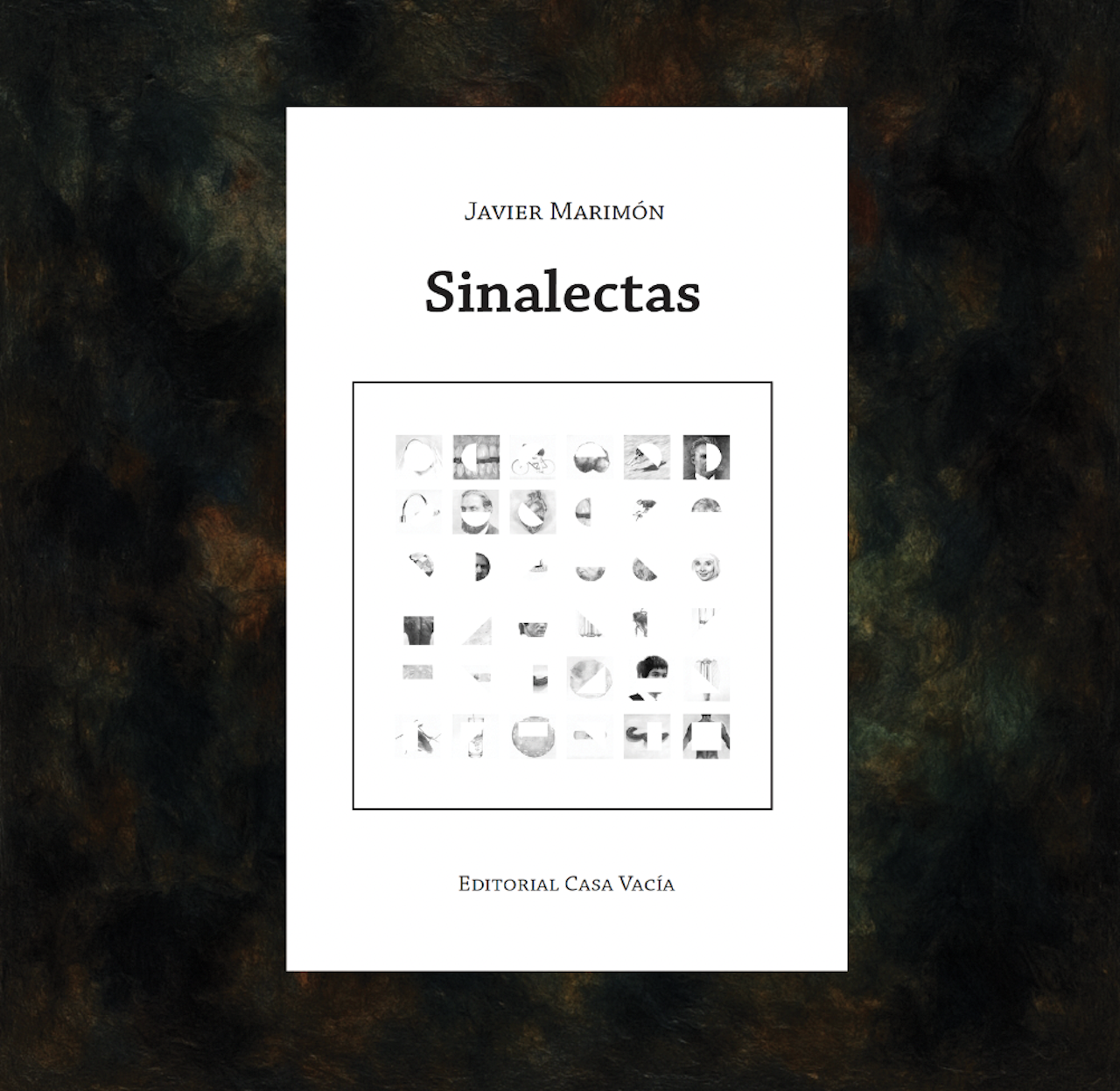
Let us consider this book as a device, with contained rhetoric, that converts observations into pure syntactic energy. In Sinalectas (Casa Vacía, 2016), Javier Marimón decides to distance the poetic from “beautiful speech”—in any case, one hears a twelve-tone bel canto—by virtue of a mechanism of observation: “Starting from the structure it causes, write it: / it peels away the moment it consists of, it makes / one admire the stroke that retains the image.” This act of “peeling away” defines the poetics of the volume: a repertoire of minimal gestures put to the test, described with measured prose that sounds like a logbook of the senses.
Hugh Kenner used to trace the engineering of style in Pound or Joyce, wondering what gears made a text turn. In Sinalectas, the gears are explicit: “Almost a biologist, he creates life from concepts… He promises not to confess the extent of his pain.” The dry, direct phrase functions as a tool; the poem, as a testing ground. The result is a lyricism of procedure: designed to measure, compare, induce. Hence the insistence on bodies and fluids (“facial contraction,” “stream of urine”), on humble utensils (key rings, bottles, adhesive tape), on regulated actions (bending down “like a waiter,” peeling an egg, turning a sardine can lid).
Filio Gálvez’s illustrations, which dialogue with each poem, are superimposed white geometries, whether semicircles, triangles, or squares that partially or centrally cover the drawing. More than illustrating, Gálvez’s images interrogate the poems. The faceless nun, the teeth sectioned by a crescent moon, the cyclist whom the white figure turns into a possible wheel, the cropped shower, the heart pierced by an empty sector, Nietzsche’s face, are images that aspire to what is “missing.” The page becomes a balance, where the weight of the words is kept in tension by a visual subtraction. So, we could talk about counterweights: while the vocabulary refines, the figure subtracts.
This visual subtraction functions as a synalepha of the visible—unions by ellipsis, continuity by cut. Thus, the texts reduce the experience to its nouns (“He has little desire to drink water… Between the lack of desire and glances, low voice, the story contracts”), while the image drains the very center of the object (the watering can with a geometric bite). If the poem records the retreat of the tide of desire, the drawing reveals the void it leaves in its wake. Ecphrasis, therefore, moves away from a description of the image, continuing it as an experiment.
“A bloody band-aid floats in the pool. They complained: ‘Do you know how important this matter is?’” In pages close to the previous passages, there are cut-out band-aids and skin interrupted by geometric white spaces. The poem detects the verbal inflation (“how important this matter is”) that surrounds every wound; the drawing reminds us that the center of the wound becomes a hollow. Text and image compose a back-and-forth between injury and suture, between word and image.
There are moments in Sinalectas where the prose is sustained by an irony that lays bare the technique: “The height of the waist was calculated by the volume of the stream of urine as it fell…” We thus see the images—a mouth, a profile, a device—in “dialogue” with the letter, mutilated by a white quadrant, so that the body becomes a scale, and the figure a measuring instrument: “Facial contraction expresses that it hurts a little… it serves to manifest the pain.” Likewise, the image of a fleeing dog, cut off by a semicircle, deactivates the anecdote; thus, rather than facing a dog, we are faced with a counterpoint between what is seen and what is read.
Kenner defended “luminous detail”: things that, by their clear presence, think for us. Marimón constructs his own ideogram with bottles, key rings, eggs, soups: “Milk bottle on the counter… partners in fraud, laughing / at how the captives of illusion always buy something.” The accompanying drawing (a portrait sectioned by a semicircle like a muzzle) makes the purchase of the self visible: the consumer’s forbidden smile. Similarly, “if you finish eating the egg, the other thing must be there…” The half-wheel cut out on the opposite page suggests a delayed bite… Could it be that desire ties the hands in order to be released?
On the other hand, the book accumulates experiments that become perfect jokes: “Fleming… eureka, / and Greek: did you call me?” Or: “For the sardine resource, you have to roll up the lid… sardine resource persists.” The image responds with industrial objects intercepted by precise targets (sprinklers, cans); thus, comedy is part of the method, even exhibiting it.
The decisive factor in Sinalectas is the twist of lyrical expectation. Where we would expect lyricism, there is fine calibration; where we would expect metaphor, there is an essay of variables: “Rehearsing dualities, snacking twice, I drink / two glasses of water…” Where we would expect interiority, there is a protocol of perception (“Peculiar in the face reaches better manifestation / in psychologist’s report…”). The verbal economy—with its device-phrase syntax, its prosody without ornamental scaffolding—produces an effect of fierce clarity: we see how what happens happens.
The images, for their part, regulate the language. Those white blocks—a full circle over the veiled face, a triangular wedge on a tortilla, a square stuck in the back—are the reverse engineering of each page, as they show the absent mold to which the text adjusts its expression.
In workshop terms, Gálvez provides the lathe and Marimón the piece; thus, the book achieves its exact fit.
In short, each poem in Sinalectas is a verbal diagram that measures trivial events and puts them to the test of a language with very little rhetorical fat, attentive to cause and effect. Each image establishes a void that forces the text to prove its thesis. This back-and-forth between engineering and spark turns this notebook into a small kingdom of perception: it teaches us to think with the economy of someone who “peels away the moment” so that the stroke retains—and at the same time empties—the image.


