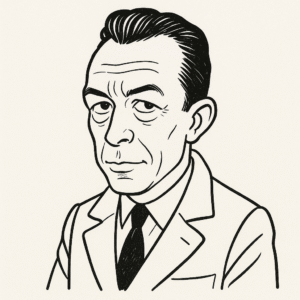
Onduras. Derived from onda, from the Latin unda (wave, movement of water), plus the abstract suffix “-ura,” which designates quality or effect. A word that suggests depth, resonance, and propagation: that which leaves a mark as it expands. A neologism coined by the editors of Bookish & Co. to name certain literary birthdays. These Onduras by Albert Camus celebrate the tragic clarity of a consciousness that knew itself to be alone in the world, the serenity of a thought that did not renounce beauty, even in the midst of absurdity.
It is noon, the day itself is in balance. Once the ritual is complete, the traveler collects the price of his liberation: it is the dry, smooth pebble, like an asphodel, that he picks up on the cliff. For the initiate, the world weighs no more than that stone. Atlas’s task is easy; he only has to choose the time. It is understandable, then, that for an hour, a month, a year, those shores can lend themselves to freedom. They welcome the monk, the civil servant, or the conqueror in confusion, without looking at them. There were days when I expected to meet Descartes or Cesare Borgia in the streets of Oran. It did not happen. But perhaps someone else will be more fortunate. A great deed, a great work, manly meditation, once demanded the solitude of the sands or the desert. There, the weapons of the spirit were guarded. Now where can they be better guarded than in the emptiness of a great city forever settled in spiritless beauty?
Here is the little stone, soft as an asphodel. It is at the beginning of everything. Flowers, tears (if one is interested), departures, and struggles are left for tomorrow. In the middle of the day, when the sky opens its fountains of light in the immense and resounding space, all the promontories of the coast look like a fleet setting sail. Those heavy galleons of rock and light tremble on their keels, as if preparing to sail towards islands of sun. Oh, mornings in Oran! From the top of the plateaus, the swallows dive into immense vats where the air boils. The entire coast is ready to depart; a thrill of adventure runs through it. Tomorrow, perhaps, we will leave together.
Oran, 1939
The Minotaur or Alto de Orán (1954)
◾️
We will not conquer our happiness with symbols; to achieve it, something more serious is needed. I simply want to say that sometimes, when the weight of life becomes too overwhelming in this Europe still steeped in misfortune, I turn to those resplendent countries where so many forces remain intact. I know them too well not to know that they are the chosen land where contemplation and intrepidity can be balanced. Meditating on the example they offer us provides us with a lesson, on the condition that we want nothing more than to save the spirit; it is therefore necessary to ignore their painful virtues and exalt their strength and prestige.
This world is poisoned by misfortunes in which it seems to take pleasure. It is entirely at the mercy of that evil that Nietzsche called the spirit of stupidity. Let us not collaborate with our help. It is futile to weep for the spirit; it is enough to work for it.
Summer (1940)
◾️
April, 1939.
The High Plateaus and Djebel Nador.
Endless expanses of wheat, no trees, no people. From time to time, a “gurbi” and a shivering silhouette walking on a hilltop, silhouetted against the horizon. A few crows and silence. Nowhere to take refuge, nothing to hold on to a joy or melancholy that could be fruitful. What emerges from these lands is anguish and sterility.
In Tiaret, some teachers told me they were “bored.”
“And what do you do when you’re bored?”
“We slander each other.”
“And then?”
“We go to the brothel.”
I went with them to the brothel. It was snowing. The snow fell fine and penetrating. Everyone had been drinking. A guard made me pay two bucks at the entrance. It was a huge, rectangular room, curiously painted with black and yellow diagonal stripes. They danced to the sound of a phonograph. The women were neither pretty nor ugly.
One of them said, “Are you here to have fun?”
The man defended himself weakly.
“I,” said the woman, “want to…”
When we left, it was snowing. Through a clearing, you could see the countryside. Always the same desolate expanse, but white this time.
In Trezel; Moorish coffee. Mint tea and conversation.
The street of the women is called “Calle de la Verdad” (Street of Truth). Admission costs three francs.
Carnets, 1 (May 1935-February 1942)
◾️
But if it is difficult to pinpoint the precise moment, the subtle shift when the spirit has decided in favor of death, it is easier to extract from the act itself the consequences it entails. To kill oneself, in a sense, and as in melodrama, is to confess. It is to confess that one has been overwhelmed by life or that one does not understand it. However, let us not go too far in these analogies and return to everyday words. It is nothing more than confessing that it is “not worth it.” Living, of course, is never easy. One continues to make the gestures that existence dictates, for many reasons, the first of which is habit. To die voluntarily means that one has recognized, even if only instinctively, the ridiculous nature of that habit, the absence of any profound reason for living, the senselessness of that daily agitation, and the futility of suffering.
The Myth of Sisyphus (1942)
◾️
Every artist thus preserves, deep within himself, a unique source that nourishes throughout his life what he is and what he says. When the source dries up, the work gradually hardens and cracks before our eyes. These are the barren lands of art that the invisible stream has ceased to water. With his hair already thin and dry, the artist, now in decline, is ripe for silence or, in other words, for the salons. In my case, I know that my source is in El revés y el derecho, in this world of poverty and light in which I have lived for so long and whose memory still preserves me from the two opposing dangers that threaten every artist: resentment and satisfaction.
Preface to El revés y el derecho (1937)
◾️
If it is true that the only paradises are those that have been lost, I know how to call this tender and inhuman thing that inhabits me today. An emigrant returns to his homeland. And I remember. Irony, rigidity, everything falls silent and here I am, repatriated. I don’t want to dwell on happiness. It’s much simpler and much easier. Indeed, of those hours that I rescue from the depths of oblivion, what has been preserved above all is the intact memory of a pure emotion, of a moment suspended in eternity.
That is the only thing that is true in me, and I always know it too late. We like the bend of a gesture, the opportunity of a tree in the landscape. And to recreate all that love, we have only one detail, but it is enough: the smell of a room that has been closed for too long, the singular sound of a step on the path. That is how it is for me. And if, loving, I gave myself, I would be myself, since there is nothing but the love that brings us back to ourselves.
The Backhand and the Forehand (1937)
◾️
Here I understand what is called glory: the right to love without measure. There is only one love in this world. To hold a woman’s body is also to hold close to me this strange joy that descends from heaven to the sea. In a moment, when I lie down among the wormwood so that its perfume enters my body, I will be—against all prejudices—aware that I am fulfilling a truth that is that of the sun, and that will also end up being that of my death. In a sense, here I interpret my life, a life with the taste of hot stone, filled with the sighs of the sea and the buzzing of cicadas that begin to sing at this hour. The breeze is cool and the sky is blue. I love this life of abandonment and I want to speak freely about it: it gives me pride in my condition as a man. I have often been told: there is nothing to be proud of. But there is: this sun, this sea, my heart filled with youth, my body that tastes of salt, and the immense backdrop where tenderness and glory meet in yellow and blue. I must apply my strength and skills to achieve this. Here, everything leaves me intact, I abandon nothing of myself, I do not cover myself with any mask: it is enough for me to patiently learn the difficult science of living, which is well deserved by all their knowledge of how to live.
Nupcias (1938)
◾️
I listened and heard that I was being judged intelligent. But I did not quite understand how the qualities of an ordinary man could become crushing accusations against a guilty party. At least, that was what astonished me, and I stopped paying attention to the prosecutor until I heard him say: “Did he at least say he was sorry? Never, gentlemen. Not once in the course of the investigation did this man seem moved by his abominable crime.” He then turned to me, pointed his finger at me, and continued to overwhelm me without me really understanding why. Of course, I couldn’t help but admit that he was right. I didn’t regret my act very much. But such relentlessness astonished me. I would have liked to try to explain to him cordially, almost affectionately, that I had never been able to truly regret anything. I was always preoccupied with what was going to happen, today or tomorrow. But, naturally, in the state I was in, I couldn’t speak to anyone in that tone. I had no right to show affection, to express goodwill. I tried to pay attention again because the prosecutor had started talking about my soul.
The Foreigner (1942)
◾️
All of Kafka’s art consists of forcing the reader to reread. His endings, or lack thereof, suggest explanations, but they are not clearly revealed and, in order to seem well-founded, require a new reading of the story from another angle. Sometimes there is a double possibility of interpretation, hence the need for two readings. That is what the author was looking for. But it would be a mistake to want to interpret everything in detail in Kafka. A symbol is always general, and, however precise its translation may be, an artist can only restore its movement: there is no literal translation. Moreover, nothing is more difficult to understand than a symbolic work. A symbol always surpasses the person who uses it and makes them say more than they think they are expressing. In this regard, the surest way to grasp it is not to provoke it, to read the work with an unprejudiced mind, and not to look for its secret currents. As for Kafka in particular, it is best to play along with him and approach the drama by its appearance and the novel by its form.
“Hope and the Absurd in the Work of Franz Kafka” (appendix to The Myth of Sisyphus)
◾️
Long ago, the Christians of Abyssinia saw the plague as an effective means of divine origin to gain eternity, and those who were not infected wrapped themselves in the sheets of the plague victims to be sure of dying. This frenzy for salvation is certainly not to be recommended. It denotes a regrettable haste very close to pride. We must not rush ahead of God, for anything that seeks to accelerate the immutable order that He has established once and for all leads to heresy. But this example serves as a lesson to us, at least. It helps our more clairvoyant spirits to appreciate that sublime radiance of eternity that exists at the heart of all suffering. This radiance illuminates the twilight paths that lead to liberation. It manifests the divine will that tirelessly transforms evil into good. Today, through this throng of death, anguish, and cries, it guides us toward essential silence and toward the beginning of all life. Behold, my brothers, the immense consolation I wanted to bring you, so that you may take away from here not only words of punishment, but also a word that appeases.
The Plague (1947)
◾️
Error always comes from exclusion, says Pascal. If you only seek happiness, you end up with the easy way out. If you only cultivate unhappiness, you end up with complacency. In both cases, a devaluation. The Greeks knew that there is a part of shadow and a part of light. Today we only see the shadow, and the task of those who do not want to despair is to remember the light, the midday of life. But it is a question of strategy. In any case, what we must strive for is not annihilation, but balance and self-control.
(…)
I am not a Christian. I was born poor, under a happy sky, in a natural environment that I felt was in harmony with me, without hostility. So I did not begin with heartbreak, but with fulfillment. Afterwards… But I feel Greek at heart. And what is there in the Greek spirit that Christianity cannot accept? Many things, but this in particular: the Greeks did not deny the gods, but they limited their importance. Christianity, which is a total religion, to use a fashionable term, cannot admit that spirit which sets limits on what, in its judgment, must encompass the whole. Although that spirit, on the contrary, can very well admit the existence of Christianity.
Interview with Émile Simon (Reine du Caire, 1948)
◾️
The world I live in repulses me, but I feel solidarity with the people who suffer in it. There are ambitions that are not mine, and I would not feel comfortable if I had to go through life relying on the poor privileges reserved for those who are content with this world. But I believe there is another ambition that should be shared by all writers: to bear witness and speak out, whenever possible and to the best of our ability, on behalf of those who are subjugated like us. That ambition was questioned in your article, but I will deny you the right to do so as long as the murder of a man only seems to outrage you to the extent that that man shares your ideas.
Why Spain? Response to Gabriel Marcel (Combat, 1948)
◾️
We have not lacked great adventurers of the absurd. But, ultimately, their greatness is measured by the fact that they have rejected the satisfactions of the absurd in order to preserve only its demands. They destroy for the sake of more, not less. “They are my enemies,” says Nietzsche, “who want to tear down and not create themselves.” He tears down, but in order to try to create. He exalts probity by castigating the “pig-snouted” pleasure-seekers. To escape complacency, absurd reasoning then finds renunciation. It shuns dispersion and leads to arbitrary nakedness, a prejudice of silence, the strange asceticism of rebellion. Rimbaud, who sings of “the beautiful crime that chirps in the mud of the street,” runs to Harrar to complain only about living there without his family. Life was for him “a farce that everyone has to play.” But at the hour of death, he cries out, turning to his sister: “I will go underground, and you will walk in the sun!”
The Rebel (1951)
◾️
Chinese theater in Chinatown. A large, dusty, round hall. The show lasts from six to eleven and takes place in front of 1,500 Chinese people who eat peanuts, chatter, come and go, and follow the show with a kind of constant distraction. Children run around the middle of the room. On stage, actors dressed in their theater costumes play their roles alongside musicians dressed in civilian clothes and suspenders, who interrupt themselves from time to time to eat a sandwich or adjust a child’s pants. Similarly, throughout the action, stagehands in vests and shirtsleeves come and go to pick up a sword that has slipped from the hands of a dying man, to place a chair or remove another, all without any real need. Behind the scenes, from time to time, you can see the actors waiting to make their entrance, chatting or following the action.
As for the play, since the program is in Chinese, I have tried to figure out the plot. But I suspect I have only made mistakes. Because the moment a good man dies on stage in the most realistic way, amid the lamentations of his widow and friends, the moment I am very serious, the audience laughs. And when a magistrate with a shrill voice makes his clownish entrance, I am the only one who laughs, while the entire audience shows respectful attention. A kind of blood-covered butcher kills a man. He forces a young Chinese man to carry the body. The young Chinese man is so afraid that his knees knock together.
Travel Diaries. United States, March to May 1946 (1978)
◾️
And then? Then God’s only use would be to guarantee innocence, and I would rather see religion as a giant laundry business, something that, incidentally, it already was briefly, for only three years, and it wasn’t called religion. Since then, we’ve been short on soap, our noses are dirty, and we wipe each other’s snot. We’re all bad, we’re all punished, let’s spit on each other and off we go to malconfort! The question is who will spit first, that’s all. I’m going to tell you a big secret, my dear friend. Don’t wait for the Last Judgment. It happens every day.
The Fall (1956)
◾️
Every generation, without a doubt, believes it is destined to remake the world. Mine, however, knows that it will not remake it. But its task is perhaps greater. It consists of preventing the world from falling apart. Heir to a corrupt history in which fallen revolutions, techniques that have fallen into madness, dead gods, and exhausted ideologies are mixed together, in which mediocre powers can today destroy everything but do not know how to convince, in which intelligence has been reduced to becoming the servant of hatred and oppression, this generation has had to restore, in itself and around itself, from its negations, a little of what gives dignity to living and dying. Faced with a world threatened with disintegration, in which our great inquisitors can establish the kingdoms of death forever, this generation knows that, in a kind of mad race against time, it must restore among nations a peace that is not that of servitude, reconcile work and culture once again, and rebuild with all men an ark of the covenant. It is not certain that it will be able to accomplish this immense task, but it is certain that throughout the world it is already making its double commitment to truth and freedom, and that, if necessary, it will know how to die for it without hatred. It is this generation that deserves to be saluted and encouraged everywhere, and especially where it sacrifices itself. I am sure you will agree with me that it is to this generation, in any case, that I wish to bestow the honor you have granted me.
Acceptance speech for the Nobel Prize in Literature (1958)
◾️
It is easy to see all that art can lose in this constant obligation. Above all, ease, and that divine freedom that breathes in Mozart’s work. This makes it easier to understand the sullen and rigid aspect of our works of art, their frowning brow and sudden defeats. This explains why we have more journalists than writers, more boy scouts of painting than Cézannes and why, in short, the romance novel or the detective novel has taken the place of War and Peace or The Charterhouse of Parma. Of course, one can always oppose this state of affairs with humanistic lamentation, or become what Trofimovitch, in The Possessed, wants to be at all costs: the embodiment of reproach. Like this character, one can also have bouts of civic sadness. But this sadness does not change reality in any way. In my opinion, it is better to give the era what it wants, since it demands it so vigorously, and calmly recognize that the days of expensive teachers, violet-colored scholars, and geniuses perched on armchairs are over. To create today is to create dangerously. Every publication is an act that exposes its author to the passions of a century that forgives nothing. The problem is not whether or not this is detrimental to art. The problem, for all those who cannot live without art and what it means, lies solely in knowing how, among the police forces of so many ideologies (how many churches, how much loneliness!), the strange freedom of creation remains possible.
“The Artist and His Time” (lecture at the University of Uppsala, 1957)