
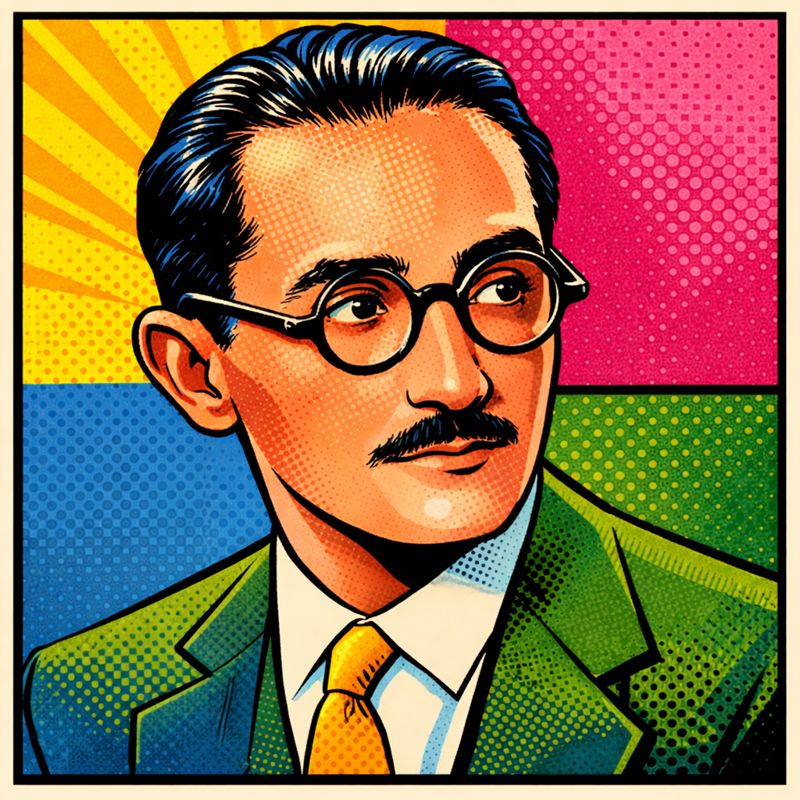
Editorial Casa Vacía—much like Julio Cortázar’s Casa Tomada or David Uclés’ recent text, La península de las casas vacías—shares a particular unease: the exclusion of those from the very space they inhabit. In the year that has just concluded, tracking the trail of exclusions (Rafael Rojas speaks of “empty shelves”), Editorial Casa Vacía published the anthology Jorge Mañach: ¿Una verdadera patria? Ensayos para un centenario en ruinas, compiled and introduced by Pablo de Cuba Soria. This volume is more than a tribute—though it is that as well—it is the crowning achievement of an inquiry. Its title encapsulates a search that, while laudatory, remains deeply critical. The questioning of a nearly non-existent and degraded homeland, evidenced by its ruins (not always circular), is the paradox that interrogates its very character.
In his prologue, Cuba Soria provides context while introducing epistemological coordinates that create a productive tension in the reading. The reader is invited to review the history of a tradition and its anomalies. Within this disquisition, Mañach emerges as a liberal thinker who auscultated, as few others have, the ontological nature of a non-existent nation. Attempting to rescue the moral nerve of the nation through criticism; unraveling the pathology of choteo as a corrosive gesture; examining the nature of the nervous laughter that dissolves the possibility of meaning; questioning the ethos of Creole improvisation and its simulacra; and establishing the epistemological reasons for the semantic fracture between “instruction” and “culture” and the moral anemia of the Cuban subject—all these place Jorge Mañach as a thinker not confined to a single discipline, but inscribed in a system of thought without precedent. At the vortex of this framework lies the question of the fatherland: What remains when its very foundation is revealed as ruin? This conceptual quagmire is the face of an ontological crisis.
For those of us who have followed Jorge Mañach’s texts and valued his work as an essential part of the liberal sensibility, this compilation represents an effort to rescue materials that would otherwise have to be tracked down with the meticulousness of a paleontologist.
The Cuban regime established in 1959—to which Mañach voiced early opposition, alerted by the emerging authoritarian drifts—has exercised selective control over cultural memory. Although the regime has published what it deems “harmless” works, Mañach remains largely unknown outside academic circles. With the occasional inclusion of essays that do not compromise the official narrative, the state’s dissemination of his work reflects a segregationist criterion in the understanding of the Cuban intellectual tradition. Mañach—like many others—has remained subject to a sort of “conditioned extrema unctio,” granted under political criteria that reveal a peculiar manipulation of historical memory.
This biased approach highlights the epistemological and ontological concerns underlying Mañach’s work, as well as the institutional fragility and authoritarian drift he pained. While this phenomenon stems from a logic that seeks cultural legitimation by reconfiguring the intellectual canon to suit power, the immediate consequence has been the invisibility of critical voices from republican liberalism. Jorge Mañach, José Lezama Lima, Virgilio Piñera, Heberto Padilla, or more contemporary figures like Ángel Santiesteban or María Elena Cruz Varela, demonstrate how authoritarian regimes negotiate intellectual heritage to sustain their symbolic hegemony.
Divided into three parts, the volume interposes Ensayos sobre Mañach y su obra, followed by La crisis de la alta cultura en Cuba (1925), and concluding with a Dossier. Centenario de La crisis de la alta cultura en Cuba.
Authors Daniel Céspedes Góngora, Jorge Domingo Cuadriello, Gustavo Pérez Firmat, José Prats Sariol, Alfredo Triff, and Ricardo Luis Hernández Otero explore bordering zones ranging from the idea of the nation and its direction to Mañach’s presence in cultural institutions, elements of style, the latest crisis of high culture (1925–2025), and the phenomenological depth—or lack thereof—in Mañach’s thought.
In “Rumbo de nación (Notas sobre Historia y Estilo)”, Daniel Céspedes Góngora performs a dissection centered on the resonances of Mañach’s text. His inquiry questions the nature of the national as it is intersected by historical formations, the purposes of the masses, and the roles of groups operating within. He asks: How do the uncontrolled enthusiasms of revolutions or the ideological “auditing” of the past affect national goals? How is the symbolic management of the national pantheon a central element in the narrative that sustains collective identity?
Jorge Domingo Cuadriello’s essay unfolds as a historiographical exercise, minutely reviewing Mañach’s role as a provocateur—much like Ludwig Wittgenstein against Karl Popper—primarily because “peoples take shape to the extent that they acquire, through internal cohesion and agreement, a character and a sense.”
Style—in a broad sense—occupies the attention of Gustavo Pérez Firmat. From the “elegant style” some attributed to Mañach’s New England education to “style” as a fundamental analytical category, Pérez Firmat analyzes it not merely as an aesthetic matter, but as a normative vehicle that articulates modes of conduct. Against the “mess” (relajo) that symbolizes disorder in the national imaginary, style appears as a commitment to formality. It is not rigidity, but creative discipline.
In contrast to Fernando Ortiz’s notion of ajiaco to describe Cuban hybridity, Mañach proposes the “blank page”—a page whose blots must be cleaned. Pérez Firmat emphasizes: formality against relajo. This “counterpoint” questions the presence of indigenous cultures in the Cuban language; Pérez Firmat notes that rather than a living culture, the indigenous presence became an extinct settlement. This absence of an indigenous subject, as Lino Novas Calvo also argued, significantly impacts the behavior of subjects in the formation of the nation.
How do behavior and style affect national order? “If the stylist chooses, the choteador improvises; if the stylist deliberates, the choteador acts on a whim.” Mañach’s radiography of the national reveals a pathology where anguish becomes a persistent feeling of frustration rooted in the lack of tradition. What does it mean to be a nation, and why is Cuba not one yet?
The essay by José Prats Sariol should have been titled, in the author’s own words, “Las ilusiones perdidas de Jorge Mañach.” Using the centenary of La crisis de la alta cultura en Cuba as a symbol, Prats Sariol balances the “ruinous, unworthy, and evasive Cuba we still suffer” as a consequence of the regime established in 1959. Even a hundred years later, Mañach’s diagnosis remains relevant in a Cuba corroded by spiritual ruin, the “decay of colloquy,” and the lack of “good conversationalists.”
Mañach’s radiography of the intellectual field and its power dynamics—anticipating Pierre Bourdieu—is devastating. Reading his critiques of “fatuous luminaries” and “showy sonorous tropes” makes comparisons to the current devastation inevitable. It is here that Prats Sariol introduces an exegesis provided by AI, assuming the voice of Octavio Paz. Though it may seem like a digression, Sariol uses the algorithm to warn against its abuse. In an exiled or local Cuban “intellectualism” where “autophagic ghettos” proliferate on Facebook, the production of books without indexes or covers reminds one of the fictional Johann Sebastian Mastropiero. We might publish a corrigendum: where it says “copious production,” it should say “copied production”—now by AI.
Alfredo Triff proposes an exploration of phenomenological traces in Mañach’s work, touching on the classic debate: Cuban thought vs. thought in Cuba. Triff notes that while Mañach does not strictly practice phenomenology, he “has it in mind.” This process of intellectual sedimentation was abruptly interrupted by a totalizing system that reduced philosophical reflection to official Marxism. Triff recognizes that the result of this curiosity is a “Creole essay” with its own identity, a perspective that clears the “receptive” character of Cuban thought, which often prefers chronicling philosophy over practicing it.
Jorge Mañach: ¿Una verdadera patria? Ensayos para un centenario en ruinas is a necessary book. It commemorates but also dismantles, offering a visceral critique of hegemonic discourses. Mañach was clear: “la patria no es un dogma, sino una interrogación permanente” (1937). This book anticipates what can no longer be hidden: the ruins, the debris, and the mirages of what we have tried to be and have not yet become.
[1] Triff, A. (2002). La filosofía cubana en el siglo XX. Miami: Ediciones Universal.


