
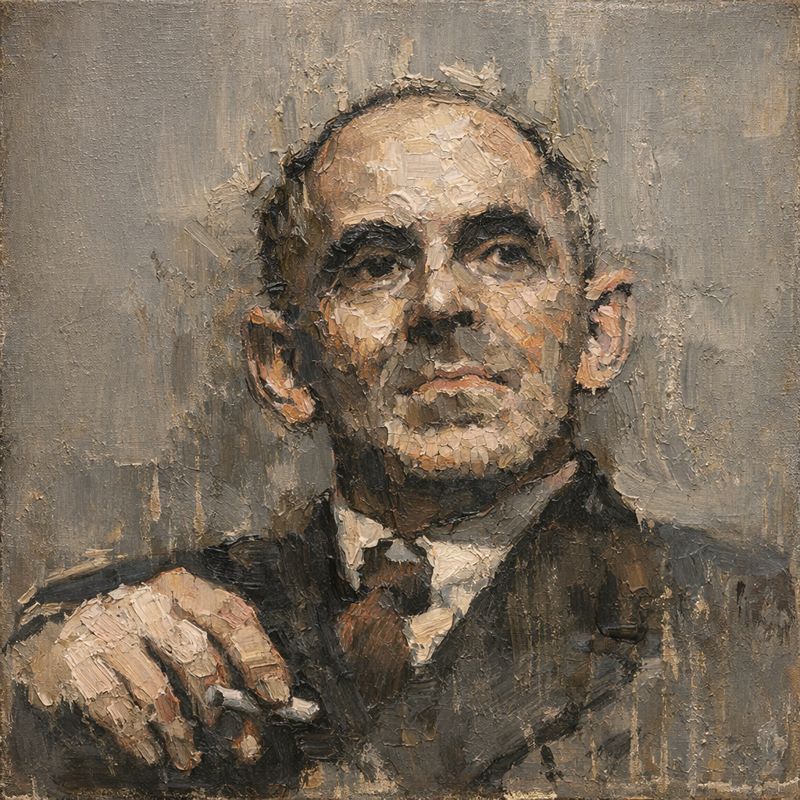
Onduras. Derived from onda, from the Latin unda (wave, movement of water), plus the abstract suffix “-ura,” which designates quality or effect. A word that suggests depth, resonance, and propagation: that which leaves a mark as it expands. A neologism coined by the editors of Bookish & Co. to name certain literary birthdays. These Onduras by Mandelstam highlight the force field that his writing continues to produce: a prosody that remains active, a syntax that operates by pressure, a word that expands by collision.
To exist is the artist’s greatest pride. He desires no other paradise than existence, and when people talk to him about reality, he merely smiles bitterly, for he knows the infinitely more convincing reality of art. The spectacle of a mathematician who, without apparent effort, squares a ten-digit number, fills us with a certain awe. But too often we fail to realize that the poet raises a phenomenon to its tenth power, and the modest exterior of a work of art often deceives us about the terribly condensed reality contained within.
In poetry, this reality is the word as such. Right now, for example, in expressing my thoughts as precisely as possible, but certainly not in a poetic way, I am speaking essentially to my conscience, but not with words. Deaf-mutes understand each other perfectly, and railroad signals perform a very complex function without resorting to words. Thus, if we identify meaning with content, everything else in the world must be conceived as a mere mechanical appendage that only hinders the rapid transmission of thought. “The word as such” was born very slowly. One after another, all the elements of the word were gradually involved in the concept of form. Even today, conscious meaning, the logos, continues to be mistakenly and arbitrarily confused with content. The logos gains nothing from this unnecessary honor. The logos asks only to be considered on an equal footing with the other elements of the word. The Futurists, unable to treat conscious meaning as creative material, frivolously threw it overboard, essentially repeating the gross mistake of their predecessors.
“The Dawn of Acmeism”
◾️
Byzantine monks constituted the first intelligentsia in Russia. They introduced a foreign form and spirit into the language. In Russia, the black cassocks, the intelligentsia, have always spoken a different language from that of the laity. The widespread introduction of the Slavic dialect by Cyril and Methodius was to their era what the widespread introduction of “Volapük” would be to ours. Colloquial language craves adaptation. It merges contradictory elements. Colloquial language always finds the right middle ground. In its relationship with the history of the language, it is conciliatory and characterized by a vague sense of benevolence, that is, by a sense of opportunism. However, poetic language can never be “pacified” enough, and after many centuries, ancient discordances manifest themselves within it. Poetic language can be compared to a piece of amber in which a fly still buzzes after having been buried long ago under several layers of resin: the living, foreign body continues to live even after it has fossilized. Everything in Russian poetry that contributes to perpetuating foreign monastic literature, everything produced by the intelligentsia, in a word, by “Byzantium,” is reactionary; it is one evil leading to another. On the other hand, everything that contributes to the secularization of poetic language, to the expulsion of the monastic intelligentsia, of Byzantium, provides only benefits or vitality to language and helps it, as one might help an honest man, to accomplish the feat of leading an independent existence in the midst of the family of dialects. The opposite case would be that of a nation ruled by an indigenous theocracy, such as Tibet, freeing itself from secular foreign invaders, such as the Manchus. Only those directly involved in the great secularization of the Russian language, in its conversion into the language of the laity, contributed to carrying out the fundamental task in the development of Russian poetry.
“Some Notes on Poetry”
◾️
I only wish to say that the epidemic of “poetry sickness” will inevitably subside with the general recovery of the country. The latest crop of young people is producing fewer poets, but more readers and healthy individuals.
One might ask why we do not introduce courses in poetic writing and versification in our elementary schools, following the example of French bourgeois schools, in order to demonstrate its difficulty and teach respect for it.
My answer is as follows: the study of versification in French schools is absurd because it only makes sense where there is a poetic method accepted by all, a method that has not changed for centuries, such as the prosodic system in ancient Greece.
At present, both Russian and European poetry are undergoing a fundamental change insofar as schools, lacking a traditional and canonical model, do not know what to teach and, at best, produce only epigones and minor poets.
It is one thing for young people to learn to write in a popular style accepted by all, that is, to simply learn to acquire culture, since culture can be taught, and quite another to imitate specific authors, since this is a matter of the imitator’s taste and conscience.
“An Army of Poets”
◾️
Aestheticism is not what best characterizes the system, but rather the geometric spirit and strict rationalism: man, space, time, and movement are its four basic elements. However, it is not surprising that rhythm, which had been banned from society for a whole century, returned much more anemic and abstract than it was in Hellas. The system is not Dalcroze’s alone. The discovery of the system has been one of those brilliant discoveries like gunpowder or the steam turbine. Once a force manifests itself, it has to develop on its own. The name of the discoverer may be forgotten in the interest of clarifying the principle, even if his disciples do not want to accept this fact. For rhythmic education to be accepted nationally, a miracle must occur that embodies the abstract system in the people. Where yesterday there was only a plan, tomorrow the dancers’ costumes will shine with colorful reflections and songs will resound. School precedes life. School sculpts life in its own image and likeness. The rhythm of the academic year will be determined above all by the school Olympic Games; the rhythm will be the instigator and organizer of these games. At such festivals, we will see a new generation educated rhythmically, freely proclaiming their will, their joys, and their sorrows. Harmonious, universal, rhythmic acts, animated by a common idea, are of infinite importance for the creation of future history. Until now, history has been created unconsciously amid the anguish of chance and blind struggle. From now on, the conscious creation of history, its birth from celebration as a proclamation of the creative will of the people, will be an inalienable right of man. Social games will replace contradictions in the society of the future and act as enzymes, as catalysts, to ensure the organic flourishing of culture.
“Rhythm and Government”
◾️
Grass grows on the streets of St. Petersburg—the first shoots of a virgin forest that will cover modern cities. This greenery, delicate and bright, astonishing in its freshness, belongs to a new and inspired nature. St. Petersburg is in fact the most advanced city in the world. The speed, the rhythm of the present, cannot be measured by subway networks or skyscrapers, but only by the joyful grass breaking through beneath the city’s stones.
Our blood, our music, our state, everything will have its continuation in the delicate life of a new nature, a psyche-nature. In this realm of the spirit without man, every tree will be a dryad and every phenomenon will tell us its own metamorphosis.
Stop? Why? Who stops the sun when, possessed by the desire to return, it runs to its father’s house with its swallow harnesses? Isn’t it better to celebrate it with dithyrambs than to beg it for a miserable alms?
“The Word and Culture”
◾️
The future appears cold and terrible to those who do not understand this, but the inner warmth of the future—the warmth of efficiency, domestic economy, and teleology—is as tangible to the contemporary humanist as the warmth of the incandescent kitchen of the present.
If the social architecture of the future is not based on a genuinely humanistic justification, it will crush man as Assyria and Babylon did in the past.
The fact that humanistic values are scarce today, as if they had been withdrawn from circulation and hidden underground, is not in itself a bad sign. Humanist values have simply withdrawn, hidden away like gold coins, but, like reserves of this metal, they are what guarantee the circulation of ideas in contemporary Europe and govern them all the more effectively because they are underground.
The transition to gold coins is the task of the future, and what lies ahead of us in the realm of culture is the replacement of temporary ideas, of paper money, with the gold coins of the European humanist tradition; the magnificent florins of humanism will ring out once again, but not when they strike the archaeologist’s shovel; when the time comes, they will recognize their era and resonate like the clinking coins of the common currency that passes from hand to hand.
“Humanism and the Present”
◾️
The theory of progress in literature is the crudest and most repugnant form of intellectual ignorance. Literary forms change, one group of them giving way to another. However, every change, every gain, is accompanied by a loss, a deprivation. In literature, nothing is ever “better.” There is no room for progress, for the simple reason that there is no literary machine or finish line toward which everyone must run as fast as possible. This absurd theory of perfection is not even applicable to the style and form of specific writers, for even in this case, every gain is accompanied by a loss or deprivation. In Anna Karenina, a work in which Tolstoy assimilated the care for structure and psychological power of a Flaubertian novel, where is the natural instinct and psychological intuition of War and Peace? In War and Peace, where is the crystalline form, the clarity, of Childhood and Youth? The author of Boris Godunov, even if he had wanted to, could not have repeated his high school verses, just as no one today can write an ode in the manner of Derzhavin. Individual preference is a completely different matter. Just as there are two kinds of geometry, that of Euclid and that of Lobachevsky, there can also be two kinds of literary history, written in different keys; one would have only gains as its object, and the other only losses, but both would deal with the same subject.
“On the Nature of the Word”
◾️
Anyone who says that Dante is sculptural is under the influence of miserable definitions of the great European. In Dante’s poetry, all the forms of energy known to contemporary science are natural. The unity of light, sound, and matter makes up its internal nature. Reading Dante is above all an infinite task that, as we achieve it, takes us further away from the goal. If the first reading only causes suffocation and a healthy weariness, for the following readings it will be necessary to equip oneself with a good pair of Swiss boots with nails, the kind that do not wear out. I wonder, seriously, how many soles, how much cowhide, how many sandals Alighieri wore out during his poetic work while traveling the rugged roads of Italy.
Inferno and, in particular, Purgatorio exalt the human gait, the size and rhythm of steps, the sole of the foot and its shape. For Dante, the step, linked to breathing and imbued with thought, is the principle of prosody. To describe walking, he uses a multitude of diverse and enchanting turns of phrase.
In Dante, philosophy and poetry are always walking, always on the move. Even the pause is a variety of accumulated movement: the space for conversation is created through the efforts of a mountaineer. The foot of the verse—inspiration and expiration—is the step. The step has the power to argue, stimulate, and syllogize.
Culture is the learning of the fastest associations. You catch things on the fly, you are sensitive to allusions: that is Dante’s favorite praise.
For Dante, the teacher is younger than the disciple because he “runs faster.”
Colloquium on Dante
◾️
Dante is unhappy. Deep down, he is a rasnochínetz of ancient Roman blood. It is not kindness that characterizes him, but quite the opposite. You would have to be blind as a bat not to realize that throughout the Divine Comedy, Dante is incapable of behaving properly; he does not know how to walk, what to say, or how to bow. I am not making this up; I refer to the countless confessions of Alighieri himself, scattered throughout the Divine Comedy.
The inner turmoil and a heavy, confusing, and painful clumsiness that constantly accompany this self-doubting man, a man who seems not to have finished his education, who is incapable of taking advantage of his inner experience and objectifying it as the label of a tormented and harassed man, is what gives the poem all its charm, all its dramatic force, and what works in the creation of its background as a psychological primer.
If we left Dante alone, without his dolce padre, without his Virgil, scandal would inevitably erupt from the outset, and instead of a journey through the torments and curiosities of Hell, we would have the most grotesque of buffooneries.
The blunders that Virgil prevents systematically correct and straighten the course of the poem. The Divine Comedy takes us into the laboratory of Dante’s spiritual qualities. What for us was an irreproachable cap and an aquiline profile, inside was a malaise overcome at the price of much suffering, of an entirely Pushkinian struggle for the poet’s dignity and social position. That shadow, the same one that frightened children and old women, was afraid. Alighieri went from unbearable cold to unbearable heat: from the prodigious paroxysm of high self-esteem to the conviction of his own insignificance.
Dante’s glory has been the greatest obstacle to the knowledge and in-depth study of the poet to this day, and will remain so for a long time to come. His conciseness is nothing more than the product of a profound inner imbalance that finds release in dreamlike torments, imaginary encounters, and refined retorts devised in advance and fueled by bile, aimed at the absolute destruction of the adversary and ultimate triumph.
Colloquium on Dante
◾️
There is nothing as instructive and joyful as immersing yourself in a society made up of people of a completely different race from your own, whom you respect, for whom you feel sympathy, of whom you are proud from the outside. The vital fullness of the Armenians, their rough affection, their noble working blood, their unspeakable rejection of metaphysics, and their wonderful familiarity with the world of real things, all told me: you are awake, do not fear your time, and do not deceive yourself.
Was it, perhaps, because I found myself among a people who, although known for their impetuous activity, were not governed by the clocks of train stations and offices, but by a sundial, like the one I had seen in the ruins of Zvartnotz in the form of an astronomical wheel or a rose engraved in stone?
Armenia in prose and verse
◾️
The revolutionary fervor of my youth, that innocent periphery, was rife with romance. The young people of 1905 went to the revolution with the same feeling that dominated Nikolai Rostov when he joined the hussars: it was a matter of love and honor. It seemed impossible for any of them to live on the margins of the glory of their century; each and every one of them considered it impossible to breathe without having performed some heroic deed.
It was a continuation of War and Peace, only the glory had changed places: it was no longer with Colonel Min of the immortal regiment or with the imperial escort of generals in their stiff patent leather boots, but in the central committee of the combat organizations, and the feat began to be cemented with propaganda.
The Noise of Time


