
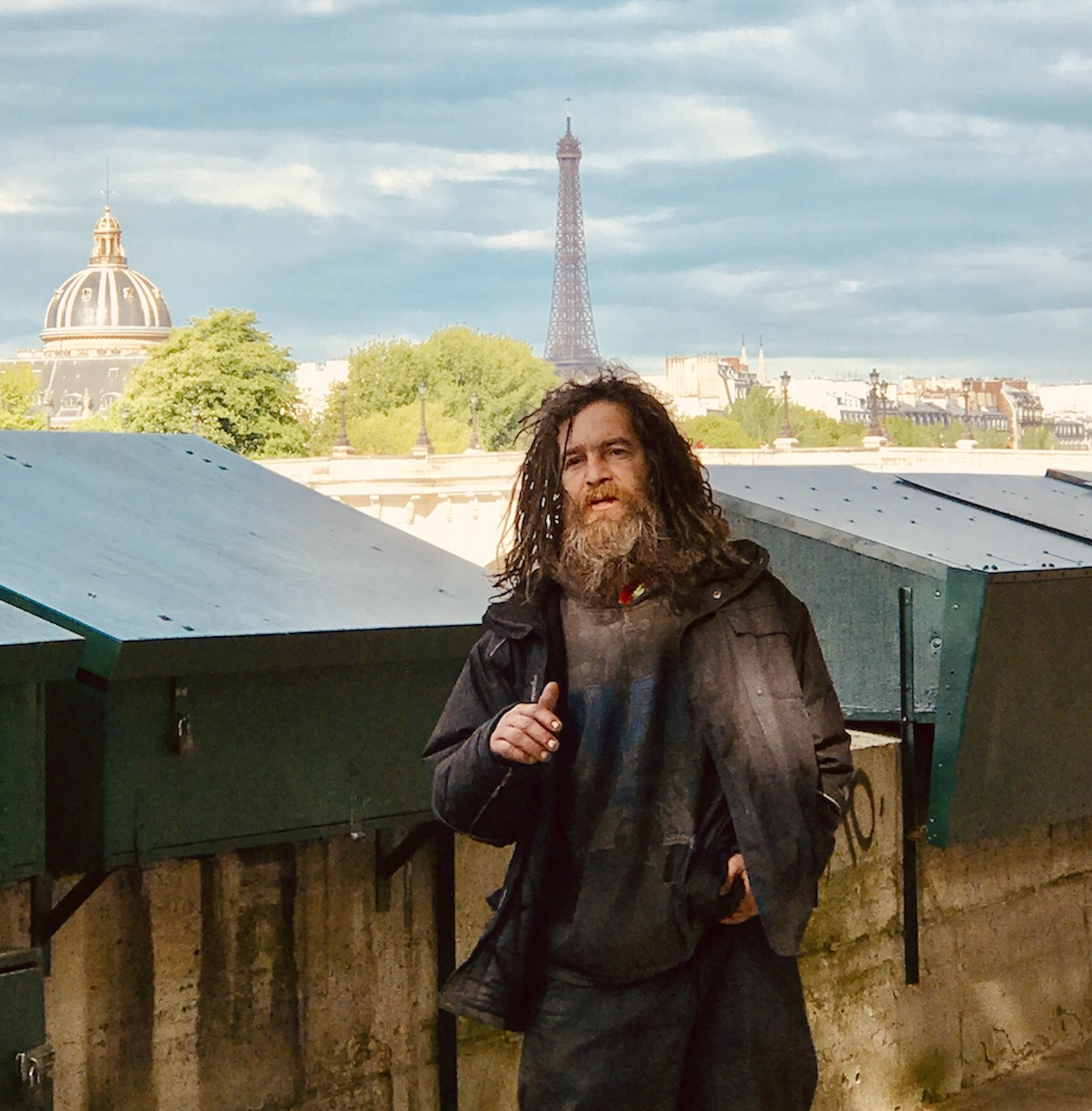
Citario. Derived from the Latin “citāre” (to quote) plus the suffix “-ārium” (repository), similar to “bestiary.” A 21st-century neologism, it emerged among Spanish-speaking scholars at Bookish & Co., with roots in ancient anthologies and florilegia. “Citario” is related to medieval books of commonplaces (such as Erasmus’s) and 19th-century proto-examples, such as “Familiar Quotations.” This “Citario of Paris 2” celebrates once again the most literary and bookish city, which is itself writing and an image of the times.
Paris, at last, lit the lights of the Boom a little before they shone over Barcelona. A hub for Latin American émigrés and a beacon of cultural trends for the entire world, the phenomenon found in its streets and cafés—but also in its diplomatic legations, university classrooms, and even its magazines—a favorable habitat for growth and expansion. Gabriel García Márquez, Mario Vargas Llosa, Julio Cortázar, Octavio Paz, Carlos Fuentes, Jorge Edwards, Sergio Pitol, Mauricio Wácquez… all lived there. And beyond the Boom, so did Neruda, Julio Ramón Ribeyro, Ernesto Sábato, Augusto Roa Bastos, Mario Benedetti, Augusto Monterroso, Manuel Scorza, Eduardo Galeano, Álvaro Mutis, Severo Sarduy, María Elena Walsh, Alejandra Pizarnik, and Osvaldo Soriano.
Latin American immigration was not the largest, but it came adorned with a cultural sheen of the highest order. In the postwar years and throughout the 1950s and 1960s, the city was the preferred destination for artists and creators. Only from the sixties onward did New York begin to rival it statistically. Paris represented freedom for Spaniards and Latin Americans fleeing dictatorships, who found there a much higher intellectual debate, a more effervescent, open, and just society. “To leap from Barcelona to Paris in those days was to stop seeing life in black and white,” says Juan Goytisolo. In the French capital, books such as Aura, The Time of the Hero, Hopscotch, and No One Writes to the Colonel were written, in whole or in part. Mario Vargas Llosa arrived in Paris in 1960 to work as a broadcaster and journalist—and ended up falling in love with another woman. That same Paris where, a little earlier, Gabo had suffered enormous financial hardship and left a girl pregnant.
—Xavi Ayén, Those Boom Years
◾️
In Paris, the Armagnacs and the Burgundians, each as fierce as the other, gave proof of what bloodthirsty madness can do: murders, massacres without equal. When in May 1418 the Burgundians entered the capital, they found it strewn with Armagnac corpses, “in heaps like pigs wallowing in the mud.” Parisians lived through the nightmare of “times of decline and damnation,” of a “world that is very near its end,” as said the poet Eustache Deschamps, born around 1346. Petrarch, visiting France near the end of the reign of John the Good in 1360, was astonished: “I could scarcely recognize anything I saw. The most opulent kingdom was nothing but a heap of ashes; not a single house was left standing, except those protected by the walls of cities and citadels. What, then, has become of that Paris which was once such a great city?”
Yet Paris survived these disasters, and until the end of the fourteenth century—and even beyond—it continued to be “the center where fashions are devised, where social rituals are invented, where lifestyles are defined, and where the taste of all those in Europe who aspire to live nobly is formed.” It was thus a capital—but a rotten, decaying capital, enlivened by war to which it adapted quite well, somewhat like Antwerp after the arrival of the Duke of Alba in 1567, who turned it into the capital of the wars in the Low Countries…
—Fernand Braudel, The Identity of France
◾️
Newfoundland, Shannon, Paris. The day breaks at Orly. How old the customs officers are, and how shabby their uniforms! They don’t seem proud to be French citizens: there’s something pleading in their faces; they’re underpaid for the puritanical respect they’re supposed to show for regulations; around an opulent suitcase they hold strange little councils, each one improvising as best he can. Along the dreary avenue leading toward Paris, people are poorly dressed, the women’s hair is faded, they walk with a humbled gait. The market vegetables are puny. Not a single taxi at the Invalides stand; on the edge of the sidewalk, travelers grow restless, they start quarreling. It’s a gray day; Paris seems frozen, the streets dull and gloomy, the shop windows ridiculous. There, in the night, a vast continent shines. I’ll have to learn all over again what France is like, and slip back into my own skin.
—Simone de Beauvoir, America Day by Day (1948)
◾️
Four years later, before fleeing and crossing bombed-out Germany, Louis-Ferdinand Céline—who refused to leave without Bébert, his cat—took him to the requisitioned Hôtel de Crillon to undergo the indispensable medical inspection before leaving the country… “Bébert is not a breeder, nor of any ‘pedigree’… and yet I have a passport for him… I took him for his inspection to the Hôtel Crillon… to a German army veterinary colonel… ‘the cat named “Bébert,” property of Dr. Destouches, residing at 4 rue Girardon, does not appear to suffer from any contagious ailment (photo of Bébert)…’ The veterinary colonel made no mention of his breed…”
Marguerite Yourcenar, who had taken refuge in the United States during the war, returned to Paris for the first time in the spring of 1952. Crossing the Place de la Concorde, she stopped “on the way” at the Crillon to drop off a few letters for friends staying there: “Paris is still very beautiful—more so, even, than I remembered,” she then crossed back over the sunlit Concorde.
The years had worn down the hotel, but it had suffered no real damage. When Anaïs Nin stayed there it still hadn’t been renovated, and that produced in her the effect of a kind of enchantment—cast by the spirits who had “inhabited” it before her…
—Nathalie de Saint Phalle, Literary Hotels: A Journey Around the World
◾️
My friend Victoria, who has lived in Paris since the late 1990s, rents a small but very lovely apartment in La Goutte d’Or, a few blocks from Montmartre. It’s an immigrant neighborhood—ninety percent African. There are shops selling magnificent fabrics, busy hair salons, lilting languages in the streets, beautiful proud women with the profiles of queens, Ethiopian restaurants, and music from Mali. Vicky’s building, however, is populated by Latin Americans: there are Chileans, Argentinians, Cubans, and Franco-Bolivians. Also living there, in the ground-floor apartments that open onto the cour—the central courtyard—are a guy from Normandy and a native of Nice in perpetual drift, Guillaume, who on previous visits, when I wasn’t in a committed relationship, was my lover. Handsome, Guillaume—blond and addicted, with greasy hair, a jazz musician. La Goutte d’Or was famous at the beginning of the twentieth century because the child serial killer Jeanne Weber lived there. Discovered in 1908, she committed suicide a year later, already confined to a psychiatric institution. My friend doesn’t know about her; at least, I didn’t offer that information.
—Mariana Enríquez, Somebody Is Walking on Your Grave (2025)
◾️
I saw the Eiffel Tower grow. We used to go see it after school, our heart-shaped collars lifted by the satchel’s strap.
Parents would check on the thing’s progress, whistling, as when they measured their children against the wall with a pencil.
The Seine, still relatively calm, savored its last melancholy moments before the pavilions, the pennants, the brass bands.
The tugboats dragged their manes through the river, groaning like an ogress in labor.
The bateaux-mouches, filleted with sunlight, melted like rays of honey.
It was the time when, whether he needed it or not, the Zouave of the Pont de l’Alma washed his feet up to his navel once a year.
The two candelabra of Trocadéro lit only the grass.
The trees along the quais ripened with lanterns.
The shelves of benches and bridges began to fill with meditative trinkets.
(…)
At night, the tower, legs spread above a bonfire too small for her, pissed standing up on Loïe Fuller and the luminous fountains. The restaurant terraces of the Palais des Arts Libéraux, packed to the brim, bristled with gypsies flogging the slow night. A star looked lasciviously at my coffee parfait, which the heat turned into a statuette. A bat signed its correspondence on the front line of battle. A staircase drank milk in the darkness.
—Léon-Paul Fargue, The Pedestrian of Paris
◾️
[Paris], autumn. With Pierre [Louÿs]. We climb to the sixth floor of a house on rue Monsieur-le-Prince, looking for a place where the gathering can be held, where the circle can meet. Up there we find a large room, made even more spacious by the absence of furniture. To the left of the door, the ceiling slopes down obliquely, as in an attic. Below, a trapdoor opens onto a loft that runs beneath the roof of the house. Facing us, a window at chest height reveals—above the rooftops of the School of Medicine, above the Latin Quarter—the expanse of gray houses stretching as far as the eye can see, the Seine and Notre-Dame in the sunset, and, in the distance, Montmartre, barely distinguishable in the rising evening mist.
And the two of us dreamed of the life of a poor student in such a room, with no wealth other than what free labor provides. And at one’s feet, before the desk, Paris. And to shut oneself away there, with the dream of one’s work—and not to leave until the work is done.
That cry of Rastignac’s, commanding the city from the heights of Père-Lachaise: “And now… you and I, face to face!” (1889)
—The Journals of André Gide (1948)
◾️
**Berlin, Paris, Munich, Vienna:** the four champion cities of modernity in 1913. Chicago was flexing its muscles, and above all New York was slowly shedding its skin, though it didn’t truly take up Paris’s mantle until 1948. Even so, by 1913 the Woolworth Building had been completed—the first to surpass the Eiffel Tower in height; Grand Central Station, the largest railway station in the world, had been inaugurated; and the Armory Show had ensured that the avant-garde took root in America. But that year Paris was still unique—neither the Woolworth Building, nor the Armory Show, nor Grand Central caused the slightest stir in the French newspapers. And why should they have? After all, Paris had Rodin, Matisse, Picasso, Stravinsky, Proust, Chagall, and many others, all working on their next great masterpiece. And the city—at the height of its affectation and decadence, embodied in the dance experiments of the Ballets Russes and Sergei Diaghilev—exerted a magical allure over cultivated Europeans everywhere, especially the four exquisitely cultured men in white suits: Hugo von Hofmannsthal, Julius Meier-Graefe, Rainer Maria Rilke, and Count Harry Kessler. Only Proust wished to remember himself in the Paris of 1913; the others wanted to move forward—but, unlike Berlin, if possible with a glass of champagne in hand.
—Florian Illies, 1913: The Year Before the Storm (2012)
◾️
All my childhood took place in that Paris neighborhood stretching from the hill of Montmartre to the grand boulevards, bounded on one side by rue de Clichy and the Chaussée d’Antin, and on the other by rue Rochechouart and the Montmartre district. Sometimes they took me as far as the Tuileries and the Champs-Élysées, and often I would also wander through the corridors and stage of the Théâtre Français. But those grand outings didn’t amuse me much—least of all the trips to the Comédie, where my father took me, and where the masterpieces of contemporary theater were already making me yawn. The only memory I’ve kept is of the fifth act of The Marriage of Figaro, the garden act, when Cherubino hums his little song. The garden seemed enormous to me, and the song made me cry: “He had a stepmother…” It’s true—looking back on those outings, I realize they were never my favorites. The area most familiar to me, where my eyes filled with images I would carry forever, lay between the streets Notre-Dame-de-Lorette and Fontaine, the boulevards of Clichy and Rochechouart, and the streets Rochechouart and Lamartine. That neighborhood still holds, for me, a special color and life of its own.
—Paul Léautaud, Light-hearted Memories
◾️
In Paris they practice a kind of counter terrorism. You approach the window and—wham!—they bite you! They throw you out in chunks before you’ve even had a chance to get close. Compared to them, we Argentines are lambs. The same thing happens with university bureaucracy. They make you feel nostalgic for the old fossils at Filo! The day I arrived, I naively tried to enroll at the Sorbonne. Big mistake! The bureaucrat, in the full bloom of middle age, went into a howling fit simply because a Brazilian friend had had the nerve to accompany me—and in the little cage where she was kept, under no circumstances could more than one person enter at a time.
“But he’s just arrived, he’s having trouble with the language,” pleaded my partner in crime.
And the harpy, implacable: “Then he shouldn’t enroll at the Sorbonne.”
No way to reason with her.
—Néstor Perlongher, “Nine Months in Paris”
◾️
In the eighteenth century, the corrosive activity of bacteria had not yet been checked, and consequently there was no human action—neither creative nor destructive—no manifestation of incipient or decaying life that was not accompanied by some kind of stench. And, naturally, the stench reached its highest concentration in Paris, because Paris was the largest city in France. And within Paris there was one place where the stench became infernal: between the rue aux Fers and the rue de la Ferronnerie—that is, the Cimetière des Innocents.
For eight hundred years the dead from the Hôtel-Dieu hospital and the neighboring parishes had been brought there; for eight hundred years, carts loaded with dozens of corpses had emptied their cargo day after day into long pits, and for eight hundred years bones had been piling up in ossuaries and graves. Until one day, on the eve of the French Revolution, some of those pits, overflowing with corpses, caved in, and the putrid smell of the crammed cemetery drove the inhabitants not only to protest but even to organize full-scale riots, after which it was finally closed and abandoned—its millions of skeletons and skulls heaped together in the catacombs of Montmartre. Once that was done, a food market was erected on the site of the old cemetery.
—Patrick Süskind, Perfume: The Story of a Murderer (1985)
Image: (c) Pablo de Cuba Soria, 2017.


