
Grandine grossa, acqua tinta e neve
per l’aere tenebroso si riversa;
pute la terra che questo riceve.
Inferno. Canto VI, 10-12.
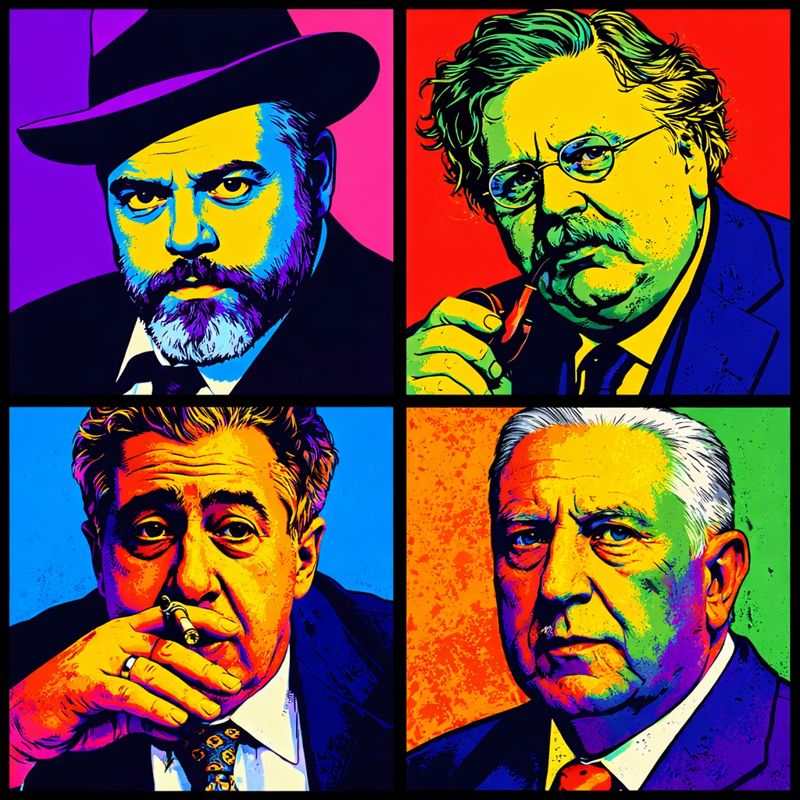
He never lost his hunger for glory. Faced with the impossibility of conquering the world, he decided to eat it. In Orson Welles, genius ended up drowned in thousands of calories. His body became as monumental as his Citizen Kane, expanding year after year to fill the void left by the masterpieces he left unfinished. He dined twice a night, a sacred ritual that defied medicine and logic: two steaks and a pint of Scotch whiskey were barely the standard. His gluttony was public, theatrical, and defended with the same sharp wit as his scripts: “My doctor told me to stop having intimate dinners for four, unless there were three other people.” At Ma Maison, his headquarters in Los Angeles, chef Wolfgang Puck fed him like an insatiable deity, using him as a guinea pig for his new dishes, aware that Welles ate to devour a world that had tragically become too small for him.
♣
G.K. Chesterton described his own body circumference as “a theological barricade.” In a century that was beginning to worship thinness and doubt, he displayed his fatness as a form of aggressive charity and militant joy. A defender of “old and cheerful England,” he elevated beer and cheese to the status of dogma. Heretics were those who rejected them. While his friend Bernard Shaw chewed lettuce with an air of moral superiority, Chesterton emptied jugs of stout, convinced that gratitude for Creation was demonstrated by swallowing it. This tension erupted in a famous encounter when Shaw said to him, “To look at you, one would think that famine was ravaging England.” Stroking his waistcoat, Chesterton replied with the calm of a Catholic Buddha, “And to look at you, one would think that I was the cause.” For the author of The Man Who Was Thursday, the pessimist is a man who looks at his plate and sees death; the Christian looks at the same plate and sees eternal life. Immense and vibrant, his belly was the only refutation that modern nihilism could never digest.
♣
For the engineer Carlo Emilio Gadda, reality was a gnommero—an inextricable tangle of causes and effects—and cooking was its edible representation. He transformed his neurosis and hatred of the Lombard bourgeoisie into baroque prose in which a plate of food is analyzed with paranoid rigor. His description in Le meraviglie d’Italia (1939) of risotto alla milanese embodies an architectural delirium: he demands that the rice (“Oryza sativa”) retain its granite-like individuality amid the “agglutination” of the broth, and treats saffron as an alchemical powder capable of transmuting inert matter into digestive gold. Gadda sublimated his rage in syntax, accumulating adjectives and technical terms about the dish in an attempt to control the chaos of the world, knowing that digestion—like life—becomes a dark process, inexorably condemned to entropy.
♣
By the age of fifty, he could barely move from his armchair on Trocadero Street, anchored by wheezing asthma and mythological obesity. For José Lezama Lima, breathing was the metronome that indicated where to place commas; and swallowing, a poetics. In his system, the pantry and the library were communicating vessels. He read with his palate and chewed with syntax. Paradiso stands as a verbal menu where Creole cuisine reaches theological status: a stuffed turkey or a coconut and pineapple ice cream that “little old Marie Brizard [sprinkles] with her anisette” are described with the same baroque detail as the sacred architecture of a cathedral. He ate with the same cumulative anxiety with which he adjectivized, suffering from a horror vacui that compelled him to fill both the page and his stomach. His physio-verbal gluttony knew no bounds. Aware of this excess, he traced his own gastric lineage with a lapidary sentence: “Hugo, the sharks, and me.” When asked why he never traveled, he replied that he didn’t need to go anywhere, because his body was already a continent to explore. In his later years, he was beset by revolutionary hardship and rationing, forced to maintain his historical immensity in the face of an empty plate: he continued to fatten himself on metaphors while the royal pantry evaporated “in the tokonoma.”


