
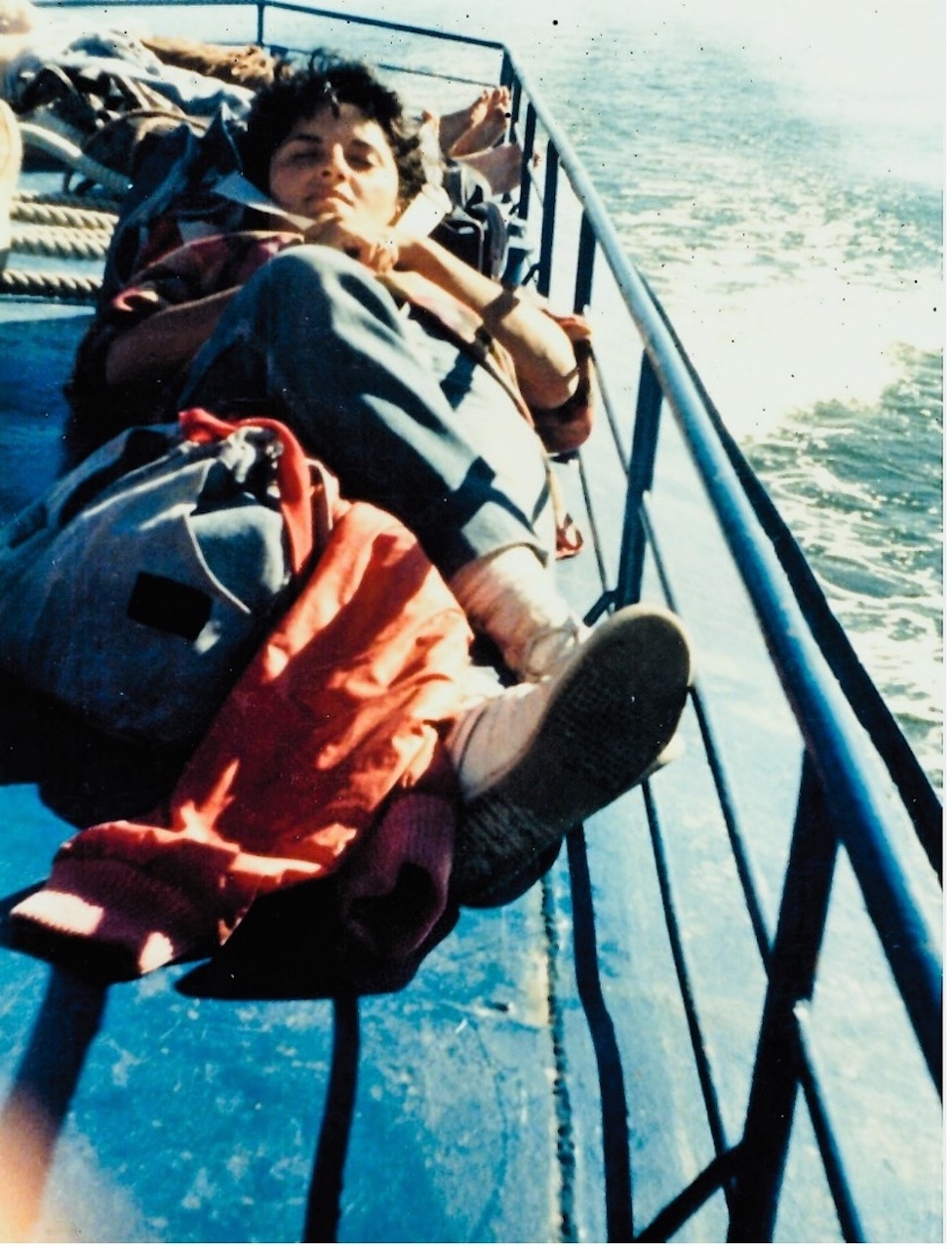
When I think back to the “television era,” I can’t imagine a time when I was alone in front of the screen, at least not during my childhood.
In a strange way, we all managed to get together. Shortly after lunch, my grandmother would announce: l’abbiocco[1].
I knew what that meant.
She and nonno would soon fall asleep, each in their respective armchairs.
My grandmother, who was in charge of the remote control, and this was no small task as it was an exercise in “government,” would wake up a moment earlier, as her responsibility demanded, just long enough to check that her husband was fast asleep and then turn to me and say, “eh, il dolce far niente.”
Today, as the institution of “television” is dying and giving way to streaming services, the idea of the “idiot box” is a valid reference for the purchase of second-hand appliances in an antique store.
If television ever had any value, it was not because of what the channels could broadcast, but because of the different dynamics that viewers, overwhelmed by what appeared on the screen, were able to establish among themselves.
If the “telly” ever brought the family together, it was to escape its shortcomings. Everyone settled into that family space not to watch a program, but to sit in front of the “telly” as if it were background noise.
During that time, the essential thing was in the “meantime,” because, just as the temptation to give in to l’abbiocco purred, someone read the newspaper, another remembered some pending gossip, and, while making it public, games were improvised. Suddenly, the phone would ring, and uncertainty would set in until we knew who had called. That present moment was the only possible state of being. It was dolce far niente, an event that burst in on our capacity for inventiveness, and this in itself was highly unlikely to happen if we think of the laziness of the fiacún[2] or the chronic listlessness of a fannullone[3].
The fiacún and the fanullone are bored (from the Latin abhorrere, “to abhor”). The urgent thing is to have fun (from divertire, “to turn away, move away, deviate from something painful or heavy”), otherwise they will experience malestar.
Not so in the dolce far niente.
If I were to define the non-action characteristic of l’abbiocco as the daily practice of a ritual of the domo, we would no longer be talking about the dolce far, but rather the nostalgic evocation of the probable benefits of the siesta.
There were afternoons, after giving up the “television” we never watched, when my grandmother preferred to stay on the balcony with the Siamese cat.
Her idea, despite the spyglass she sometimes carried with her, was not to spy on the habits of the Piazzas, our neighbors, or perhaps to make sure that no UGEL official parked his car in front of the house.
That was it: to be there with Shantih, the cat, doing “nothing” or, once on the balcony, to know for sure how many cuculíes had swirled around the huge amounts of rice she had provided for them that afternoon. That way, nonno could also stay in his armchair as if he were immersed in a strange trance. He just smoked, impassive, and then looked at the smoke he had just exhaled as if searching for a hidden meaning among the fleeting shapes that the smoke was drawing in the air.
“What are you thinking about?” he would sometimes ask me.
He usually chose to share his latest dream with me, taking a keen interest in the interpretation we could both find for it. On other occasions, my grandmother would approach me with the expression of someone who has a mystery up her sleeve.
Then she would ask:
“Non vuoi fare una passeggiata?”
I would nod enthusiastically.
“E dove andiamo?”
I could barely bring myself to admit in a disappointed tone: “Non lo so.” She would laugh. “Nemmeno io, ma andiamo.” Then we would walk. That’s how I discovered Rospigliosi Castle, the Whale, the Azul cinema, the Moorish Arch at the beginning of Arequipa Avenue, the houses that had been designed by Enrico, my great-uncle, the one where Doña Fulana (a famous actress from period soap operas) lived, and further on, the one belonging to Fernando De Szyszlo. Even when we got lost during the passeggiata, we always came across a place that should have been discovered long ago.
The passeggiata never had a destination, but it did have a destination. It was about experiencing the “drift” and from there introducing something new into the world.
What was at stake was the idea of walking without a fixed direction, strolling, getting lost, and rediscovering the utopia of a path.
Because of this, even today, when we travel with Ludy, we are quite reluctant whenever someone suggests the possibility of sightseeing. We prefer a thousand times over to wander, like an essay whose fundamental purpose is to be that essay, which “seems to happen suddenly and interrupts the normal course of things; something that apparently arises out of nowhere…”[4]
I know it can be difficult to understand from the “outside,” and I am thinking of everything that could have been said about dolce far niente in the film industry, except when it comes to Michelangelo Antonioni.
That’s how I remembered it, and not without a certain annoyance, that Hollywood version of Elizabeth Gilbert’s bestseller Eat, Pray, Love, directed by Ryan Murphy, where the most significant thing is Julia Roberts’ performance in the role of Gilbert, who, throughout the film, after several romantic failures, flees from her own malaise until she finds inner peace on a gastronomic tour while devouring a succulent plate of spaghetti all’Amatriciana.
The dolce far niente does not respond to the imperative condition of “doing nothing” of the Dutch niksen, nor to the pressing momentism of Carpe diem (Horace, Odes, I, 11), but rather of becoming “being the present” as best one can, for a period of time that serves a function very similar to that of a metronome, pausing the beat of time until harmony is achieved.
In the 18th century, Carlo Goldoni spoke of the “dolce mestier di non far niente”; in the early 20th century, Alfredo Panzini recorded this concept in his Dizionario moderno as a “caratteristica della razza, conosciutissima all’estero” (a characteristic of the race, well known abroad), and later, Carlo Rosselli would attack this experience, considering it an offensive legend that undermines the “moral order.”
So much so that, according to Rosselli: “Italians are morally lazy. There is an underlying skepticism and opportunism that easily leads them to contaminate and despise all values and turn all tragedies into comedy.”
According to its nature, dolce far niente could not respond to a moral order. It originates from nothing, without the mediation of history, and is beyond any possibility of meaning. Perhaps it arises, supported by this void, and from there breaks with the ethics of custom, as well as with habitual leisure and everything that is outside of self-realization.
A similar concept could be that of Wey-Wu-Wey (Doing-by-not-doing), an idea which, according to the translation by the nonno of the Tao te King, manifests itself as a return “to spontaneous action, like that of a child who plays just for the sake of playing, like the wind that moves the trees, like the stream that runs”[6]. “The event illuminates its own past and can never be deduced from it” (Arendt, 1995: 41).
I am thinking not of Walden’s Utopia, but of Henry David Thoreau’s daily life during the two years, two months, and two days he lived in that forest in a cabin he built with his own hands on the shores of a pond in Walden Pond (near Massachusetts), feeding exclusively on what he grew, a mile away from any neighbor.
Thoreau, not only in Walden, had a habit of dividing his day into two main parts: “four hours in the morning for reading and writing, and four hours in the afternoon for long walks”[8]. During this time, Thoreau was a watchman for snowstorms and an interpreter of the wind: “Many were the days in autumn, and even in winter, that I spent outside the city, trying to interpret the murmur of the wind” (1959, p. 22), and a guardian of the forest: “I have watered the red guava, the pumis pumila, the hackberry, the red pine, the black ash, the white vine, the yellow violet; had I not done so, they would have withered in the dry seasons” (1959, p. 23[10]) and also as a self-cosmologist or self-explorer.
It is not that Thoreau, who was against both sedentary lifestyles (which turned men into slaves to their own homes) and nomadic life (whose purpose was reduced to saving enough money for a peaceful retirement), did nothing or concentrated his efforts on writing a book. He did things, he kept doing things, as he reconstructed a primordial time.
The real tragedy, according to a utopian “moral order,” returning to Carlo Rosselli’s idea, is the new dimension that time seems to have acquired, whose value seems to be determined according to deadlines, set according to the achievement of certain objectives, when the real problem, given that time is nothing more than a vast succession of nows, is what do we do “in the meantime”?
[1] It can be described as a sudden drowsiness that occurs especially after a heavy meal.
[2] noun/adjective. Ar. A lazy, indolent person. pop.
[3] noun/adjective. Ar. Lazy, slacker, loafer.
[4] S. Žižek, Event (Madrid: Sexto Piso, 2014), 16.
[5] Rosselli, C. “Il socialismo italiano e la lotta per la libertà,” in De Felice, R., Il Fascismo. Le interpretazioni dei contemporanei e degli storici, Laterza, 1998, p.129.
[6] Lao Tzu, Tao Te Ching. Translated by Onorio Ferrero. Ignacio Prado Pastor First edition, Lima, February 1972.
[7] Arendt, Hannah (1995), Understanding and Politics, Hannah Arendt, From History to Action, Barcelona: Paidós, pp. 29-46.
[8] Antonio Fernández Vicent. ‘Walden’, by Henry David Thoreau, or the art of living. Semana. Tuesday, June 13, 2023. At: https://www.semana.com/cultura/articulo/walden-de-henry-david-thoreau-o-el-arte-de-vivir/202217/
[9] Thoreau, H. (1959). Walden, or Life in the Woods (trans. C. Aguayo). Mexico: Editorial Novaro.
[10] Ibid.


