I ask Lucas Margarit, an expert on the subject, “Isn’t Alejandra Pizarnik’s play Los perturbados entre lilas another example of Beckett’s influence on a Latin American author?”
I have sometimes thought that Los perturbados occupies a hypertextual space with respect to one of the essential plays of the theater of the absurd, Fin de partie, and an intratextual space with respect to “Los poseídos entre lilas” (The Possessed Among Lilacs), the last of the four parts that make up Pizarnik’s poetry collection, El Infierno musical (Musical Hell). In this way, and starting from that piece as hypertext, the Argentine author produces two of her most notable writings.
Possibly not diametrically true. Nor false.
So.
Here: Attempt an experimental exercise (or double staging) first representing a fragment of Fin de partie (1); and then the last section of the dramatic poem El infierno musical, “Los poseídos entre lilas,” by A. Pizarnik.
Excerpt 1 (S.B)
“HAMM (with passion): Let’s both go south! By the sea! You will build a raft. The currents will carry us far away, to other… mammals!
CLOV: Don’t talk about misfortunes.
HAMM: I’ll set sail alone! Alone! Build me a raft immediately. Tomorrow I’ll be far away. CLOV (rushing towards the door): I’ll start right away.
HAMM: Wait! (Clov stops.) Do you think there will be sharks?
CLOV: Sharks? I don’t know. If there are, there are. He goes to the door.
HAMM: Wait! (Clov stops.) Isn’t it time for your painkillers?
CLOV (violently): No! He goes to the door.
HAMM: Wait! (Clov stops.) How is your eyesight?
CLOV: Bad.
HAMM: But you can see.
CLOV: Well enough. HAMM: How are your legs?
CLOV: Bad.
HAMM: But you walk.
CLOV: I come and go.
HAMM: In my house. (Pause. Prophetic and voluptuous.) One day you’ll be blind. Like me. You’ll be sitting somewhere, a small fullness lost in the void, forever, in the dark.
Like me. (Pause.) One day you’ll say to yourself, I’m tired, I’m going to sit down, and you’ll sit down. Then you’ll say to yourself, I’m hungry, I’m going to get up and make myself something to eat. But you won’t get up. You’ll say to yourself, I shouldn’t have sat down, but since I’ve sat down I’ll stay seated a little longer, then I’ll get up and make myself something to eat. But you won’t get up or make yourself something to eat. (Pause.) You’ll stare at the wall for a moment, then you’ll say to yourself, “I’m going to close my eyes, maybe I’ll sleep a little, then everything will be better,” and you’ll close them. And when you open them, there will be no more wall. (Pause.) The infinity of emptiness will surround you, the dead of all time, resurrected, will not fill it, and you will be there like a little stone in the middle of the steppe. (Pause.) Yes, one day you will know what that is, you will be like me, except that you will have no one, because you will have taken pity on no one and because there will be no one left to take pity on.
Excerpt 2 (A.P.)
“The flower of distance has opened. I want you to look out the window and tell me what
you see, unfinished gestures, illusory objects, failed forms… As if you
had been preparing for this since childhood, come closer to the window.
—A café full of empty chairs, lit up to the point of exasperation, the night in the form
of absence, the sky like deteriorated matter, drops of water on a
window, someone passes by whom I have never seen, whom I will never see…
“What did I do with the gift of sight?
”A lamp that is too bright, an open door, someone smoking in the shadows,
the trunk and foliage of a tree, a dog crawling, a couple in love
walking slowly in the rain, a newspaper in a ditch, a child whistling…
“I continued. (In a vengeful tone). A dwarf tightrope walker throws a
bag of bones over her shoulder and walks along the wire with her eyes closed.
”No! She is naked, but she wears a hat, she has hair everywhere, and she is gray
in color, so with her red hair she looks like the chimney in the
theatrical set of a theater for madmen. A toothless gnome chases her, chewing on
sequins…
—Enough, please.
— (In a weary tone). A woman screams, a child cries. Silhouettes spy from their
burrows. A passerby has passed by. A door has closed.” (2)
The final question floats above the blank space. Isn’t there something “there” (not just in language) that unites them? A question of agogics?
(No answer. End).
Notes
(1) Endgame in its English version. // Complete work: Samuel Beckett, Endgame (Fin de partie), 1957. Online document. Libros Tauro. Microsoft Word – Beckett, Samuel – Endgame.
(2) Complete book: Alejandra Pizarnik, El infierno musical, 1971. Online document. https://docs.google.com/…/0B2pra8lhhoOKU0xPa2Rk…/edit…
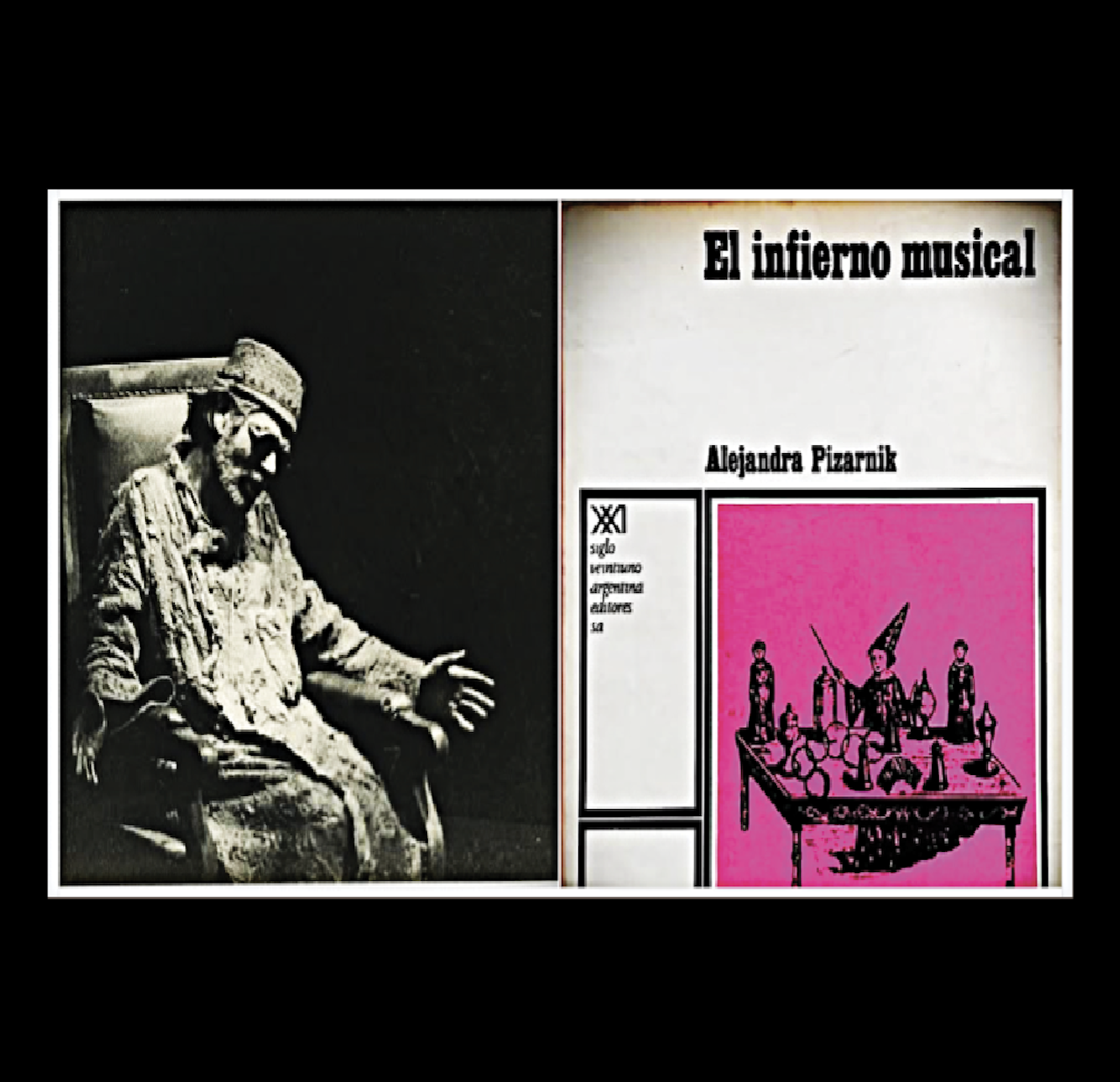
Image: Collage. Left: A scene from the play Endgame (Fin de partie), 1957, translated from French by Beckett himself. Right: Cover of El infierno musical by Alejandra Pizarnik, 1971.