
Surrealism or structuralism avant la lettre? On the two vertical uprights, a crossbar called a chapeau holds the blade. It’s a clear mockery: just before losing their heads, the condemned wore this hat; when they lost their heads, they still had it. Chapeau! This dolmen has little to do with Stonehenge; even before beginning its work, and from the scaffolding itself, it caricatures the fashions that parody it out of hatred for the blade.
The heavy blade with a hat became popular. So much so that the fanaticism of the scaffold was matched by a poetry of terror. Between violence and social or aesthetic forms, verses that were accomplices in this case, Siamese links emerged. As unusual as it is pathetic and frivolous, a cut connects the guillotines that decapitated hundreds of men and women with the scissors of barbers and hairdressers in France, especially those in Paris, the perennial cradle of fashion. Young dandies, as Chateaubriand recounts in his Memoirs from Beyond the Grave, where he calls them, like Napoleon, petimetres and dandies, combed their hair in the style of the severed heads.
The revolution was a dramatic political fashion that imposed social fashions on its supporters and opponents. The cries for blood; the insults to give the condemned a gruesome welcome to the city and accompany them with rapid insults to the scaffold; the celebration of death and the heads displayed on the tips of spears characterized the liturgy of terror, especially for the femmes cannibales, women inflamed by violence. The horrified counterpart also took pains to express its rejection of terror by flaunting fashions inspired by terror. Some women imitated those guillotined, debuting a shorter hairstyle, aptly named coiffure à la victime. This was despite the hairy irony: Sanson did not even have a Delilah to shear him.
Although hatred and parody do not share the same DNA, another curious relationship between violence and form suggests a similarity. There is a chic outfit derived from the guillotine. In aristocratic Parisian circles, the so-called incroyables or merveilleuses, to distance themselves from the fanatics of death, dressed like victims who had been imprisoned or executed. Not only did they wear the underwear that relatives or friends were forced to wear behind bars, they also stopped wearing heels and even walked barefoot, like some of the condemned women who went to the scaffold that way.
Art became involved in violence, multiplying it through the newly opened Madame Tussaud’s wax museum, which served as a news program and spectacle for the fashion world, displaying effigies of the successive heroes of the revolution, but removing them as soon as the supposed leaders fell from grace. During those days of liquidations, as in today’s consumerist sales—sales with suction cups—peeling was the fashion: hypothetical, provisional, and devoid of marble, the heroes whose heads were delivered like telegrams to the museum of the immediate became—at the beginning, the double meaning of the word applies—realistic images of Sanson’s bloody craft.
Fashion intrudes on practice and theory. Even medicine, in its own terms, suffers from it; literary theory too. I have always felt, as a long-term consequence of the fashion for hackwork, the disappearance of biographism in criticism, which reduced works to the author’s ego. What was written and read was unraveled in the circumstances of lived experience. Ortega’s “I am myself and my circumstances” was applied in advance, fixing observations on the cultured and even the hidden aspects of the author revealed in the word, giving a supposed and mechanical causality to the novel and the poem, which, examined with the magnifying glass of facts or the desires of lives no longer so foreign, turned out to be specifically Gustave Flaubert or Walt Whitman. Biographical criticism gave way to autism. The author became text and the text became textuality. Standardized abstraction represented a decapitation of the author. A disavowal of the author.
The novel and the poem are not mirrors. Readers should not take advantage of reading to appear as images in someone else’s mirror. Nor is writing the mere happening of the author, the image that, however fleeting, and even if projected in a blurred mirror like that of Las Meninas, must be captured, revealed, so that the encounter between the reader and the author becomes real.
♣♣♣
Despite being as ignorant as I am distracted, and perhaps for that very reason, for centuries I have linked the disavowal of the author to the terror of 1893. There is a reason why both blots are so French. I reject biographism. However, I maintain that de-subjectivisation should not be imposed. The experience of the writer and the reader cannot be ignored; vital, complex, social however personal they may be, and personal however social they may be, and although elusive and even paradoxical, they remain decisive.
In the light reflected by four symmetrically placed mirrors, I saw my absence and knew that I was not Narcissus. Robert Morris’s catoptric exercise at the Sonnabend Gallery in New York had erased my image and my gaze. I tried to describe the disconcerting experience in “Robert Morris: espejismo, especulación (un pequeño monumento a la mirada)”, an essay collected in Superficies.
I am my absence. I am absent in being. I am absent in order to be.
In everything I do, as a writer and reader, there is subjectivity, there is me, there is Octavio, and therefore there is absence.
More than a decade ago, in an interview with Johan Gotera, I summarized this point of view as a vanishing point:
In France, literary theory has served as a substitute for the guillotine to behead authors. To bring the study of letters closer to that of numbers, to found a science, it was necessary to melt subjectivity, to deny its unfathomable chaos, its quicksilver. A J’accuse without Zola against the self, as if the loneliness of the first person were not enough. This degenerated into obvious contradictions. Just as power in the hands of Marxist-Leninists of all stripes, from Castro to Mao, has dusted off the dynastic regime, turning loyal Raules and ultra-loyal Kims into Versailles-style Louis, from Tel Quel and such academic circles, authoritarian theorists have beheaded in order to lead, reigning ever more freely thanks to the straitjackets they invent for others, and replacing the former authors with their pontifical authority. Theory is the true fiction of our time. An argotic cathedral, a novel with little subjectivity but told from the inside, radiographically, with a plot of terminologies that parade like on the catwalks of Chanel and Saint Laurent, meteorizing the works. Pulverizing them. The volumes are atoms. I am not among those who believe that the work is superfluous. On the contrary, meteorically and not at all theoretically, I feel that it is urgent to meteorize theory.
No less impressive, although with a more diffuse and prolonged effect, if we trace the causality of the violence that dynamizes forms back to the revolution of gala as a prelude to our times, the link, not difficult to imagine, between Fontana’s torn canvases and the widespread fashion for cut, holey, ripped, and worn blue jeans, which, incredible as it may seem, cost more, much more, than those that have not suffered this highly elegant outrage.
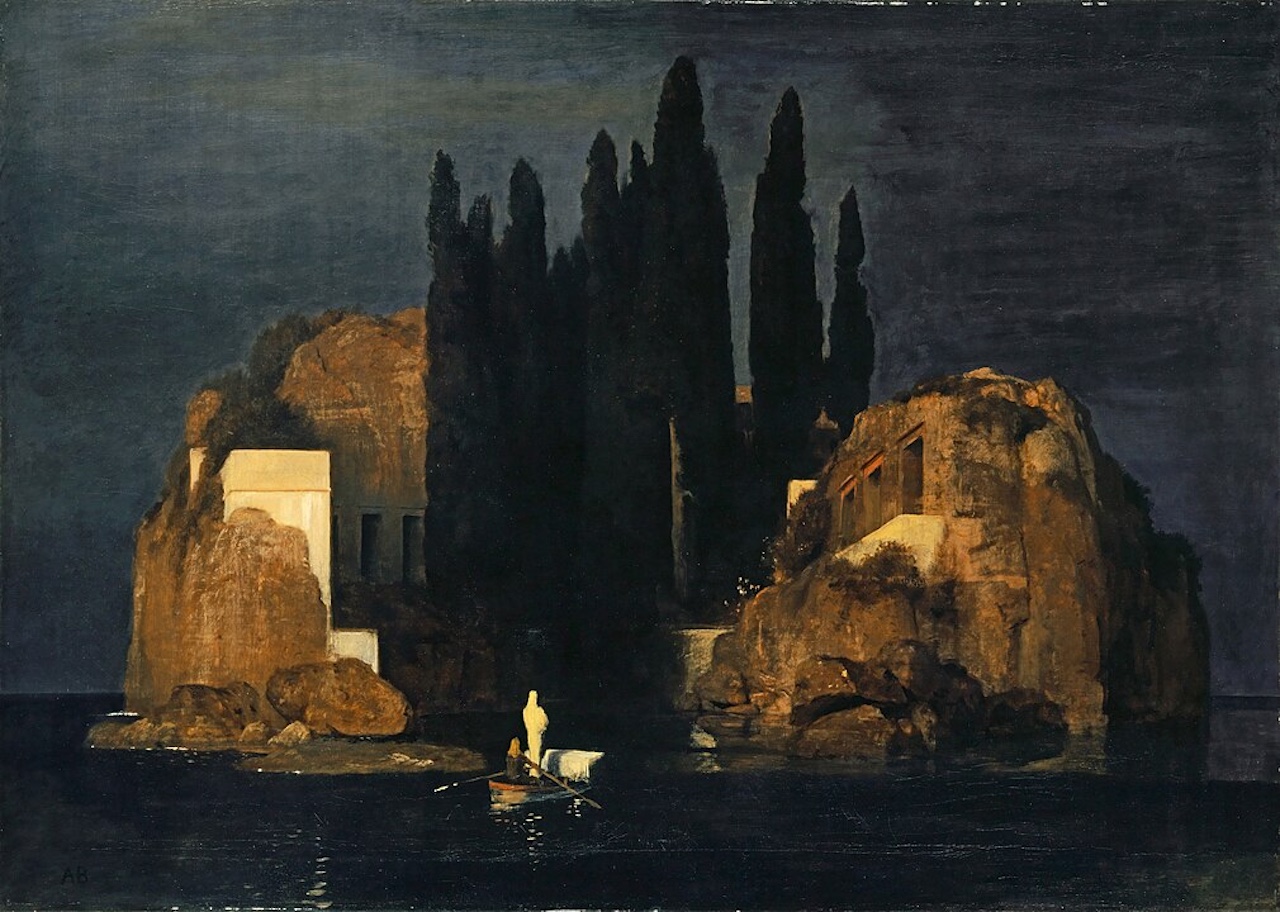
Image: Isle of the Dead (1880), by Arnold Böcklin. Basel Art Museum.


