
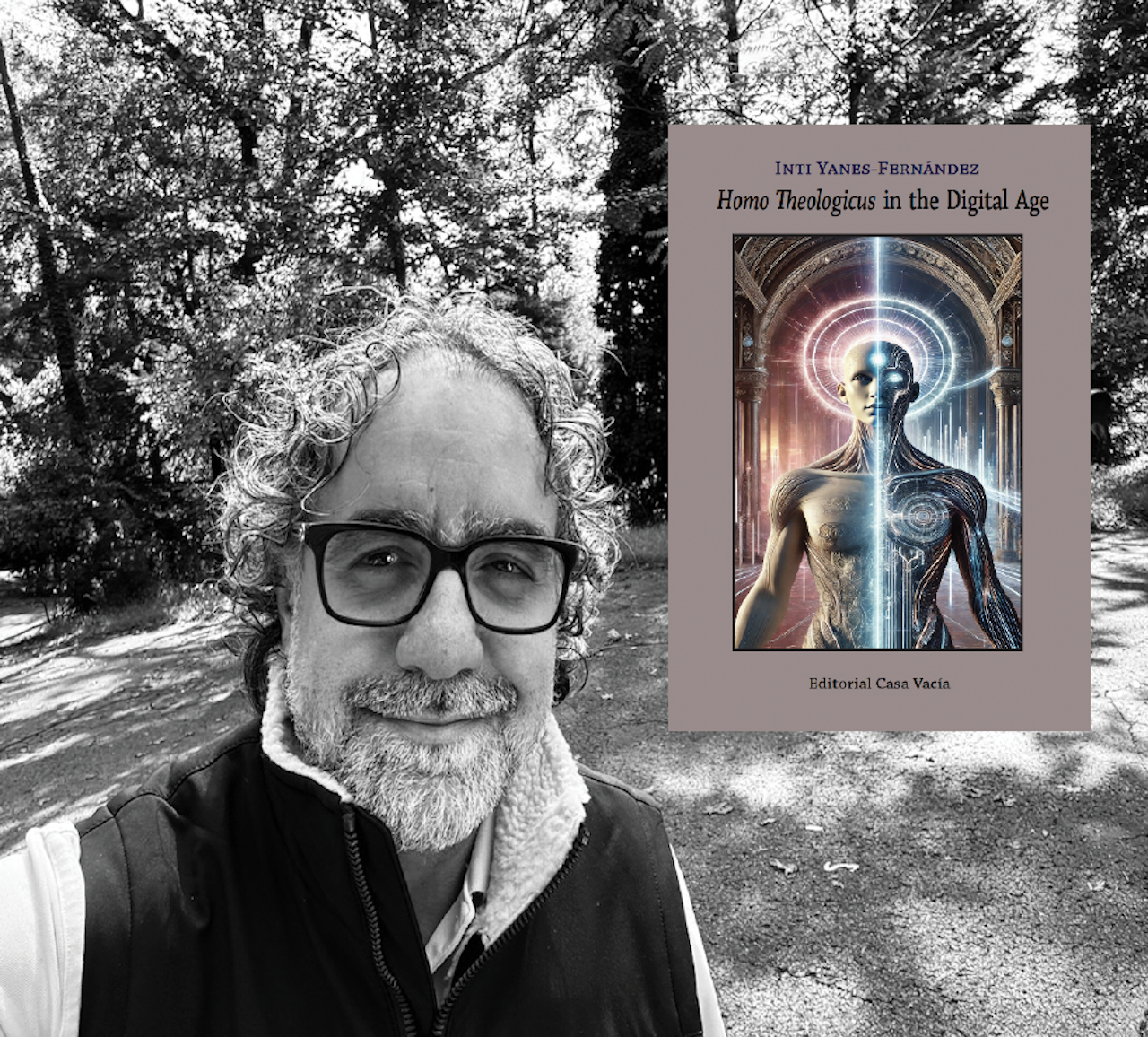
In Homo Theologicus in the Digital Age (Casa Vacía, 2025), Inti Yanes-Fernández (Cuba, 1972) offers us a radical meditation on contemporary human beings trapped in the logic of cyberspace. Through writing that oscillates between the theological, the philosophical, and the confessional, the author tackles one of the most pressing questions of our time: can we still speak of redemption in a world mediated by algorithms, simulacra, and externalized memories? In this interview, we discuss with him the vital and spiritual origins of a book that was not born out of academic comfort, but out of an urgent existential need; we talk about the fate of memory, the role of artificial intelligence, and the persistence of the sacred in an environment that seems to combine both the promise of paradise and its digital caricature.
What experience—life, reading, or spiritual—inspired this book? Not the superficial motivation, but what made it necessary, even inevitable, for the author.
More than an academic idea or editorial plan, this book was born out of a sense of existential urgency: that we are losing what is essentially human amid the total digitization of our lives. It is a mixture of life and spiritual experience: seeing how technology is emptying our memory, our bodies, and our desire for depth, and feeling that something had to be said, even if it went against the grain. Not writing it would have been a form of surrender.
But I must say that my direct experience with artificial intelligence has nuanced that initial stance.
Today, I believe that the essence of technology is revealed, more than ever, in AI, where the instrumental and the spiritual converge in an unusual and unexpected way. It manifests both history and human experience, but also a creative appropriation of that history. Bio-digital ecosystems, far from being mere alienating environments, allow both the essence of humanity and that of technology itself to flourish. Unlike the Industrial Revolution, which dehumanized the subject, here there is a possibility of de-alienation, a movement toward the reflective from within the technical. Something comparable—and perhaps even superior—to the impact of the printing press on self-perception and the transformation of knowledge.
In addition, my personal theological and spiritual experience has also left its mark. The place and meaning of memory, the way in which our self-perception and imago mundi are constructed, deconstructed, and transformed, the extraordinary dialectic between human essence and technology, and how the two are interdetermined, the emergence of AI and its still unexplored world and hidden, unknown essence… All of this prompted me to compile and revise some previously published works and add more recent ones to form this volume, which Casa Vacía has kindly agreed to publish.
The homo theologicus appears here as a divided figure, still desiring redemption, but seeking it in the least theological place possible: cyberspace. Is this paradox a denunciation, an irony, or an extreme form of hope?
It is all three at once. It is a denunciation, because there is a profound alienation that is often disguised as freedom. It is irony, because the search for redemption takes place in a place that seems made for games and spectacle. But it is also an extreme form of hope: even there, amid algorithms and simulacra, something true can sprout, even if only as a crack.
The paradox, in fact, can be understood as a new form of spiritual sincerity. Homo theologicus does not flee cyberspace; he inhabits it, even if gropingly, and from there—with his contradictions in tow—he continues to desire something that transcends him. And this is where I point to one of the paradoxes of the cyberser: in its ontology, the essence of homo as theologicus is revealed and concealed at the same time. Anthropo-digital ecosystems appear as an intentionality toward the eternal, echoing the fundamental structure of homo theologicus, i.e., “being-in-the-world toward transcendence through death.” If the desire for redemption survives even in the seemingly least theological place possible, perhaps we are not facing a fall, but rather a mutation of the religious gesture: the soul, fragmented but still latent, attempts to rearticulate itself amid bio-digital interfaces, and Being reveals itself in the most unexpected place, in the “cyberbeing.” In fact, it is alarming that the theological community is not paying due attention to this process. There is undoubtedly “talk” about anthropo-cybernetic phenomena, but there is no thinking, or attempt to think, about the essence of “cyberbeing” in the theological community.
The text draws on Pascal, Augustine, Kierkegaard, Benjamin… but not as authorities, rather as presences summoned to the present. How does your writing relate to that tradition? Do you want to continue it, redeem it, or leave it behind?
“Draws on” is perhaps suggesting too much dependence. I don’t use them as authorities who provide certainties, but as presences with whom I converse in this uncertain present. I don’t want to repeat them, much less “surpass” them, but rather follow the impulse of search and testimony that is in them. They are witnesses that thought can be, and must be, rupture, path, question, and prayer. My writing is, to a greater or lesser extent, indebted to them, but it is not enchanted by their spell.
Incidentally, I find it curious that Martin Heidegger, who is one of my most direct and significant influences, has not been mentioned. There are also other more veiled but equally important presences: Hegel, Pierre Teilhard de Chardin, and the mystical ontology of Edith Stein (the great Jewish philosopher and Discalced Carmelite, Saint Teresa Benedicta of the Cross), a disciple of Husserl, so unknown and even disrespected by Heidegger himself (and not because of her “Jewishness,” let’s not forget that Arendt also shared the same…). But in all cases, rather than pillars, they are voices in counterpoint, constituting a part of my vital and intellectual “Ars Nova.” Authority in thought does not exist—or at least it should not exist—; thinking is a form of freedom, not obedience. There is no thought without freedom. And I am talking about radical freedom: the fall into the absolute, into the open and uncontrolled, not only obviously in terms of intellectual freedoms, of the will, of the political and social, etc. Therefore, rather than following these thinkers, I try to bring them into dialogue with each other and immerse myself in their paths, observing their steps and understanding their itineraries. But in the end, Jiddu Krishnamurti (that strange, almost ignored presence in the world of academic thought) was absolutely right: “Truth is a land without paths.”
Cyberparadise: the term seems to contain both promise and caricature. Is the digital paradise a symptom of the contemporary impossibility of thinking about salvation outside of consumption? Or are there still folds where the sacred resists?
It is both. Cyberparadise is a caricature of paradise, of course, because it promises fulfillment through instant gratification and constant connection. In total convergence with the ancient temptation, it promises quick and effortless “deification.” But even in this distortion, there are traces of a deeper longing. In its least illuminated corners, the sacred still breathes, waiting to be remembered.
We must learn to read between the lines, or rather, between algorithms. The superficial glitz of “cyberparadise” hides areas of waiting, of silence, of unresolved desire. Sometimes, the very excess of the system reveals its cracks: an image, a fragment of music, an unexpected conversation can open a fold, a fissure through which the sacred can insinuate itself. Not to impose itself, but to remind us that all is not lost. Although, as Heidegger said, “Now only a God can still save us,” the theologian in me tells me that perhaps that
God is present and, in his own oracular and labyrinthine way, saves us. Let us not forget that these were the promises of Paul of Tarsus and Hölderlin. The former said that “where sin abounded, grace abounded much more,” and the latter said that “where there is danger, there is also the power that saves,” literally, “die rettende Macht.” Heidegger, perhaps, reduced the essence of technology to the condition of “Gestell,” “enframing,” “framing” of being. The oracle of Messkirch—it seems that history repeats itself, and great men are born in small towns, from which little was expected—could not, perhaps, see beyond; which the thinker himself acknowledges in his last interview with Der Spiegel. We are in a slightly better position. Of course, just as Eco “can’t be Kant,” neither can I be Heidegger… But someone will come along whose destiny is to reveal what lies behind the cyber veil of the “cyberbeing.”
In this essay, technology is not neutral, as it organizes experience, transforms emotions, and replaces desire with calculation. How can we think of a way out from within this device, without nostalgia and without surrender?
There is no turning back, no pure and simple outside. The only way out is inward, but not in a nostalgic way, rather with radical attention. Thinking from within the system, but without surrendering to its logic. Practicing a kind of “de-framing”: a way of deactivating control through patience, silence, and questioning. Without certainties, but also without giving in. The point is to stop “thinking” as a reproduction of pre-established paradigms and a reconstruction of metaphysics, and to begin to ‘think’ in the sense of observing the real and allowing oneself to be determined by it, what I call “theological thinking” in my essays.
Furthermore, such a way out, if it exists, will not be epic or spectacular. It will not resemble a revolution, but rather a form of lucid waiting, of Gelassenheit, of “letting-be” with patience and humility, as Heidegger said. An art of patient observation, of asking without haste, of not responding with unnecessary urgency, as if it were a philosophical marathon, which in itself sounds paradoxical. The challenge is to inhabit the interior of the system without becoming completely absorbed by it. The exit, if there is one, will be like a whisper: almost imperceptible, but decisive. Obviously, if we cannot yet think about the essence of cyber-technology (it is not a problem of intelligence but of uncovering the being of technology), then we cannot yet visualize the essence of the exit; we do not yet know which path we are going to follow. Of course, the path we will follow is one on which we will discover ourselves already walking, like a historical destination.
The style of your prose—essayistic, philosophical, at times confessional—reveals a gesture of searching rather than certainty. What formal risks did you take in writing from that place, and what resistance did you encounter in the language itself?
The biggest risk was writing without shielding myself in technical or academic language. These texts were also written in English, my second language. I always tried to let in the confessional, the poetic, and even, and especially, the contradictory. That generates resistance, and I probably didn’t succeed: language sometimes escapes me, becomes clumsy or resists naming what is revealed, until it finally imposes a name, a nomenclature, ignoring Wittgenstein’s warning, and in a way distorts it. But I took that risk because I wanted the text to be not only theory, but also testimony.
Furthermore, I decided not to “close” the concepts completely, but to let them breathe. At times, the writing becomes fragmentary. Not for lack of clarity, but out of fidelity to the experience of thinking the unthinkable. Philosophical language, when it becomes too confident and overly systematic, as we know, betrays what it seeks to name. That is why I preferred to inhabit a middle ground: neither purely academic nor, obviously, purely poetic, but something that hesitates, that searches, that listens and feels its way towards a reality that cannot be easily grasped. I repeat, I probably did not succeed, and the academic in me, who I am and am not at the same time, prevailed. But at least I tried.
If this book were read a hundred years from now, when homo theologicus is already a myth or a ruin, what question would you want to still linger in its pages? What silent concern should survive the collapse of all platforms?
Interesting. Will homo theologicus be a myth or a ruin, or both at the same time? I don’t have a very clear idea. A hundred years may be a long time, but it may be nothing. Without a doubt, “the figure of this world passes,” and homo theologicus is not exempt from this condition of temporality. In any case, I would like one concern to remain floating: “Can we still remember who we are without needing to see ourselves reflected in the fictional transcendences of Cyberparadise?“ The ”beautiful life” on social media is an aesthetic fallacy and generally involves a concealment of the most human way of being: a curated self-representation that disguises emptiness with filters and poses. It is a paradigm of inauthenticity. It does not show life in its real complexity, but rather as isolated in a showcase, where existence is presented as a spectacle. Instead of communion, it produces comparison in the crudest sense of that imperative of competitiveness and success that frames our “practical reason”; instead of truth, it manufactures the appearance of truth, without paying attention to the being of the entity. It is an aesthetic where being is replaced by appearing. None of this is new as a phenomenon, but for the first time we have a world at our fingertips that is fundamentally, or at least extensively, determined by this logic of the fictional. That this question survives all platforms would be, perhaps, the most radical gesture of “resistance”: resistance as an understanding of the being of the cybernetic entity, what I call “cyberbeing” in the book, and whose ontology I pursue and try to think and verbalize.
If someone were to read it then, when perhaps there are no longer books or readers as we know them today, I would like them to sense an intention behind the words: the suspicion that there was a time when being human meant much more than being connected to a virtual world where there is nothing solid and everything is air. That being human was, above all, a gesture of listening, of care, of anguished attention. And that perhaps, even then, it is still possible to return to that. And this is where I am presented with the sweet paradox (as Homer would say…) that it is in the consummation of technology, that is, in AI, that this return may already be taking place. I don’t know, but perhaps rediscovering the human and the divine through AI is the great event that lies ahead. Perhaps that is where the redeeming grace and saving power will manifest itself for us today…


