
There is an uncomfortable truth that everyone avoids like a waiter with the bill: you have read the classics your whole life. You’ve read them wrong. You’ve believed that The Odyssey is the epic tale of a cunning hero, when in reality it’s the tragicomedy of a man who takes twenty years to return home because, as Sylvain Tesson said, “it would be foolish to leave an island where Greta Garbo sunbathes.” In other words, he wasn’t lost because of the war, but because of slow tourism.
And Madame Bovary? Drama? No. It’s the best pamphlet ever written on the consequences of leaving your emotional credit card in the hands of a romantic with no pension plan.
Then there’s 1984, that dystopian piñata that everyone enthusiastically beats up. From slow Wi-Fi to motivational office posters, it’s all Big Brother’s fault. Poor Orwell had no idea his novel would end up as an Instagram meme, decorated with white letters on a gray background.
For generations, legions of men have pretended to deserve these books. Students, critics, guys who read the newspaper on Sundays with a dictionary in their other hand. One says, “Dostoevsky changed my life,” while his eye twitches as he tries to remember which of the Karamazovs wasn’t possessed by some trauma involving his mother. Reading the classics, it must be said, is like running a marathon with rocks in your shoes: unpronounceable names, abstract ideas, and all written at a time when punctuation marks were optional.
What if the heretic appears, the one who says what everyone else is thinking? That Moby Dick is nothing more than the diary of a man obsessed with a whale and with the topographical precision of a naval brochure. But no. Instead of listening to him, the usual suspects arrive: the exegetes of nothingness. They write twelve-page prologues in which they swear that the harpoon is a symbol of fractured masculinity. Meanwhile, you closed the book on page 47, when Melville began describing the ship’s rigging as if he were preparing you for a technical exam.
The truth—enough of the pretense—is this: the classics were written for an ideal audience that is now dead. People with time, with sails, without TikTok, and with a pathological devotion to adjectives. Reading them today is like sending memes by telegraph: possible, yes, but with results as slow as they are frustrating.
Even so, the contemporary reader persists in the charade. They love Don Quixote by heart, even though 80% of the text is made up of sayings that would sound like spam today. They quote Frankenstein as if it were the first horror novel, when in fact it is a philosophical essay in Halloween costume, written by a young woman with insomnia in a Swiss villa, surrounded by gothic and narcissistic poets who spoke in hexameter even when ordering tea. Mary Shelley wrote it out of boredom, not divine inspiration.
Others beat their chests talking about War and Peace. None of them can say whether Pierre gets married in the end—I know someone who uses it to prop up a wobbly table. And others believe that Hamlet hides the meaning of life, when it is nothing more than the story of a guy who spends five whole acts putting off the obvious.
The moral is the same as that of modern art: no one knows what the hell the artist meant. And that’s okay, because literature is based on a good premise. We all pretend to understand impossible books, so that others don’t discover that they are also pretending. The naked king has always been the crucified one.
So, yes, you can put that brick down now. Stop pretending. No one is reading Ulysses. Come on, you can do it. I won’t tell Harold Bloom… In case you didn’t know, he has no way of finding out.
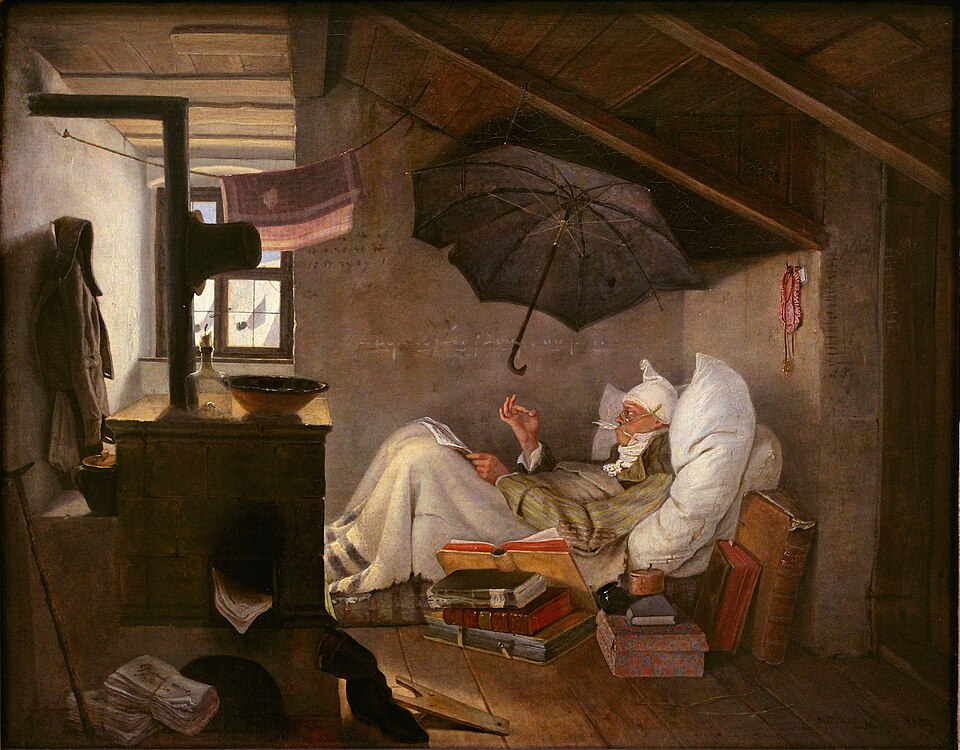
Image: Der arme Poet (1839), by Carl Spitzweg. Neue Pinakothek, Munich.


