
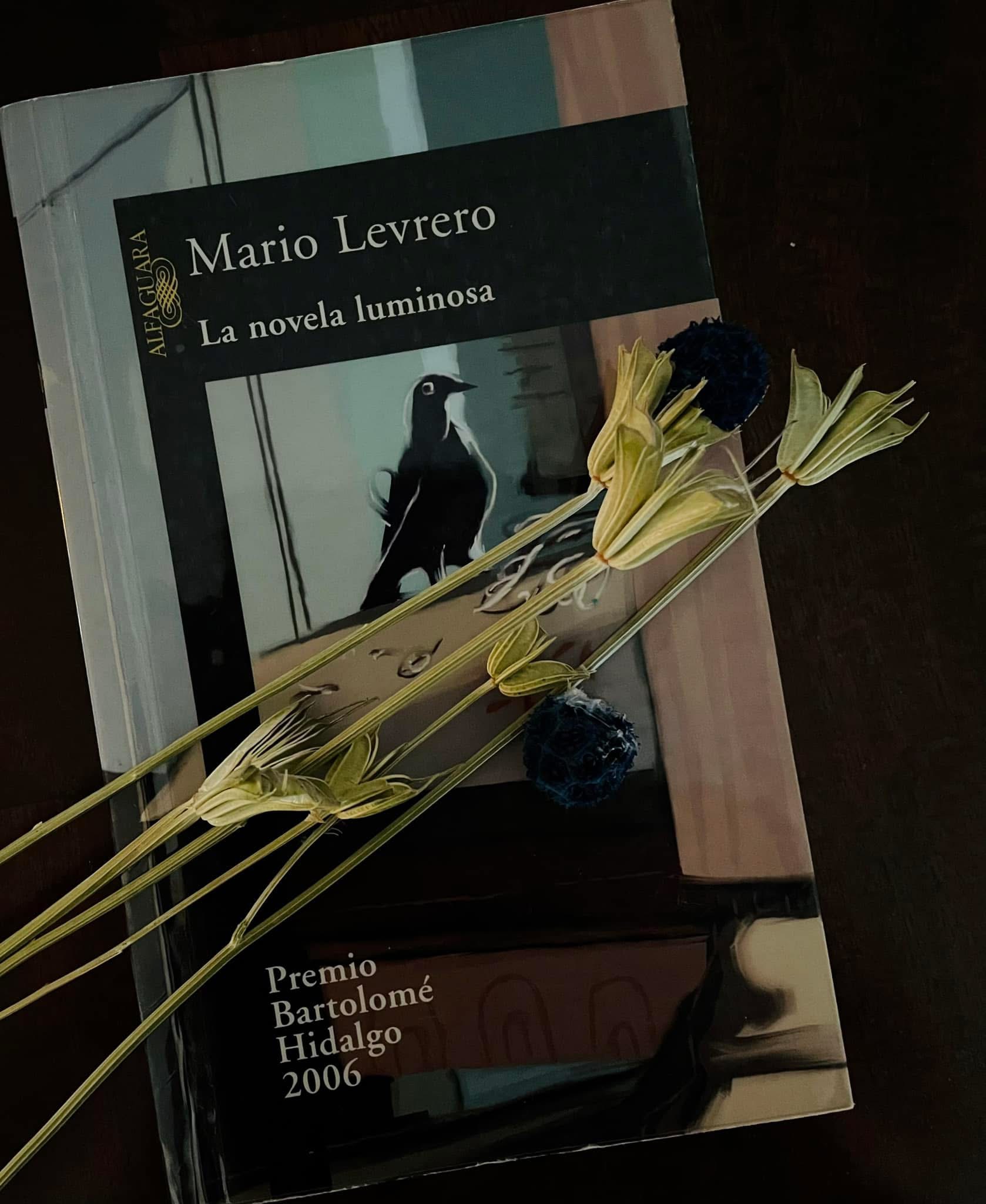
Don’t ask me to define why one becomes hooked on books like La novela luminosa. It’s not something that can be easily explained. Recently, I also saw Short Cuts (Robert Altman, 1993) and discovered that it too could escape certain definitions. It’s a film made up of fragments of stories by Raymond Carver and seems like the ideal complement to this type of book.
La novela luminosa is what you write when you know you have nothing in your head to sit down and write, but you have to do it to justify a grant. Levrero plays with the limits of the novel, but the best thing is that he does so with indifference, as if he couldn’t give any more because of the tradition he belongs to. If you have a Borges, a Lezama, or an Onetti in your national dictionary, you’re going to try harder than you should to not even come close to them. “A novel today is anything you put between a cover and a back cover,” he says.
A writer spends hours in front of a late-90s computer, playing games and downloading soft porn. He gives writing workshops, plays solitaire, Tetris, and Pipe Dream (no idea what that is, do as I do and Google it), looks out the window two hundred times to tell us what is happening to the decomposing body of a dead pigeon, sometimes he goes for a walk, sometimes he takes the bus, sometimes he goes to mass and takes communion, he almost always stops at the neighborhood bookstore to buy a detective novel by authors like Ellery Queen and Edgar Wallace, but he also reads Rosa Chacel, though you didn’t see that coming. He also recounts his dreams. You learn that he hates opera and prefers the classical music played on a local radio station. He eats milanesas, has a girlfriend he calls Chl (Chica lista, or “smart girl”) who is always leaving. He has problems with ventilation and has a hard time installing air conditioning.
The very long first part is a diary, followed by the “luminous novel,” more or less the same as the diary, but now in the form of a linear narrative. The writing is a stream of “reality.” For Alberto Olmos, it’s “Bolaño for smart people,” which means nothing, it’s just reading with a sense of humor. For Alejandro Zambra, it’s very like Kafka’s Diaries, but in Uruguayan.
And despite all of the above, which couldn’t be more trivial, you won’t be able to put it down until you reach the end. Telling the trivial things that happen to us is a way of holding up a mirror to the lives of others. It’s saying to them: don’t kill yourselves yet, give yourselves some time. That’s La novela luminosa, a book put there to make you question your own condition as a reader. You can throw it against the wall, just as some threw themselves again and again into the ocean of the great Latin American novel, while someone wrote a diary about the impossibility of a novel that deserved to be filmed in fragments by Robert Altman. And, incidentally, justified a scholarship.


