
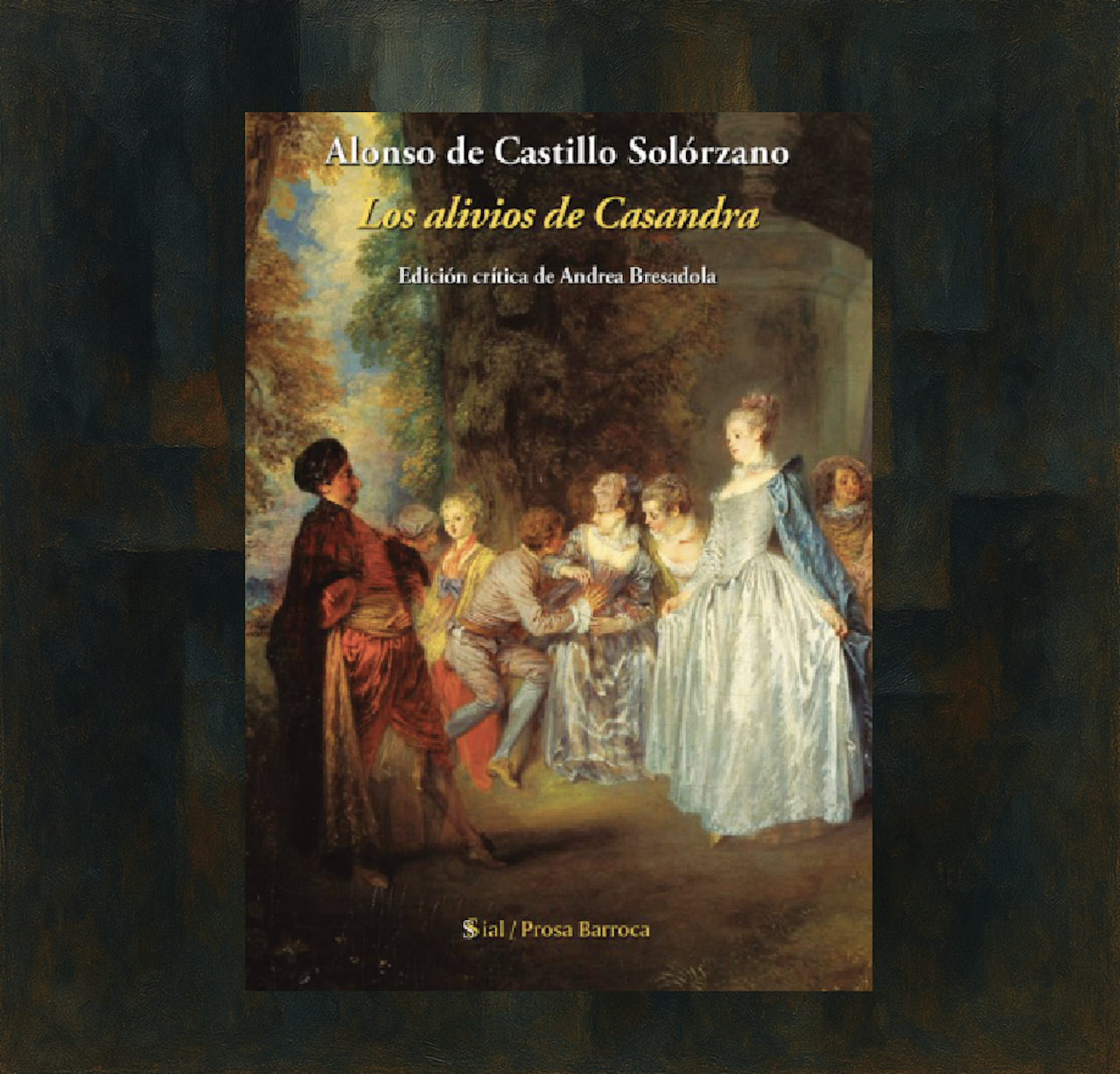
The critical edition of Los alivios de Casandra (The Reliefs of Cassandra) by Alonso de Castillo Solórzano, prepared by Andrea Bresadola (Grupo Editorial Sial Pigmalión, Madrid, 2020), offers a rigorous and contextualized reading of a fundamental work of Spanish Baroque literature. Originally published in 1640 by Jaime Romeu in Barcelona, this work brings together five short novels and a comedy, organized within a Boccaccio-esque framework in which Cassandra, a Milanese aristocrat plunged into deep melancholy, moves to a country house on the banks of the Po with her father, the Marquis Ludovico, and his entourage. In this courtly setting, the ladies narrate their stories at sunset, reserving the last story for the theatrical performance of El mayorazgo figura, thus completing a multifaceted literary experience that includes music, poetry, and dance.
Alonso de Castillo Solórzano (Tordesillas, 1584 – probably Italy, ca. 1648) was a prolific writer of the Golden Age whose biography is fragmentary, although his settlement in Madrid from 1619 and his later period in Zaragoza provide context for his work. His work, highly valued by contemporaries such as Lope de Vega and María de Zayas, combines picaresque elements with narrative virtuosity, evident in this book through stories featuring noble knights and ladies in episodes of romantic intrigue and capricious fortune, such as La confusión de una noche (The Confusion of One Night) and Amor con amor se paga (Love is Paid with Love). The comedy that closes the collection introduces a grotesque and satirical counterpoint through the figure of the servant Marino, a sort of “big shot” who parodies false erudition and provokes laughter.
The story En el delito el remedio (In Crime, the Remedy) is particularly relevant because it is a lipogram written without the vowel “a,” a rhetorical device that Castillo Solórzano cultivates with mastery, becoming a pioneer of this highly difficult and aesthetically complex linguistic game. This uniqueness constitutes the greatest formal display of the work and one of the milestones of the Baroque in terms of literary experimentation, showing the author’s rebelliousness and sharpness in the face of traditional linguistic norms.
From a stylistic point of view, the prose of Los alivios de Casandra is part of the Baroque tradition, with its dense and elaborate language and systematic use of hyperbaton, antithesis, and periphrasis. This virtuosity can be compared to the Elizabethan prose of Ben Jonson (1572–1637), who in his prose work also combined rhetorical precision, irony, and expressive complexity to explore the human and social condition. Castillo Solórzano, like Jonson, uses verbal ornamentation to modulate tones and create multiple levels of interpretation, thus consolidating a complex and effective style. This critical edition, with its thoroughness and rigor, is an indispensable tool for the detailed study of an essential author in Spanish Baroque literature.


