
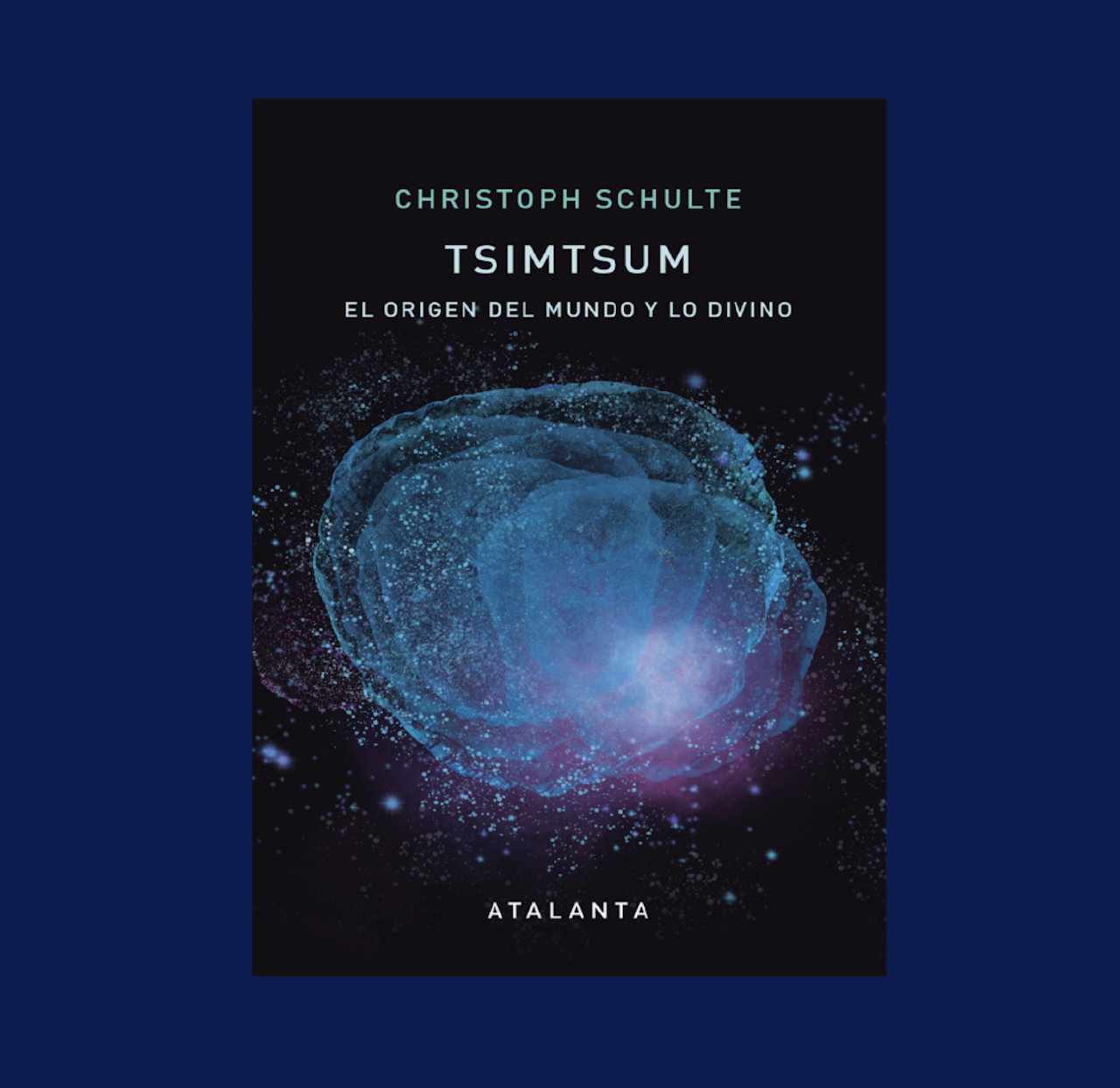
Before the beginning, before time could be spoken of, there was a space completely empty of God. There are many words to describe how that region, a kind of cosmic sphere, came into being: contraction, concentration, limitation, withdrawal. The Kabbalists of the 16th century—the century of Luther, St. Teresa, and Jakob Böhme—preferred the term tsimtsum.
Isaac Luria, a rabbi from the then-prosperous city of Safed in Galilee, taught his disciples that before creating the world, YHWH had to limit himself—and therefore restrain his omnipotence and ubiquity—and open up a space within himself. Enveloped by God, but empty of him, the universe was created in that space. Luria did not write a word about it. He belonged to the Socratic tradition of teaching. It was his disciples who shaped, reinterpreted, and fixed the doctrine.
Following the development of tsimtsum from Luria’s visions to modern art and literature—some four centuries of tradition—has been the life’s work of Christoph Schulte, a German scholar specializing in Jewish culture and especially Kabbalah. Tsimtsum, published by Atalanta (whose catalog on science, spirituality, and esotericism is indispensable for understanding the 21st century), contains decades of research on an idea that is fundamental to Hebrew mysticism.
Why does YHWH withdraw into himself? What are the moral implications of God’s withdrawal, self-emptying, contraction? One cannot help but think of God as a planetary monster, Cthulhu or Tiamat, who opens up a place within himself to found the cosmos. God as an inconceivable magnitude that curves, compresses itself to make way for existence. What is that existence like? Chaim Vital, Luria’s first disciple to write down his doctrine, imagines that from the surface of the sphere opened by the tsimtsum, a thread of light descends from Ein Sof—the Infinite—and from the thread emanate the ten famous sefirot or worlds of Kabbalah.
The engraving of these ten spheres (Malkut, Yesod, Hod, Nezah, Tiferet, Gevurah, Gedullah, Binah, Hokmah, and Keter) is well known in literature. Depicted as a tree, it opens Umberto Eco’s Foucault’s Pendulum and structures Harold Bloom’s Geniuses, is mentioned in books and films, and is the pillar par excellence of Kabbalah.
Vital did not want the doctrine of his teacher Luria to be made public. He was educated in the private dimension of mysticism and spent his life, like Kafka, writing and keeping his books. In 1586, already old, he suffered frequent fainting spells, and a rabbi, Yehoshua ben Nun, paid his brother fifty gold coins to let him copy his writings. After one of the fainting spells, a group of scribes arrived at Vital’s house, took the books out of the drawer, and scribbled down what they could. The tsimtsum began its long journey with that furtum sacrum.
Also part of Luria’s teaching was the emergence of Adam Kadmon, the primordial man—the first golem, as Gershom Scholem would later observe—whose body channels the light of God. That body receives the divine emanation and distributes it to receptacles that are increasingly difficult to imagine. The light is so intolerable to anything that is not YHWH that the receptacles eventually break. Thus evil arises in the world: from an excess of divinity, which causes the arrival of light in the universe to be uneven.
The first cosmos, therefore, is shattered and—according to the Kabbalists—a process of restoration, a return to Ein Sof, will ultimately be necessary. In a way, it is the opposite of tsimtsum, the tikun, the return to light. (In the third century, Origen of Alexandria claimed that at the end of time there would be apocatastasis, that is, the restoration of all beings, including the Devil, to their starting point: God).
But Vital’s tsimtsum is not the only one inherited by Luria. With Israel Sarug, another of his great disciples, Kabbalah leaves Galilee and spreads throughout the world. Sarug imagines God’s contraction with other details, for example, the presence of a divine mantle woven from the combination of the letters of the Hebrew alphabet. For him, tsimtsum is, in a way, a metaphor, a construction of language.
Vital and Sarug offer contrasting visions of God’s void: the real and the metaphorical. This counterpoint proved to be extremely creative and inspired philosophers, theologians, architects, artists, and writers. Schulte’s book details each of these ramifications, including those who have wanted to see in tsimtsum the ancestor of the technical prose with which quantum physics is expressed today. Both Newton and Spinoza reflected on the concept, and certain Christian theology even identified Adam Kadmon with Christ.
Scholem, to whom we owe the rescue and an almost unsurpassable scientific study of Kabbalah, rounded out the doctrine of tsimtsum, and many readers received it from him. Read by Scholem, even Kafka starts from nothing to create his world; he belongs to the tradition of emptiness. Exiled several times, the great scholar of Jewish mysticism also saw in tsimtsum a symbol of the exile of Yhwh himself.
Marginalized by his own people, like Spinoza and dozens of other Jewish heterodox throughout history, Scholem embodies like no other the nefarious relationship between culture and politics. Today, when Jewish culture (crudely identified with a government or even a country) is being canceled, the publication of Tsimtsum is a courageous gesture. Perhaps doomed to failure and misunderstanding, Schulte’s work hits the shelves to remind us that culture is superior to barbarism, no matter which side it comes from.


