To Javier Gomá, who gathers in our Zoom the great philosopher and the best of friends
To structure reality in antagonistic pairs seems to be a constant feature of human experience: being and non-being in philosophy—and its metaphysical variant, being something rather than nothing—, 0 and 1 in computer science, mortality and the hope of eternity in theology, X and Y in the chromosomes of biology. Everything suggests that existence organizes itself through dualities in which negation occupies a foundational place.
And yet, there is a tradition of thought, led by the one whom the Scholastics simply called the Philosopher, that relegates negativity to a secondary position. The Stagirite does not ignore the power of the negative: the principle of non-contradiction is the cornerstone of the Organon, and the negative condition that sustains the first principles of the Metaphysics—impossible to demonstrate and defended only by refuting those who deny them. But when it comes to thinking being itself, negation assumes an ancillary role.
Aristotle approaches first philosophy through movement and becoming. Negation, there, is not an origin but a limit with respect to a potency, a privation of what could be realized, or an impossibility of what will never be. Thus, being is said in many ways, yet all these ways find their balance within a tension regulated by potency. Even what is pure actuality—the first principle or unmoved mover, free of accident and change—is always defined in contrast to that horizon of becoming. In this way, the Metaphysics turns the datum of movement into a point of departure but reabsorbs it within an affirmative logic that prevents negativity from erecting itself as a foundation.
Negativity, in Aristotle, is conceived as lack or privation (stéresis). It appears only when something in physis(nature) fails to fulfill its telos (end or goal), whether through partial or total deficiency or through external violence. For that reason, one may say that in him there is, properly speaking, no philosophy of the negative. Potency (dynamis), on the other hand, allows one to think how everything contains within itself the possibility of being otherwise. The problem is no longer formulated through the pair being/non-being but through the pair potency/act (energeia). Aristotle even develops a precise vocabulary for what fails to be realized: relative privation, when an existing potency does not actualize because of an accidental impediment (“I do not run because I am injured”); inherent privation or adynamis, when it is a negation intrinsic to a potency (“I do not see because I am blind”); and impossibility or adynaton, when something lies outside the horizon of possibility that every being or substance possesses (“I do not fly with the organs my body has been given, nor am I immortal, because such things are denied to human nature”). This gradation shows that Aristotle does not eliminate the negative but stratifies and subordinates it to potency.
It is no coincidence that the great thinkers of potency inscribe themselves within this same affirmative logic. Spinoza, for example, in a letter to Jarig Jelles dated June 2, 1674—known in modern editions as Letter 50—questions the celebrated scholastic dictum omnis determinatio est negatio. That which supposedly guarantees the unity and univocity of things—their singularity or individuation—does not arise from their own being, from their essence, but as the result of an external element that circumscribes them. By contrast, what is fully real, like God, is neither one nor unique: in him essence and existence coincide, and he requires no negativity in order to be. Full being needs no determination and, by extension, no negation.
For Deleuze and Bergson, however, the problem is no longer how being can gain determination or difference but how difference can gain being—how to define the being of difference. Difference—that which is prior to identity and its respective negations—is what founds being. It denies nothing, and even less does it deny Nothingness. To be or not to be is not the question. The real question is another: “Why this rather than that?” There is no “path of despair,” as Hegel would have said; difference follows only the path of joy.
Here, however, one must specify the boundary that Aristotle drew with greatest clarity. For him, difference has meaning only within a genus: it is there that ousía attains its final plenitude, the highest degree of universality permitted to it without losing its anchorage in the concrete. Beyond the genus there is no difference but contradiction—and contradiction defines nothing other than the incommunicability between regions of reality incompatible with one another. To seek difference outside that frame is to surrender to abstraction, to empty chatter. Deleuze, in seeking to extend difference to everything, risks losing it: his project could be struck by the same dart that Hegel hurled at Schelling. The night of absolute differentiation—that which supposedly frees thought from reflection and exposes it to the catastrophe of the real—is, as Hegel would say, the night in which all cows are black.
This explains why the great genealogist of these affirmative ontologies, Deleuze, did not grant Aristotle the place he deserves as founder of this mode of thought. For Deleuze, Aristotle remains trapped in the subordination of difference to representation and to the identity of the concept. Yet what has been shown here suggests another reading: the Aristotle who replaces the drama of being and nothingness with potency and act, who conceives impediment as privation, relegating “no” to a secondary role in his metaphysical edifice, not only stands at the origin of an affirmative tradition that traverses the history of philosophy to this day, but in him that tradition finds its finest expression.
Aristotle, however, encounters a limit. In Book IX, chapter 8 of the Metaphysics, he writes: “Whatever has the possibility of not being is corruptible—either absolutely or in that particular respect in which it is said to be able not to be, whether with respect to place, quantity, or quality. What is corruptible in the absolute sense is what is corruptible in respect of substance” (1050b 12–15, Trans. W. D. Ross). Here he seems to note that corruptibility in regard to substance has a radicality lacking in the other categories. Substantial corruption is what makes something simply cease to be. One could derive from this a more radical ontological character of corruption. Yet Aristotle avoids expressing it in terms of being and non-being. Within that language he defines only matter, which he recognizes as potentially both. To accept, in its most radical form, the corruptibility of substance would be to grant a certain actuality to non-being: just as what is actualized exists, what is absolutely corrupted would cease to be fully. Aristotelian thought does not allow, for it cannot conceive, such an articulation.
What gives existence and actuality to a living being is its form. Death, in that sense, would be the loss of that ruling principle—the soul as psyche—that made it an organism. The corpse is potency actualized in its various forms of corruption. What was once organism disintegrates and fragments into autonomous processes: putrefaction, mineralization, nourishment for other organisms. Yet the corpse is not pure formless matter; it still preserves partial configurations, structures that endure for a time, remnants of order no longer sustained by vital unity. This shows that the soul is the governing principle of life, but not the only principle of organization. An organism is a multiverse: a set of partial forms ruled by the psyche. Upon death, that teleological unity ceases, but not all the configurations that coexisted within the organism. The corpse occupies that in-between time in which the living ceases to be and opens itself to multiple becomings. Death, rather than the actualization of non-being, is the dissolution of the unity of the living and the opening of its matter to a plural horizon of forms.
Thus death is explained at the individual level, according to each concrete entity, but in De Anima reproduction is conceived as a form of eternity: individuals undergo destruction, but not the species:
“For any living thing that has reached its normal development and which is unmutilated, and whose mode of generation is not spontaneous, the most natural act is the production of another like itself—an animal producing an animal, a plant a plant—in order that, as far as its nature allows, it may partake in the eternal and divine. That is the goal towards which all things strive, that for the sake of which they do whatsoever their nature renders possible. Since then no living thing is able to partake in what is eternal and divine by uninterrupted continuance (for nothing perishable can forever remain one and the same), it tries to achieve that end in the only way possible to it.” (De Anima II.4, 415a23–b7, trans. J. A. Smith)
Every being aspires to the eternal. Indeed, this is the telos toward which all functions of life converge. Yet this supreme end is achieved only as a species. The species is preserved—but the “this,” the substance, the tòde ti, that which truly exists, does not die either: it returns to potency only to be immediately transformed, to take shape as something else.
Where Aristotle halts his analysis, another register opens: that of the human outcry, irreducible to logical categories. How, then, can one account for the irreparable loss that reality suffers each time something concrete disappears, each time an individual dies? How to speak of—or even remember—that corner of the world that becomes mutilated, uninhabited, inaccessible, for one could only enter it through that companionship, through the gaze that sustained it? That cry was formulated by Unamuno, better than anyone, in words that still resound in our ears:
“This means that your essence, reader, mine, that of the man Spinoza, that of the man Butler, that of the man Kant, and of every man who is a man, is nothing but the endeavor, the effort, which he makes to continue to be a man, not to die. … That is to say that you, I, and Spinoza wish never to die, and that this longing of ours never to die is our present essence.” (Miguel de Unamuno, The Tragic Sense of Life, trans. J. E. Crawford Flitch)
Could that, then, be the function of being able to say no in philosophy—to find a language capable of accounting for the nothingness that stalks us and for the hunger for infinity that overwhelms us?
Author’s note: Note. The two essays that will appear in Bookish are part of a book on Aristotle that I am currently working on. The book I will compose with them, which will have between 15 and 20 essays, will be a kind of dictionary, but in which each entry will function as an independent text that can be read on its own. The essays would touch on each other, but in an oblique way. None will be longer than 2,000 words. In it, I will address the topics of Aristotle that interest me, connecting them with contemporary literary and philosophical problems. The book will be titled Aristotle is said in many ways. The structure of a puzzle that indirectly, almost secretly, comes together to form a whole; I believe it does justice to the way in which Aristotle’s corpus has come down to us: mutilated books, such as the Poetics, writing sketches, course notes.
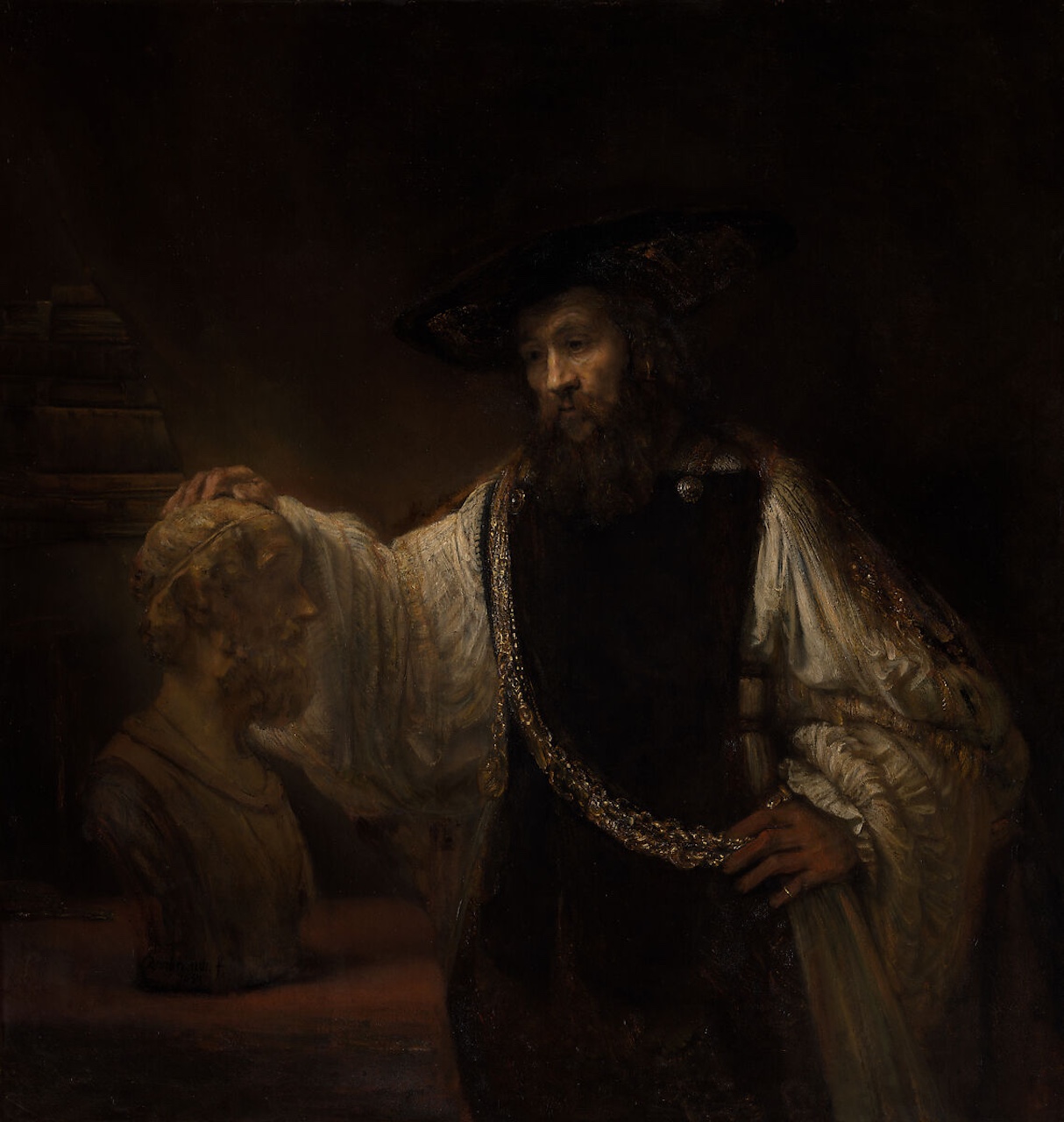
Image: Aristotle with a bust of Homer (1653), by Rembrandt.