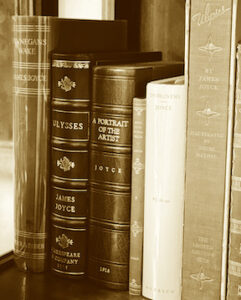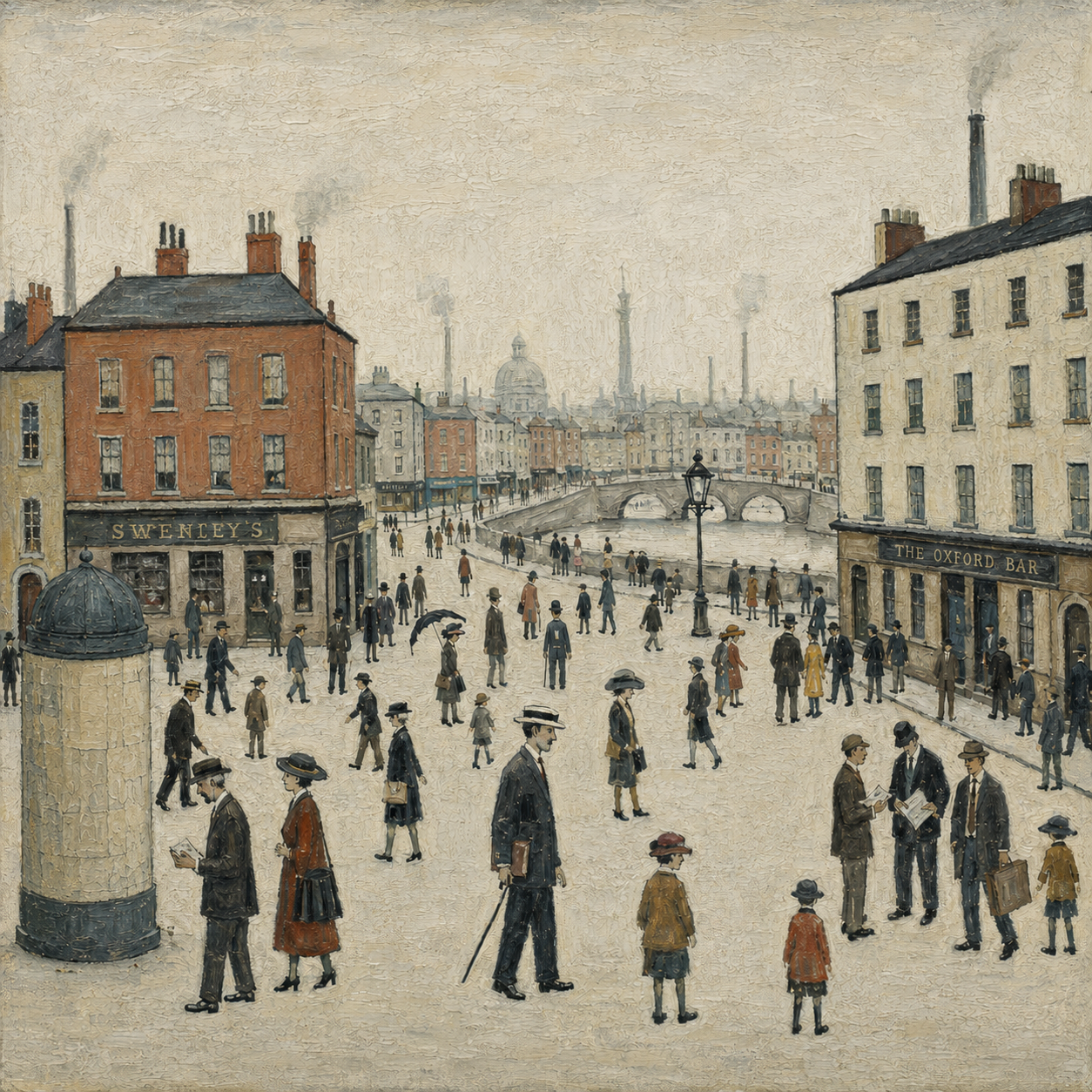
“Flaubert, Henry James, Proust, Joyce, and Virginia Woolf brought the novel to an end. Everything will now have to be reinvented from head to toe,” Father Connolly pronounced in 1944 (The Unquiet Grave). Today we can say it again. Since the landing of Joycean syntactic forces on the shores of Western literature—whether by Ireland, Normandy, or the Adriatic—the novel has done nothing but drift aimlessly across Odysseus’s seas, that is, through the Dublin streets of Bloom and Dedalus. The D-Day of modern prose corresponds to the day Sylvia Beach, in Paris, put Ulysses on sale.
With his last “partially legible” novel (Borges’s words), James Joyce did not undertake the return to Ithaca, for he knew that what remains in universal memory is not precisely the reunion of Ulysses and Penelope, but the journey itself. Not Bloom’s return home to Molly, at 7 Eccles Street, but the beautiful and complex literary voyage that the author of Exile carried out in his work. “We are still learning to be James Joyce’s contemporaries,” writes Richard Ellmann at the beginning of his meticulous biography of the Dubliner.
In Ulysses, Joyce makes us forget Ithaca; or, at any rate, he replaces it with the narrative seas that traverse every literary technique until reaching Molly Bloom’s stream of consciousness. In fact, the hero’s return to his wife’s bed will be followed not by the calm of Odysseus’s final days, but by the oneiric delirium and grammatical Babel of Finnegans.
Guido Ceronetti observed that Ulysses was “pure illegibility, the interminable screwing attempt of a chronically impotent lecher, with a sad shortage of genius, a funnel of ugliness into which the great age of the novel comes to an end.” The distinguished author of Il silenzio del corpo committed a beautiful act of forgetting: Joyce was to the modern novel what Cervantes was to the tradition of chivalric romances; that “illegibility”—also noted by George Sampson in his History of English Literature—and that “interminable screwing attempt” marked the beginning of the ludic labyrinth that modern prose would have to cross.
The last nail in the coffin of the nineteenth-century novel, as well as the burial of the novel to come, are works completed by the creator of Dubliners. T. S. Eliot had already noted that Joyce “killed the nineteenth century, by exposing the futility of all styles and destroying his own future.”
And yet that “definitive death” of the nineteenth-century novel—realism, naturalism…—after the Joycean adventure, decreed its constant presence beyond death, for it came to inhabit the underworld between the lines of prose, living, babbling specters within the labyrinthine forms of literary writing. Joyce’s aesthetic managed to cast symbolism with naturalism; it made the naturalist endeavor emigrate toward the territories of Verse; it set symbols to “transcribing reality.” Not satisfied, however, he added to his writing doses of Freud and the avant-garde, music and cinema, alcohol and increasing blindness.
With Ulysses, its author achieved what very few others have: just as Prague might be considered a city invented by Kafka, and Lisbon a city inhabited only by Pessoa’s heteronyms, Dublin is a cartography and a language created by James Joyce. Just as Dante became an adjective in order to conquer the territories of popular culture with the term Dantesque—think also of Orwell, of Kafka, already mentioned, of Don Quixote…—Joyce became Joycean.
“The artist, like the God of the creation, remains within or behind or beyond or above his handiwork, invisible, refined out of existence, paring his fingernails,” Joyce said. From Dubliners to Finnegans, he wrote more than fifty passages in which characters cut, file, imagine their fingernails: “vulturelike,” “of horses and cows,” “scabby”… In the inside pocket of his suits, he used to carry a Cook brand nail clipper. Nora Barnacle recalled that Lucia Anna, as a child, had her schedule reversed: she was “nothing but crying in the middle of the night”; fortunately for them and for literature, they discovered one day that the child calmed down until she fell asleep to the sound made by Nonno’s Cook—Nonno was what Joyce’s children called him—as he refined the hands and feet of his parents, on a daily basis, per diem.
♣
I, Jonathan Edax, also cut my fingernails on a daily basis, because it is “the act that distances us from the merely animal” (Bernard Shaw). Likewise, for years, I have pursued the first edition of Ulysses (Paris, Shakespeare & Company, 1922) through bookstores, antiquarian fairs, usurers, prestigious library thieves, the web, well-known cities, and remote cities, at a “reasonable” price. According to Father Connolly, it is the modern book that every bibliophile “must own as an obligation.” I have attempted the same with Dubliners (London, Grant Richards, 1914). In both cases, so far in vain.
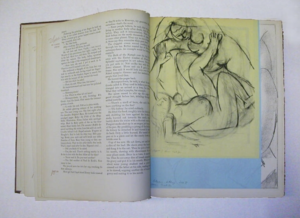
In the Wunderkammer, there lives a seventh impression (October 1925) of Ulysses, bought at a Goodwill in San Francisco, as well as the beautiful Limited Editions Club publication (1935) of the same novel, with Henri Matisse’s lithographs and signature. Of the short-story collection, which the critic Gerald Gould baptized in The New Statesman as the prose of “a sterile genius,” I house the first American edition (New York, B. W. Huebsch, 1916).
I have had better luck with Finnegans Wake (published simultaneously by Faber & Faber, London, and Viking Press, New York, in 1939) and with what its author called “my novel with the concertina title,” A Portrait of the Artist as a Young Man (New York: B. W. Huebsch, 1916). In the case of the latter, the New York publication (December 29, 1916) preceded the London one (The Egoist, March 1917), which was delayed in going to press because of obstacles imposed by English law concerning immoral writings.
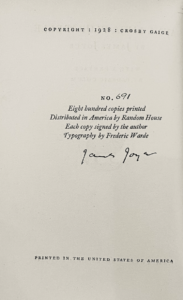
Over the nearly two-decade process of writing Finnegans Wake, Joyce published fragments in several magazines such as Transatlantic Review, Transition, and Criterion, under the heading Work in Progress. Beginning in the late 1920s, several books appeared that corresponded to chapters: Anna Livia Plurabelle (New York, Crosby Gaige, 1928), Tales Told of Shem and Shaun (Paris, The Black Sun Press, 1929), Haveth Childers Everywhere (London, Faber and Faber, 1931), and Storiella as She Is Syung (London, The Corvinus Press, 1937). In the Wunderkammer, there is a copy of Anna Livia Plurabelle, signed by its author.
Dubliners.
In the publishing contract between Grant Richards and Joyce, it was agreed that no royalties would be paid on the first 500 copies sold, of which the author himself had to purchase 120. Joyce demanded only that the dialogues use long dashes and not the classic English quotation marks, because these “are ugly and give an impression of unreality.” On June 15, 1914, the book went on sale with quotation marks, because the printer corrected “a set of proofs full of French dashes.”
A Portrait…
First, it was published in installments in the magazine The Egoist, between 1914 and 1915. Then, thanks to Ezra Pound’s good offices, A Portrait was published in book form in New York and London, almost simultaneously. Before that, it had been rejected by more than twenty publishers on both sides of the Atlantic. Edward Garnett, reader for Duckworth, noted in his report that “sometimes it seems as though the author’s thoughts and pen have run away with him. The fragments of writing and ideas are disconnected and fall like damp squibs, without effect.”
Joyce found in Balzac’s The Country Doctor the idea for the famous phrase he would place in Stephen Dedalus’s mouth: “the only arms I allow myself to use: silence, exile, and cunning.” “Fuge, late, tace” is the Latin motto that appears in the book by the author of The Human Comedy. And yet, in a letter to his brother Stanislaus, we read that, for Joyce, the French novelist’s work was “a shapeless lump of putty.”
Ulysses.
“My book will never be published,” Joyce told Miss Beach in the bookshop then located at 12 rue de l’Odéon. “Would you allow Shakespeare and Company the honor of being your publisher?” Miss Beach replied.
A great enthusiast of Ulysses (“it is as great, broad, and human as Rabelais; Bloom is as immortal as Falstaff”) and supervisor of its French translation, carried out by Auguste Morel and Stuart Gilbert between 1924 and 1929 (Ulysse, Paris, La Maison des Amis des Livres, 1929), Valery Larbaud asked Joyce how long it had taken him to write it. “Two hundred visits to hospitals, diabetes, colitis, gastritis, alveolar pyorrhea, rheumatic fever, glaucoma, twelve operations, and the total removal of my teeth. Still, if it had thundered and flashed a little less in Trieste, Zurich, and Paris, I would have finished it sooner.”
At an evening gathering at the country house of Virginia and Leonard Woolf, the author of Orlando told Katherine Mansfield that she had read fragments of the manuscript of a “vast novel” by James Joyce—Pound and Eliot wanted Hogarth Press to print it—a book “riddled with Irish indecencies,” “the work of a self-taught working man,” of a “scrupulous undergraduate scratching his pimples.” Mansfield, who had thought A Portrait of the Artist an excellent work, asked Virginia to see the manuscript. After mocking a couple of scenes, she told the Woolfs: “But there is something in this book that belongs to the history of literature.”
The English novelist Sidney Schiff kept insisting that Joyce read Proust because he perceived similarities between the two works. Joyce agreed. In a letter to Sylvia Beach from Nice, he wrote that “I have just corrected the first half of Ulysses for the third edition and read the first two volumes of À la Recherche des Ombrelles Perdues par Plusieurs Jeunes Filles en Fleurs du Côté de chez Swann et Gomorrhée et Co. par Marcelle Proyce et James Joust […] In Proust, the reader finishes the sentence before he does.”
Halfway through the undertaking, six typists quit transcribing the manuscript “in fair copy.” One confessed to Sylvia Beach that she was going bald; another that her husband had thrown “that thing for degenerates” into the fire. On the day of the novel’s presentation, given by Valery Larbaud, Shakespeare and Company was packed. Seeing this, Joyce said to his wife, “Do I see correctly? Without a doubt, my blindness is advancing, and my ego is swelling.”
Joyce dedicated copy number 1000, the last of the first edition, to Nora: “In Ithaca, for Penelope.” During a financial crisis that the family went through a few years later, she sold it to an antiquarian for a few francs. Likewise, whenever anyone asked Nora whether she was Molly Bloom, she always replied: “Can’t you see? She is fatter.”
Finnegans Wake.
On the night of May 4, 1939, Joyce and Nora celebrated the publication of Finnegans Wake. Nora said to her husband: “Well, Jim, I haven’t read any of your books, but someday I suppose I’ll have to.” A few weeks before her death, which occurred in April 1951, Nora confessed in a letter to her brother-in-law Stanislaus Joyce: “I feel an immense guilt for not having been able to get beyond the first two or three pages of Jim’s books.”
♣
He worked as a pianist in the bar of the Hotel Lutetia. It was James Joyce and the beginning of the Second World War; winter was starting. The records of the Parisian hotel show that he played only one night in December. And yet we know from Ellmann that he wrote parts of Finnegans at the corner tables in the hotel bar, where he could sometimes be seen smoking, drinking, where “he liked to write among voices, searching for the right place of words on the page.” Perhaps some melodic resonances of that musical experience still inhabit certain pages, in the novel’s nocturnal language.
In the early hours of January 13, 1941, Joyce woke from a coma in a Zurich hospital. He repeatedly asked the nurses to call his wife and son. Since he could barely stammer, they did not hear his request. “Does nobody understand?” said James Augustine Aloysius Joyce—according to one of the white-coated women, who did hear him this time—only to return at once to the previous state of unconsciousness, from which he would not awaken again. It was a quarter past two in the morning.
♣
Diary of a Bibliophile.
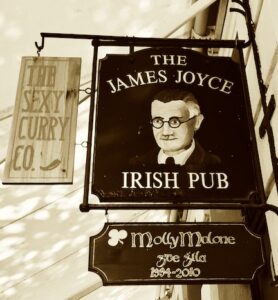
June 30, 2016. Prague. The writer Carlos Oblomov Chang, a tropical exile of Siberian and Cantonese ancestry, invites me to see the city. At his suggestion, we enter the James Joyce Irish Pub in the Old Town. I ordered a draft Pilsner Urquell, as custom dictates. “Did you know all the waitresses in this bar say their name is Molly?” Carlos tells me. I smile, incredulous. I ask the young waitress serving us: “So, is Molly your name?” “Oh, no, my name is Adéla, Adéla Bloom!” she replies as she sets two frosty, foaming mugs on our table.
July 7, 2018. I stop by Black Swann Books, one of the two antiquarian bookstores that still persist in Richmond. “Hello Nick, something new?” I greet the owner. “I do not think so,” he answers, with an apologetic gesture. I spend a long while browsing comics. “You’re a piece of trash!” a woman shouts. Seconds later, I hear Nick ask her—I assume it is the woman who has just shouted; I cannot see the scene because several shelves stand in the way—to leave the store, or he would call the police.
There is an exchange of a couple of harsh phrases… A door slams…
“Beautiful copy of Finnegans. I already have it, otherwise I would buy it… ‘But soon we’ll bonfire all his trash’, sang Persse O’Reilly… I would have preferred this scene not to happen,” a man says to Nick as he heads toward the exit.
“Do you have a first edition of Finnegans?” I ask Nick.
“Oh, I forgot to mention it, sorry. It’s in that bookshelf… next to Tender is the Night.”
July 8, 2018. I read in the Richmond Times-Dispatch (Poe’s first job as an editor and his earliest writings were at this newspaper), in the local news section, that “A bookstore owner in Richmond said he called the police after a woman confronted Steve Bannon, former White House chief strategist for President Donald Trump, in his shop Saturday.”
Finnegans Wake dreams in the Wunderkammer.