
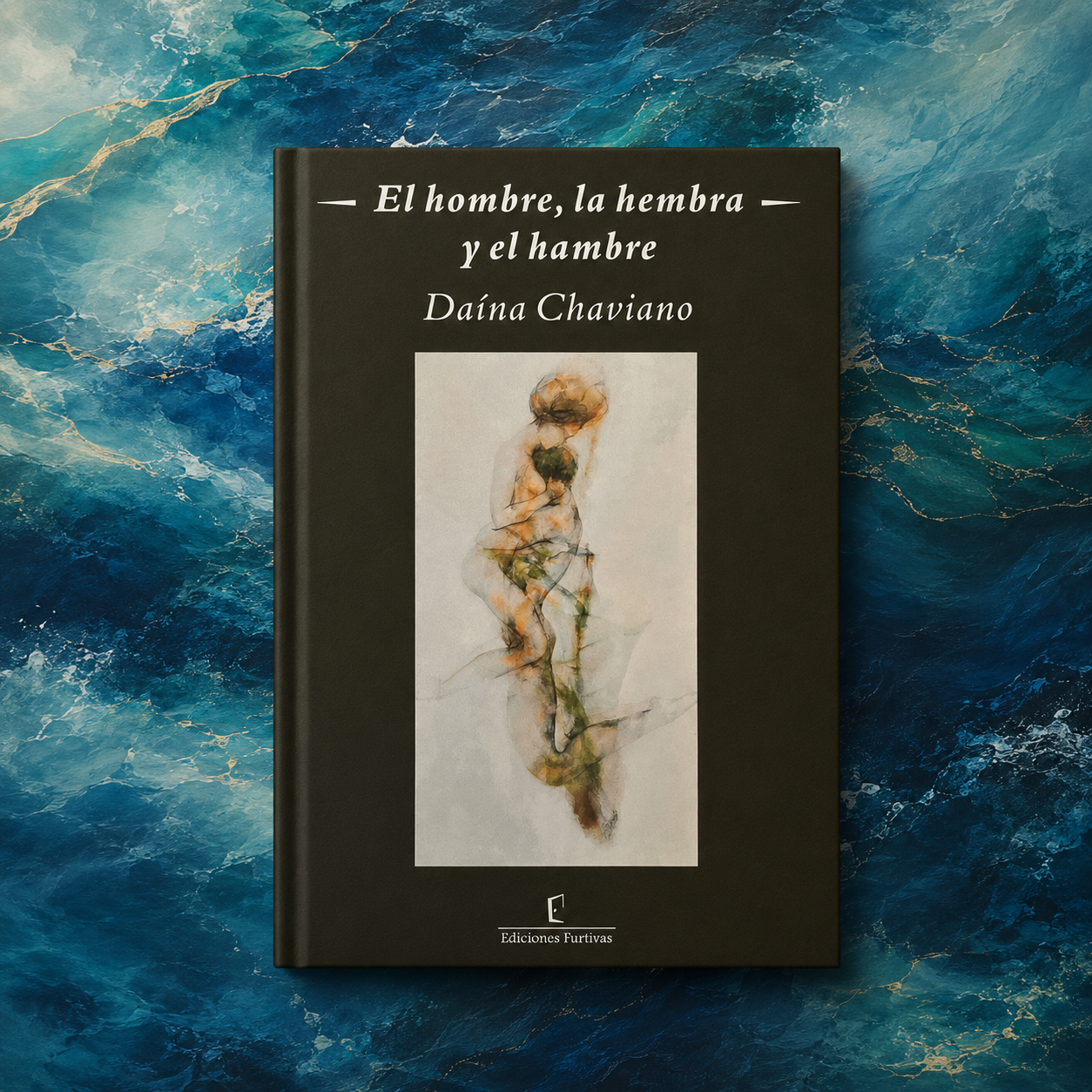
It was in the library of the Facultad de Filosofía y Letras at the Universidad de Buenos Aires that, quite a few years ago, I read Daína Chaviano’s El hombre, la hembra y el hambre. To reissue it[1] twenty-eight years after its original publication places in perspective the symptomatology of a fiction anchored in a historical reality[2]. At a moment when Cuban literature seems to waver between autofiction, a certain —Parisian— pseudo-nostalgia, and the political rewriting of the past, Chaviano’s novel resurfaces as a fiercely lucid and extraordinarily current text. And it does so because it moves toward an anthropological meditation on the body, toward the erosion of social bonds and the persistence of desire —as an experiment in social engineering— rather than toward a mere “testimonio” of what was euphemistically called the “Período Especial”.
Although the novel oscillates among political denunciation, a certain testimonial “realismo”, the “ficción fantasmagórica[3]” that hallucinates through certain characters, fragmented life —“la desesperación es la madre del delirio”[4]—, the schizophrenia intensified by every process of survival; hunger —“dolorosa y punzante, inextinguible, sádica”[5]— becomes a principle of self-organization of existence. It is not only a material lack, not hunger per se, but the force that structures human existence and conditions the moral, the erotic, identity, and above all, the perception of time. Hunger thus acquires a symbolic, ontological, and anthropological density that cannot be overlooked.
Hunger cuts through the novel through bodies; it is not that the characters are hungry, but rather that the perception of hunger produces them. Perpetual hunger, “hambre generacional”, “el hambre física”, “el hambre espiritual”, “el hambre devota de mi generación”[6].
Hunger as symptomatology presupposes the questioning of the boundary between the human and the animal. That is to say, by reducing the cultural distances among subjects that sustain the notion of civilization, they begin to act driven by primary instincts and by needs in which any moral normativity dissipates.
—¡Llegó la carne!
El grito lanzado desde las profundidades del patio llegó a las alturas.
—Corre, Papucho…
—M’hijita, quítate del medio.
—Eh, ¿y a ésta qué le dio?
—Oye, tú, so pelúa, conmigo sí que no te metas. Mira que a mí me da lo mismo un escándalo que un homenaje.[7]
What remains of morality in a hungry body? What remains of morality when eating becomes an imperative of absolute order? Hunger introduces a dystrophy not only on the physical level but also on the linguistic one. It becomes a matter, then, of naming the unnameable by generating a kind of linguistic atrocity established as euphemism, as longing, but above all as illusion. Bisté de toronja, bisté de frazada, pollo de población, novena de carne, picadillo extendido, picadillo de cáscaras de plátano, pasta de oca, fricandel, and the most transfigurative of all, pollo por pescado[8]. Such a simulacrum operates only from survival. The abominable —in the precariousness of existence— ends up becoming sacred.
Hunger in El hombre, la hembra y el hambre ultimately becomes a totalizing ontological density; the categorical imperative of hunger presupposes the anthropophagic:
Yo, caníbal en esta isla que se engulle a sí misma. Yo, devoradora de cuanto pueda ser devorado en sueños[9].
Mi mente ya no piensa en otra cosa que no sea comida; es como si todas las ideas hubieran sido devoradas por una sola.
Hunger will radically condition decisions; moral normativity and cultural structures matter little, since both collapse. Simone Weil said, rightly, that hunger is a force capable of destroying attention and, therefore, any ethical possibility[10]. Hunger, then, conditions not only the limits of freedom but also those of possibility. The very title of the novel highlights this progression toward the animality that hunger presupposes. La hembra replaces la mujer, implying a regression to the biological sphere, where instincts prevail.
This inversion of meaning is fundamental. Chaviano’s approach reverses the logic when the biopolitical structure that produces hunger models and conditions human behavior. The hungry body is no longer an accident, but a technology of control established through the administration of bodies; scarcity, therefore, not only disciplines, but also transforms subjectivity[11].
The women who lead the novel are fragmented subjectivities, trapped between erotic desire, profound precariousness, and hopelessness. Survival is the narrative exegesis; for that reason, eating, loving, and negotiating are indistinguishable actions. Removed from the atmosphere of intimacy, the female body becomes currency. What matters is that Chaviano does not stitch her characters together as allegories of political suffering; they are, rather, profoundly human densities in which there persists —even in the most degrading situations— a vital impulse, a search for pleasure, for beauty.
Within a complex plot, material need, produced by deep precariousness, turns eroticism into a mechanism of survival. Unlike sex as subordination to violence or exploitation, in El hombre, la hembra y el hambre, eroticism and desire —not sex— preserve a disturbing autonomy. The body desires, even when it is already an exhausted body, even when crushing reality annihilates any possibility of pleasure. Georges Bataille said that eroticism is a limit-experience that simultaneously confronts death and the continuity of life. Mario Vargas Llosa, in Los cuadernos de Don Rigoberto, proposes the distinction between eroticism and pornography: “lo erótico es la dignificación del sexo a través de la fantasía y la cultura… En tanto que, para usted, pornógrafo, lo único que cuenta a la hora de hacer el amor es, como para un perro, un mono o un caballo, eyacular, Lucrecia y yo, envídienos, hacemos el amor también desayunando, vistiéndonos, oyendo a Mahler, conversando con amigos y contemplando las nubes o el mar.”
This digression is not gratuitous, and it is not because, in the novel, eroticism is a precarious form of resistance against the dehumanization produced by misery. Pleasure, although it does not eliminate suffering, suspends, at least momentarily, the logic of hunger. Yet ambiguity also takes hold of the narrative scenarios once desire establishes a plot of domination—the body observed, negotiated, and consumed within a system of urgent economic needs—which presupposes a new ethical frontier. Chaviano recreates this phenomenon without moralism or romanticism. The precision with which this crisis affects affective relations and the way intimacy becomes a field of transactions places the novel within an anthropological perspective, showing how crises reorganize symbolic structures and the perception of the female body.
From this perspective, the feminine is “revaloriza” and circulates within informal and clandestine economies regulated by desire and tourism. Far from blushing or judging, Chaviano objectifies a conflict often veiled by morality, simulacrum, and the paternalistic “erradicacionismo” of a regime. There is no glorification in this, much less victimization; what emerges, in any case, is a sense of survival at any cost. The body is an economic resource —“El cuerpo se convierte en lo único que puedes ofrecer cuando no te queda nada más”— situated within a subsistence economy such as the one described by Karl Polanyi.
The setting in which subjects survive by exchanging favors and pleasures, simulating and improvising an existence that has no tomorrow, is La Habana[12]: the space of decomposition, ruin, but above all the space from which legitimacy is lost. The city—a metaphysical ruin—is the narrative space. The city has been a constant in Cuban narrative; nevertheless, in El hombre, la hembra y el hambre, La Habana is not simply an urban setting. The names of its streets, its destroyed streets that find a lament in their names, the blackouts, the buildings in ruins, all end up generating a state of suspension in time. Time freezes into a perpetual and ruinous present. The city ends up as the reservoir of a sick body, of a sick collectivity, of a broken nation that is dying. There is no aestheticization of ruin, much less exoticism; these are metaphysical ruins, the decadent city shown from within. They are the peeling façades where a fragmented subject experiences life in physical and emotional precariousness. Ruins —Walter Benjamin said[13]— are the remains of an unfulfilled historical promise. La Habana in ruins is therefore the residue of a collapsed utopia. Chaviano does not merely lament that fall; what is most interesting is her exploration of the new forms of life that emerge from the rubble. Ruin—as Antonio José Ponte says—presupposes the ruined subject. In the end, Chaviano looks at her city like an anthropologist, but with the sensibility of a poet.
The reissue of El hombre, la hembra y el hambre once again places memory, uprooting, and historicity at the center of attention. Far from idealizing the past, Chaviano narrates the magnitude of loss, the trace left by the wound in individual and collective memory. What emerges is a profoundly tragic vision, riddled with precariousness and cynicism, where—because everything is implausible—everything belongs to prehistory. It is not the past, not history, but what comes before all that. Twenty-eight years after its publication, the implausible has become flesh; the crisis of a nation in crisis, of a failed state, places in perspective the magnitude of a fraud[14].
When hope today seems to be something more than a word, when we are all awaiting a definitive outcome to the Cuban case, the reissue of Chaviano’s novel preserves its capacity to unsettle, but above all, to move. It is not only a matter of reading it again; it is a matter of recognizing the intact force of a work that continues to challenge us without concessions, of a force that becomes more piercing and, above all, of a truth that, without ceasing to be emotional, dilutes and erodes a fear that turns into hope.
[1] Ediciones Furtivas, 2026.
[2] See Trilogía sucia de La Habana (1998) and El Rey de La Habana (1999), by Pedro Juan Gutiérrez; Silencios, by Karla Suárez (1999), and Las palabras perdidas (1992) and Las iniciales de la tierra (1987), by Jesús Díaz.
[3] The spectral transitions into the past become a narrative device through which the characters discover a country, but above all, a history that has been denied to them, altered, and written by a political ideology. The past is a premonitory resource, a diatribe, a mockery of what could have been and was not, but which explains the present very well; hence the allusions to José Martí, to the sinking of the Remolcador 13 de Marzo, to human tragedy, but above all to the victims of a totalitarian regime. «¿Cómo se puede tener futuro cuando no se tiene pasado? El pasado era una historia saturada de guerras y esclavos. Y si era cierto ese refrán de que cualquier tiempo pasado fue mejor, ¿qué podría esperar del mañana? Ella no se daba cuenta, pero aquel fatalismo inculcado desde la infancia había minado su espíritu.» Chaviano, D. (1998), p. 163. See also pp. 190 and 194.
[4] Chaviano, D. (1998), p. 257.
[5] Chaviano, D. (1998), p. 137.
[6] Chaviano, D. (1998), pp. 53, 54.
[7] Chaviano, D. (1998), pp. 81, 82.
[8] See Del Risco, E. (2022): Nuestra hambre en La Habana, Plataforma.
[9] Chaviano, D. (1998), p. 41.
[10] Weil, S. (2001): Oppression and Liberty (A. Wills and J. Petrie, translators).
[11] Chaviano, D. (1998): El hombre, la hembra y el hambre, Planeta, p. 259.
[12] «[…] irritación, angustia o miedo: los tres sentimientos que más abundaban en La Habana que ella conocía.» Chaviano (1998), pp. 184 and 199.
[13] See El giro copernicano en el tratamiento del pasado: Benjamin y la memoria de lo no-acaecido, by Germán Aristizábal Jara and Sergio Bedoya Cortés, p. 239, in Interpretaciones benjaminiana (2025), Enengativo Ediciones.
[14] «La mentira es un requisito para la supervivencia». Chaviano, D. (1998), pp. 41 and 295-298.


