Left-wing thought, as it has repeatedly emerged since the advent of modernity—particularly from the eighteenth century onward—is characterized by its aspiration to transform the existing order. Wherever it acquires historical significance, it seeks to alter what it regards as a given order, whether natural, social, or political. From this perspective, the political left presents itself as a challenge to humanity’s natural intuitions, replacing the continuity of tradition and the values that have accumulated over time with projects aimed at the rational reorganization of reality.
The left arose from an ideological ferment that brought together those sectors that perceived themselves as excluded from the established order. It is at this point that revolution became the political instrument par excellence. To break the existing order means not only replacing it with another conceived in theory, but also assigning the intellectual class the role of an elite responsible for carrying out that project.
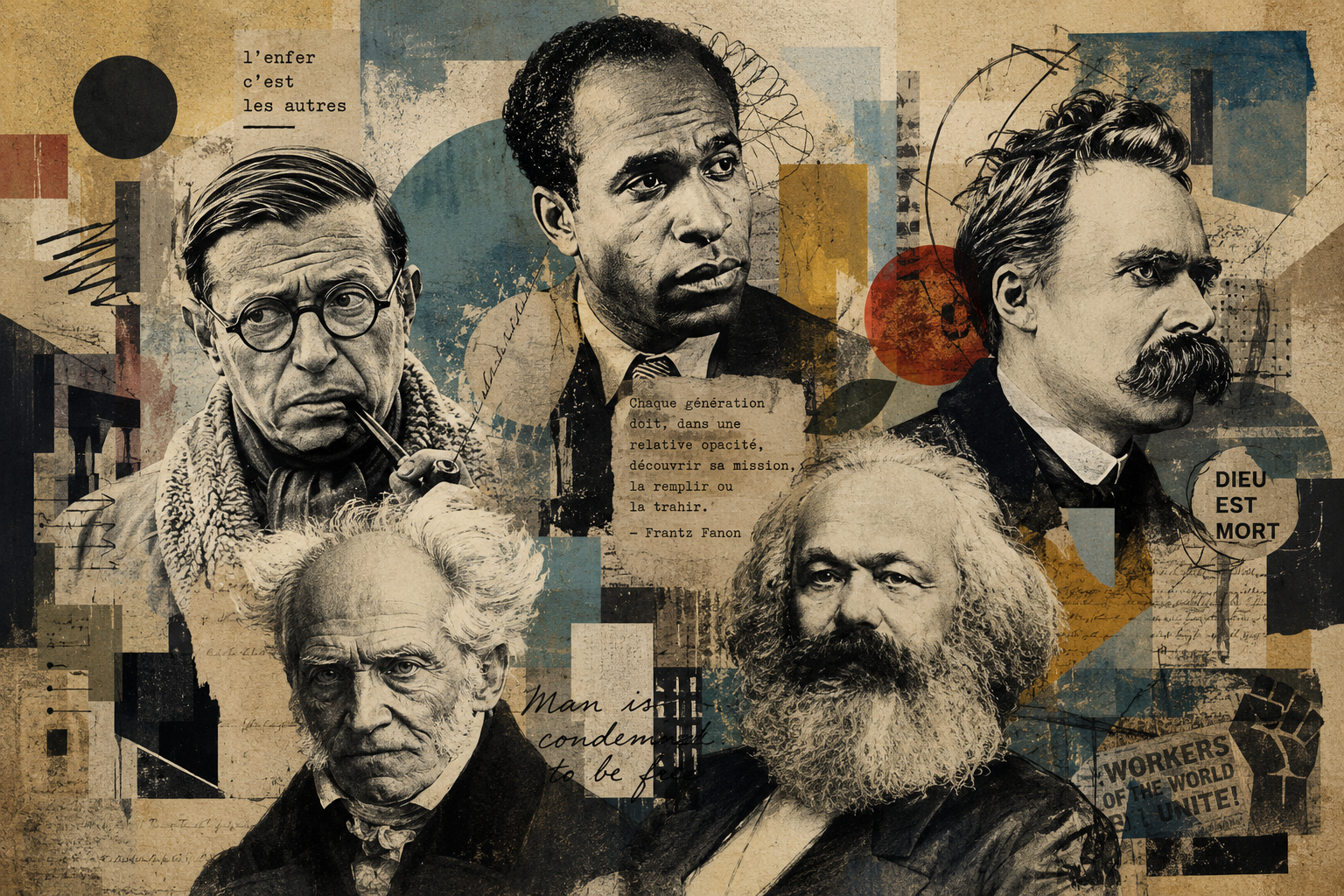
Modern philosophy, which laid the epistemological foundations of the so-called “new world,” begins from the premise that reality does not possess an order that is fully accessible per se. Through his three Critiques, Kant suggests that it is the subject who organizes the world by means of its own systematic categories. Schopenhauer, Nietzsche, and Marx—more radical in this respect—would argue that the existing order is by nature flawed or unjust and must therefore be transformed. In each of these cases, Enlightenment modernity adopts a profoundly critical attitude toward the natural order while granting primacy to the artificial order constructed by human beings.
Kantian modernity, from which liberalism derives, and Marxist modernity, the intellectual foundation of socialism, ultimately converge in their reformist impulse. Both share the conviction that reality can—and indeed should—be reconstructed according to principles conceived in advance by reason. From this perspective, they stand in tension with an understanding of reality as an ontology that precedes human will.
From this premise emerges a normative framework that progressively fragments our understanding of the world according to political and ideological interests. Culture—and with it, art—ceases to be understood as a representation of the natural order—the mimesis of the Greeks—and instead becomes an instrument in the service of a political project. The modern world becomes political precisely because it is ideological; that is, it presupposes an interpretation of reality based on conceptual schemes formulated a priori.
When Marxism became the dominant ideology throughout much of the university and academic world—the very sphere in which intellectuals and artists are formed—culture came to be interpreted primarily as an expression of power relations. From this perspective, ruling elites preserve their dominance through a hegemonic discourse that must be dismantled and replaced. The mission of the political left, therefore, is to subvert this supposedly repressive order by whatever means necessary.
Yet this interpretation reduces culture to its political dimension alone. Culture arises not only from relations of power, but also from humanity’s spontaneous interaction with nature, tradition, and communal life. To reduce it exclusively to conflict is, from this perspective, one of the defining characteristics of modern thought.
It is the artist, above all, who ultimately comes to embody this logic advanced by the political left. By virtue of the artist’s imaginative capacity, the artistic subject becomes a privileged instrument for projecting new values intended to replace the existing order with one previously designed through ideology. One might see here an antecedent in Kant’s notion of the transcendental imagination, understood as the faculty that generates new possibilities.
Thus, both the ideologue and the artist cease to employ reason as a means of discovering the order of things and instead use it to construct an alternative order. Imagination becomes the faculty entrusted with shaping the future and revealing the supposed laws of history. Ideologues and artists consequently appear as quasi-prophetic figures descending from the ideological mountain bearing the tablets of a new salvation, directing society toward the path it is expected to follow “for its own good.”
It is in these terms that Jean-Paul Sartre’s enthusiasm in his preface to The Wretched of the Earth by Frantz Fanon may be understood, where he presents socialist revolution as a historical necessity. In doing so, the political left once again projects a horizon of political redemption that promises to lead humanity toward a conceptual paradise, despite the fact that historical experience has repeatedly demonstrated the inherent difficulties of such a project.
The artist, therefore, is embraced by the political left as its favored subject because he or she performs the role of demiurge within this political imaginary. Through the ability to envision and represent possible worlds, the artist helps disseminate a conception of reality grounded in one of modernity’s defining assumptions: that reality is not an objective limit but rather a material capable of being reshaped according to human will.
The comparison with Plato’s Timaeus is illuminating. There, the Demiurge orders the world according to a transcendent principle. The modern artist, by contrast, acts without reference to any objective transcendence, guided solely by a historical and ideological project that aspires to transform reality in a radical way.
Contemporary art, along with many of its performative expressions, illustrates—according to this interpretation—this dynamic of cultural subversion. The artist becomes the principal symbolic representative of the new order that emerged from the philosophical rupture of Enlightenment modernity, a development that presupposes the subordination of the natural order to the subjective will of Homo ideologicus.
Art, however, does not in itself transform the structure of reality, nor does the artist possess a demiurgic power capable of altering the very being of things. The world retains its own inherent order and a teleological structure that gives coherence to its constituent elements. What can occur, however, is a discursive inversion capable of presenting as reality what is, in fact, merely an ideological construct. To achieve this, politicians, scientists, and philosophers aligned with the political left require the artist as an illustrator of the progressive future, as a creator of images capable of lending plausibility to that idealized horizon, encapsulated in the well-known phrase attributed to Ida Auken: “You will own nothing, and you will be happy.”
From this perspective, artists tend to be left-wing because the political left itself has helped shape their cultural role. The artist proclaims that poetry redeems; seeks to restore both old and new idols; fashions imagined futures; and offers them to a society willing to contemplate them as anticipations of a higher truth. One is therefore left to ask whether, from utopian socialism through Marx’s scientific socialism and into many contemporary progressive currents, the political left has not, in a certain sense, come to assume the role once reserved for God.