
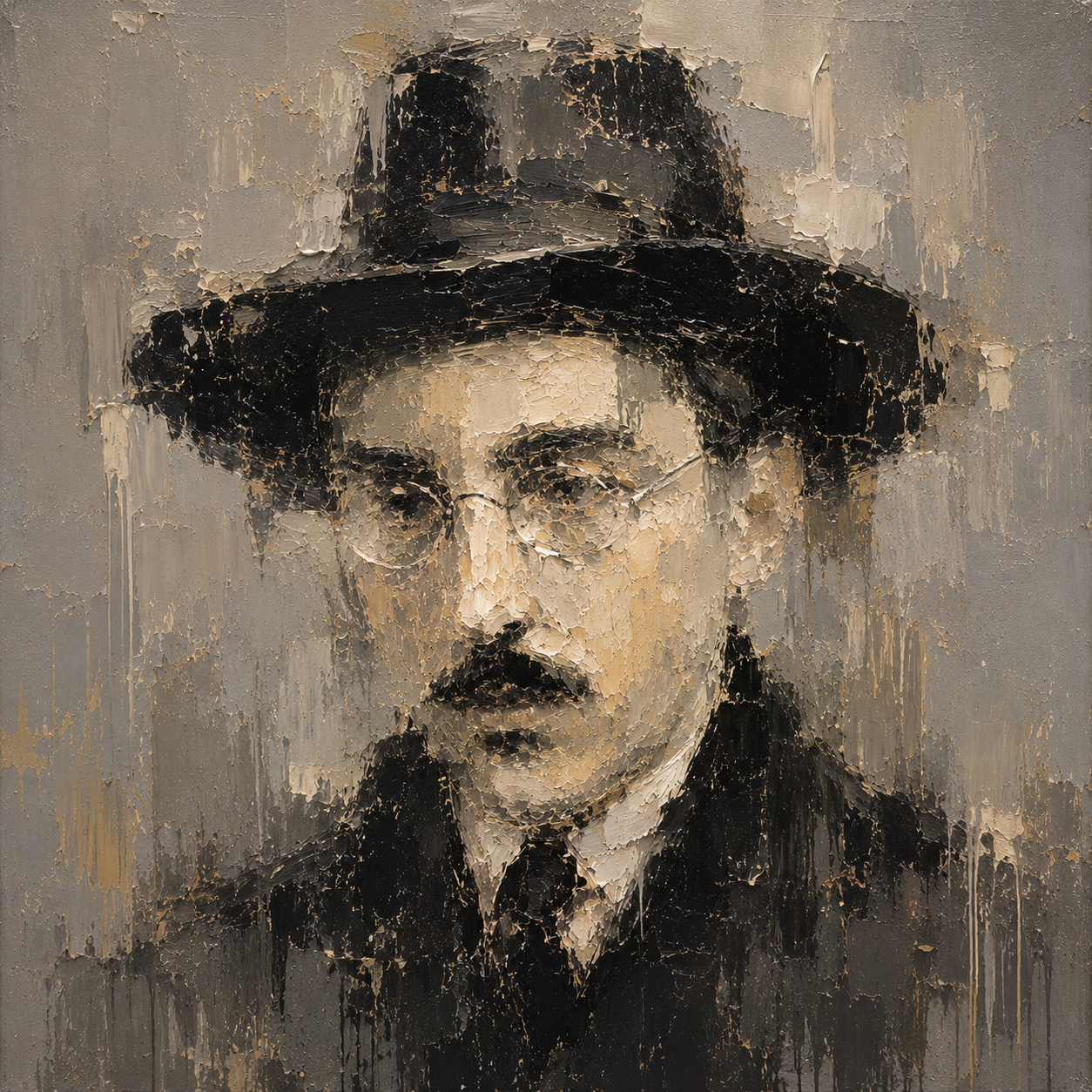
Citario. Derived from the Latin citāre —to quote— plus the suffix -ārium —repository—, similar to bestiario. A 21st-century neologism, coined by the Spanish-speaking scholars at Bookish & Co., with roots in ancient anthologies and florilegia. «Citario» is related to medieval books of commonplaces—such as those by Erasmus of Rotterdam—and to 19th-century proto-examples, such as Familiar Quotations. This «Citario Fernando Pessoa» celebrates the 138th anniversary of his birth through a constellation of phrases that surround and multiply the poet. Rather than establishing a definitive image of Pessoa—an almost impossible undertaking for someone who made heteronymy a form of intellectual respiration—this collection brings together voices that have regarded him as one of the great fragmented consciousnesses of modernity.
In twentieth-century poetry, perhaps the most striking example of a process of de-subjectivization—the transformation of the poet into a pure “testing ground” for the self—and of its potential ethical consequences is Pessoa’s letter on heteronyms. In a reply dated January 13, 1935, to his friend Adolfo Casais Monteiro, who had asked him about the origin of his numerous heteronyms, he begins by presenting them as “an organic and constant tendency toward depersonalization.”
(…)
The account continues until it reaches the sudden personalization—on March 8, 1914—of Alberto Caeiro, one of the most memorable heteronyms, who would become his teacher (or, rather, the teacher of another heteronym, Álvaro de Campos).
Let us analyze this incomparable phenomenology of heteronymic depersonalization. Not only does each new subjectivation (the appearance of Alberto Caeiro) imply a desubjectivation (the depersonalization of Fernando Pessoa, who submits to his master), but, just as immediately, each desubjectivation entails a resubjectivation: the return of Fernando Pessoa reacting to his own nonexistence—that is, to his depersonalization in Alberto Caeiro. Everything unfolds as if the poetic experience constituted a process so complex that it brings at least three subjects into play; or rather, three distinct subjectivations-desubjectivations, since here it is not possible to speak of a subject in the strict sense. There is, above all, the psychosomatic individual, Fernando Pessoa, who on March 8, 1914, approaches the writing desk to write. With regard to this subject, the poetic act can mean nothing other than a radical desubjectivation, which coincides with the subjectivation of Alberto Caeiro. But a new poetic consciousness, something like the authentic ethos of poetry, only emerges when Fernando Pessoa—who has survived his depersonalization and returns to a self that is, and at the same time is no longer, the first subject—understands that he must react to his non-existence as Alberto Caeiro, that he must account for his desubjectivation.
Giorgio Agamben
◾️
“Alberto Caeiro is Alberto Caeiro is Alberto Caeiro…”. The “quote” contained in the “sentence” (whether understood as a logical sequence in its grammatical formulation or as a religious litany) was more or less contemporary, as is its content: the constitutive tension of that text as a tautological syllogism: reasoning plus tautology.
The undeniable, radical assertion that someone is someone—that Alberto Caeiro is Alberto Caeiro—must be understood there, or rather, accepted, as a fact; but not one to be interpreted alongside other similar or, perhaps rather, related facts—for where does the relationship occur, as a (sub)position or rather as a presupposition, an inescapable circular argument?—;
rather, on the contrary, it constitutes what would be the founding fact—an unfounded fact-act—the foundation that supports/constructs the edifice that is—already in and of itself—its creation, and that creation which, as such (its theoretical, transposed model), comes to be prior to what it creates. Tautology, then, but only insofar as it is articulated as a deduction—the one resulting from the fact that something is something of what it becomes as something (the fact that Alberto Caeiro is such makes it deducible that he is so and makes it deducible each time… thereby grounding, at the same time, in that act—and one that is also theatrical, his condition, his drammatis personnae—the conditions of his appearance at the very moment he appears). Through which the syllogism—a feigned syllogism: the enthymeme—destroys/reconstructs in its unfolding the edifice of its tautology as a founding tautology—a foundation (of) the beginning—that cannot be renounced.
Juan Barja
◾️
It is difficult to compile a collection of Pessoa’s critical texts.
For Pessoa’s criticism is not pure and simple. In the briefest article, in the briefest survey or interview, one finds a measure of fiction. If not, how could one understand his defense of Pascoaes and the Saudists in 1912, and his break with them in 1913? Or how could one understand his interest in António Botto, a minor poet whom he integrates into a universe in which Botto becomes the archetypal character? And as for his preface to a book by Eliezer Kamenezky, whose quality is far below the tolerable, doesn’t Pessoa’s appropriation of the “wandering soul” as a myth have much more to do with the Jewish aspect he emphasizes in himself?
Furthermore, the fictional nature of many of his contributions is intentionally highlighted, from those he wrote for the sections “Chronicles of Life as It Passes…” and “Decorative Chronicles” to the one titled “A Great Portuguese,” not to mention the journalistic hoaxes surrounding the figure of the magician Aleister Crowley.
Another example of the radical ambiguity between criticism and fiction in Fernando Pessoa is “Fábula,” which can be, at the very least, a prose poem, a short story, and a critical essay; choosing the critical relevance in this case is a challenge for the reader.
Fernando Cabral Martins
◾️
Although it has been said for years, and on more than one occasion, that Fernando Pessoa had no biography, and he has even been described as “the man who never existed,” the truth is that the uninterrupted progress in our understanding of his astonishing unpublished literary legacy has demonstrated that he did indeed have one, and that it was one of the most secretive, intriguing, and exemplary of our century. It has also been written—and this is justified because when it was written, much less was known about him than is known today—that he was a stranger to himself, but in attempting this modest biographical essay, I have adhered to the words of Maria Teresa Rita Lopes, according to whom “for Pessoa, the spectacle [of his literary work, conceived as a drama] begins with the discovery of himself. He devotes himself entirely to the spectacle, he enacts it, even knowing that it is an interlude, that the true play is not there.” Moreover, if we take into account that Pessoa lived with more sincerity than he saw fit to confess in his writings—not only his life as a Portuguese citizen by birth, but also those of his heteronyms, and with particular intensity and continuity those of Alberto Caeiro, Ricardo Reis, and Álvaro de Campos—we must admit his undeniable biographical versatility.
The physician and publicist Taborda de Vasconcelos states in his Anthropography of Fernando Pessoa that “although, due to the irreducible versatility of human behavior, there is no single monolithic temperament, as we mature this ambivalence softens; from being plural, the individual becomes a harmonious whole, singularized by the principles he establishes.” But he adds immediately afterward that this did not happen to Fernando Pessoa due to his character and that “the heteronyms are not, therefore, splits of a personality lacking in cohesion, but rather so many ‘faces’ of the same, ‘masks’ in Vitorino Nemésio’s characterization, in which, if anything persists as deliberate, there is also much that is spontaneous and sincere. In all of them he placed, as he said, a profound conception of life, different in each but always deeply attentive to the mysterious importance of existence (…) Strongly conditioned by his biological fate, he built a unique universe, inhabited by distinct voices: those of Ricardo Reis, Álvaro de Campos, and Alberto Caeiro, voices of characters with distinct social structures but akin in a single, and always the same, social being.” Although the following pages contain some subtle differences compared to what has just been transcribed—all of them due to the examination of certain issues not considered by Taborda de Vasconcelos—I am convinced that his observations are very useful as a starting point for attempting to understand—and to recount—the life of Pessoa, so singular precisely because of his highly personal plurality.
Ángel Crespo
◾️
When the pieces of the puzzle first appeared in book form in 1982, the heralds of postmodernity hailed it jubilantly as a work that anticipated, defined, and legitimized their senseless toy; today, when those same heralds shamelessly and clandestinely bury the stafermo they once heralded, the rest of us—the vast majority—are left with the joy of the unease this unclassifiable work brings (much to the unease of the few).
In one of my previous public dialogues with Bernardo Soares’s semi-heteronym, I said of him that he was, for me, the great Poet of Modernity—that is, the one who had best, most profoundly, and with the least modesty managed to translate into literature the meager Ithacas conquered (few), the doubts and contradictions of the voyage (many), the storms and hardships endured (many), and the misdeeds and monstrosities committed (countless) by that ship of Modernity, repeatedly run aground and always refloated. And I also said that Pessoa would continue to be, to borrow the nautical image, cast again and again against the rocks, and time and again returned to the oceans where we constantly confuse ourselves and swap roles as sailors and castaways. I now reaffirm all of this,
after having repeated my own personal voyage through the pages—sometimes choppy, at other times dormant amid treacherous seaweed, and on a few occasions, finally, transparent and inviting—of this Book of scraps or fragments or book projects.
Perfecto E. Cuadrado
◾️
Bernardo Soares is that part of Creation that fears nothingness, that abhors creating in a vacuum. The Book of Disquiet is the logbook that abhors creating in a vacuum. The Book of Disquiet is the logbook of the scribe, of that Bartleby who awaits King Sebastian—who was the citizen Fernando Pessoa in the forgotten and negligent Portuguese Republic—a traveling scribe of business letters in English and French. By splitting into Bernardo Soares, Pessoa commits the folly of seeing himself reduced to a lack of talent, to being the victim who dreams—only dreams—of existing and of being nobody. From that haughty resentment, the imaginary Bernardo Soares writes his diary while the imaginary poets Alberto Caeiro, Álvaro de Campos, and Ricardo Reis, though they curse the fire, breathe life into it.
So great was Pessoa that he allowed himself the novelistic luxury of inventing the most perfect of failed writers, that Bernardo Soares who traverses being and time, the phenomenal world, ethical diatribes, hatred of democracy, and aesthetic ramblings under the negation of all love. Beyond Kierkegaard’s intimate philosophy or diaries that turned out to be secret novels, such as Amiel’s, The Book of Disquiet is the novel of a poet without posterity.
Christopher Domínguez Michael
◾️
He was a master of the invisibility cloak. And he wore not just one, but a considerable number of them: Alexander Search, Robert Anon, Alberto Caeiro, Ricardo Reis, Álvaro de Campos, Antonio Mora, Bernardo Soares—all names that can hardly be considered mere pseudonyms.
Fernando António Nogueira de Seabra Pessoa would have rejected the idea that these were mere fictional names, for he viewed his dual or multiple authorial identities as a form of heteronymy in which each author possessed his own style, biography, merits, and flaws.
“Be multiform, as the universe is!” he exclaimed.
But where is the “real” Pessoa? Where does he find himself in this variety show? In the language of his homeland, “uma pessoa” means “a person.” It is a surname that says little.
What was most striking about Pessoa was that he didn’t stand out. One imagines him as a short man, with a mustache and glasses, who always wears the same hat to La Baixa, the lower district of Lisbon, and frequents the same café, where hardly anyone notices his presence. Women play no role in his life. He barely makes a living as a translator.
He handles the correspondence for a company, a tedious and boring job that nevertheless ensures what is most valuable to him: his independence. He wrote constantly, but published little. His manuscripts lay around, “for the trunk,” as he used to say. His legacy was a mess that has caused many headaches for philologists, who to this day continue to sift through his posthumous works.
Hans Magnus Enzensberger
◾️
A pluralistic environment, some important poets and thinkers tell us. It is likely that among the former, none went further than Fernando Pessoa. I am referring now not so much to his heteronyms—an obvious expression of a tireless desire for diversity—as to what some of his fictional reincarnations saw in the world. Ricardo Reis, a heteronym, is commissioned by Pessoa to write the preface to the poetry of one of his invented colleagues, Alberto Caeiro, and what he emphasizes in his work is the reconstruction of a pagan sensibility. Caeiro feels and asserts that Nature is made up of parts without a whole, exempt from a whole (XLVII):
Nature is parts without a whole.
This, perhaps, is the very mystery of which they speak.
And another character, António Mora, a prose theorist of this neo-paganism, emphasizes the essential multiplicity of the world. “Now, nature is plural. Nature, naturally, does not appear to us as a whole, but as ‘many things,’ as a plurality of things. We cannot positively affirm that there truly exists a whole called the Universe… a thing that is one, designable by nature. Reality, for us, appears directly plural.” What doctrines or texts on the subject—occultist perhaps, or philosophical—might the great Portuguese writer have known?
(…)
Finally, I refer to the reflections, in another sister language, of Bernardo Soares, the voice of Fernando Pessoa in his Book of Disquiet. I do not believe anyone has delved deeper into our subject. Is Bernardo Soares a character, a heteronym, a semi-heteronym, the author himself? It does not matter too much. From the moment he feels, thinks, and writes, Pessoa is very clear that he is fictionalizing himself. Soares, the modest bookkeeping assistant at an office on Rua dos Douradores in Lisbon’s Baixa district, when he appears in the heterogeneous and unfinished collection of fragments that is the Book, has the air of a novel’s character, yet without novelistic events befalling him, with scarcely any varied or coherent actions. Descriptions, however, abound. A setting is introduced—the atmosphere of a small shop, desperately gray and monotonous—but what essentially occupies this atmosphere is the thought of a character who is entirely separable and separated from it. Soares—a reader of Amiel, himself plural and a pretender—produces what Ángel Crespo aptly calls an “intermittent intimate diary.” We could call it, like Leopardi’s Zibaldone, even though Pessoa did not possess a single philosophy nor did he wish to have one, the philosophical diary of a poet. Its author is also a tireless thinker, tenacious to the point of exhausting ideas and surpassing himself.
His diary gives rise to a wide variety of variations—even contradictory ones—on the same obsessive themes that gradually spiral upward.
Claudio Guillén
◾️
From its violent oxymoron, which holds such promise, The Anarchist Banker intrigues the reader. After reading it, it continues to intrigue. The citizen of the year 2000, as conscious of the value of universal suffrage as of the Mediterranean diet, does not want to believe that Pessoa, the sublime author of certain poems, presents himself as a refined madman who denies the common man his social bread and salt. According to all plausible indications, Pessoa, in the wake of the critical rebellion opened by Campos’s Ultimátum (1917) against the democratic bureaucracy, set out in The Banker to satirize the possibilities of the individual’s social emancipation. And the ideal subject of scorn—while also of praise once imbued with new meaning—was anarchism, a doctrine that around 1920 still held value. The fin-de-siècle mentality of social transformation was still too much in vogue (Wilde’s *The Soul of Man under Socialism* dates from 1891) for Pessoa not to laugh at it and seek out its weak points, always highly sensitive both to clichés and to the individual’s possible place within the masses.
Pessoa’s political ideas are not widely known, even though they often intertwine with his poetic ideas. He defined himself as “an English-style conservative, that is, liberal in conservatism and absolutely anti-reactionary.” In that vein, he was clear that something—perhaps not much—had to be done to improve the social contract. The world he had inherited from his elders, his Portuguese world, did not look very promising to him.
“The product of two centuries of false Franciscan and Jesuit education, followed by a century of confused pseudo-education, we are the individual victims of a prolonged collective servitude. We have been oppressed by liberals for whom the word ‘freedom’ was nothing more than the safe-conduct of a reactionary sect; free thinkers for whom the height of free thought was to prevent processions from taking to the streets; Freemasons for whom Freemasonry (far from any view that regards it as the custodian of the sacred heritage of Gnosis) has never been anything more than a ritual Carbonari.
A product, then, of educations imparted by beings whose lives were a perpetual betrayal of what they claimed to be and of the beliefs or ideas they claimed to serve, we found ourselves destined to always be on the periphery…»
That we are victims, and that we must do something to cease being so, seems clear to Pessoa, though not so clear is who the perpetrator is—whether the world (as the sum of supra-individual forces) or the individual himself (as a victim of his own fantasies or inhibitions).
Jorge Jimeno
◾️
In literary matters, English was his first language: it was in English that he made his first significant readings, wrote his first texts, and received his first recognition. The most evident effect of his South African childhood was a deep intimacy with English culture, an intimacy that went far beyond the education he received: his first four poetry publications, self-published, were in English. He sent them to the English press and received a couple of favorable reviews in major publications, which noted the strangeness of his hyperliterary English.
He asserted that English was the language of intelligence, to which he turned naturally when it came to thinking, solving problems, or developing an argument; to express himself, however, he needed Portuguese. So his final text also stands as a final paradox—a loose sheet of paper found in the hospital:
I know not what tomorrow will bring.
He also read and wrote quite a bit in French, but he did not feel as comfortable with French culture. He maintained philosophical distances: from the classics, because “the French castrate, limit, first round off life experience, then discipline that castrated sensibility”; from the Romantics, because in them “the French spirit immediately revealed its weakness, lost the power of discipline, produced the monstrosities of construction that are the poems of Hugo, Musset, Lamartine…
In any case, Pessoa’s Anglophilia and his disaffection with French culture were a major novelty in Portuguese circles. This trait in itself represents a break, because as was often the case then—not only in Lisbon—veneration for French culture permeated every salon and even some back alleys.
Adán Méndez
◾️
I begin reading Fernando Pessoa’s *Book of Disquiet*, translated by Ángel Crespo, and it is such a dense work, so laden with everything that Pessoa, Alberto Caeiro, Ricardo Reis, Álvaro de Campos—and now this Bernardo Soares to whom Pessoa attributes its content—signify in the world of literature, poetry, and sadness—that I struggle to get past the first few pages, and a battle ensues with it, almost a personal boxing match in which I quickly opt for the defensive: it is impossible to fight against that negativity, against the fascination it exerts on my spirit, which begins to absorb it and ends up being absorbed by it.
I wonder if “negativity” is the right word. And I doubt it. I imagine Pessoa would reject it. Or not; and he would carry on without caring that I call that essential sadness—which was the foundation of his art—by that somewhat, well, yes, somewhat defensive term. But I deliberately refuse to use the word melancholy, which sounds very nice in England but not in Lisbon; I don’t know why, perhaps because countries have already divided up the images among themselves, and Portugal’s is more one of sadness and decadence…
Augusto Monterroso
◾️
Poets have no biography. Their work is their biography. Pessoa, who always doubted the reality of this world, would unhesitatingly approve of going directly to his poems, forgetting the incidents and accidents of his earthly existence. Nothing in his life is surprising—nothing, except his poems. I do not believe that his “case”—one must resign oneself to using this antinomic word—explains him; I believe that, in the light of his poems, his “case” ceases to be one. His secret, moreover, is written in his name: Pessoa means “person” in Portuguese and comes from persona, the mask of Roman actors. Mask, fictional character, none: Pessoa. His story could be reduced to the transition between the unreality of his daily life and the reality of his fictions. These fictions are the poets Alberto Caeiro, Álvaro de Campos, Ricardo Reis, and, above all, Fernando Pessoa himself. Thus, it is not useless to recall the most notable events of his life, provided one knows that these are the traces of a shadow. The true Pessoa is another.
Octavio Paz
◾️
September 1982.
I receive Bernardo Soares’s (Fernando Pessoa) Book of Disquiet. I immediately recognize that unmistakable lucid indolence, that dissolution of the boundary between sensation and thought. And, immediately, this reflection, so very Pessoan: “without syntax there is no lasting emotion”; it is not far from Mallarmé’s dictum “Moi, je suis un syntaxier,” nor from some maxim of Valéry’s. For all of them—and not just for Pessoa—“words are … embodied sensualities.” I already seem to see in this book a touchstone, a book for an eternal return.
Andrés Sánchez Robayna
◾️
Vila Nova, December 3, 1935.
Fernando Pessoa has died. As soon as I read the news in the newspaper, I closed my office and went into the woods. I went to mourn with the pines and the rocks the death of our greatest poet of today. Portugal has watched him pass in a coffin toward eternity without even asking who he was.
Coimbra, April 26, 1953.
What we needed was a great variety of mental coexistence so that no single influence would be overwhelming, but so that all would be stimulating. In the work of Pessoa, who enjoyed this circumstance, something unexpected and promising shines through. In his case, national lyricism is driven by contradictory winds, and rises above routine banality in magical whirlwinds of restlessness. If we cannot, as it seems, perform the miracle of specific and lofty creations on our own, let us at least have the decency not to consent to total alienation. Let us occupy the entire world, so as to be strangers in any homeland that is not our own.
Vila da Feira, November 30, 1983.
Inauguration of a monument to Fernando Pessoa. At the end of the ceremony—to which I had contributed—I was given the national flag that had covered it. And I will keep it for two reasons. Because it is the symbol of my homeland and because, symbolically, it has enveloped the poet’s glory. A pure glory that, like few others, deserved the grace of this posthumous maternal warmth. No one before had performed the miracle of creating from scratch a Portugal made of verses.
Miguel Torga


