
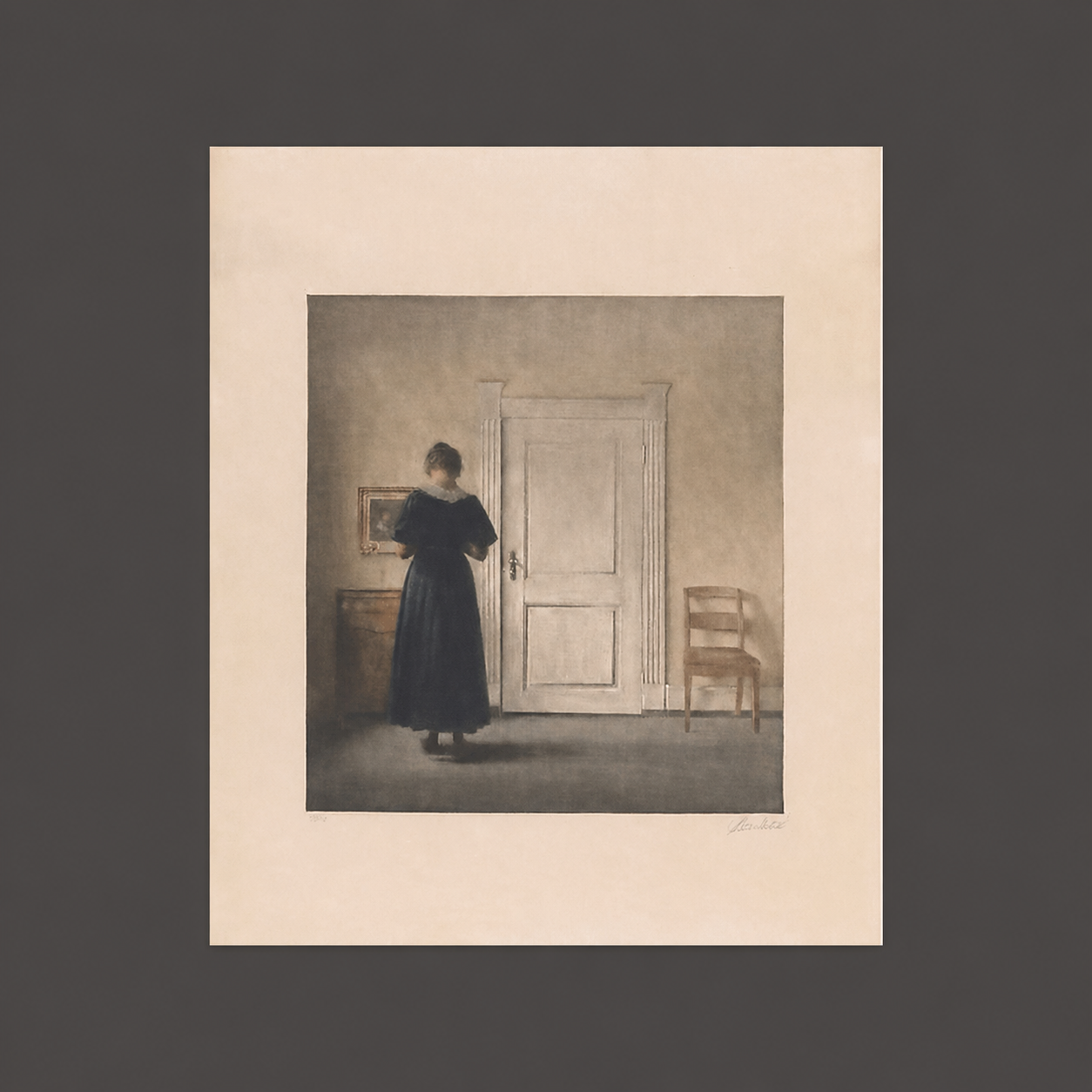
Today is Sunday, and this, which may not seem important at all, perhaps is. There is a kind of thought that comes to me only in the almost absolute calm of the Sundays I spend at home. They are not thoughts born of Friday’s euphoria after work, nor of Tuesday’s discipline. They arise in that strange moment when the week seems to pause, and one can contemplate, even if only for an instant and before a giant cup of coffee, the irregular fabric of one’s own life.
Vocation, art, affections, and bills to pay. For years, we tend to imagine that these things belong to different and contradictory worlds. Vocation inhabits an elevated, cold, Platonic region, one might say. The affections of the heart, another. Art seems to demand its own territory: the three eyes… the pineal one, I mean. And the bills to pay are relegated to a gray dimension of existence, practical and almost shameful. Bills always feel like an interruption of what truly matters. But experience teaches us something else: life is not organized into compartments. Everything in it happens at the same time.
One tries to write a page of prose that is at least moderately decent or, at the very least, comprehensible to the reader, while also thinking about the electricity bill. You love someone with whom you would rather spend the morning at home, and yet you have to get up early and go to work in front of people who, perhaps, cannot even stand you. You listen to a song that changes your mood for the day, that moves you to tears, and then you go and do the week’s grocery shopping. Reality mixes the sublime and the everyday with absolute indifference toward our classifications.
Whenever I arrive here, I also arrive at that observation by Saint Teresa of Ávila, according to which God walked among the pots and pans. The phrase is often cited for its spiritual value, and, for me, as the quintessence of what sixteenth-century Spanish mysticism was; but I believe it also contains a human intuition, one that can be discovered without needing to be a mystic: what is important, what is transcendental, does not occur outside ordinary life. It occurs within it, within its immanent temporality, that is, among pots and pans or, perhaps, in the “mud of the macadam,” as Baudelaire put it. The Heart Sutra of Mahayana Buddhism also contains a singular phrase in this regard: form is emptiness, and emptiness is form.
This Sunday, I was thinking about all this while watching some Soundgarden concerts. Not the Soundgarden of the 1990s, of grunge’s beginnings. Not the powerful, young band that seemed destined to conquer the world, and did. I am speaking of Soundgarden’s final period, between 2012 and 2017, before the strange death of its singer and songwriter, Chris Cornell. What appears there is not a veteran and experienced rock band trying to recover its lost youth with a second gulp of oxygen. Nor is it a group clinging to nostalgia, like so many we know. What appears is something rarer and more interesting: men who have learned to live with time… and with fame.
Chris Cornell no longer possesses the almost supernatural beauty of the old photographs. His face shows the wear left by sleepless nights, excessive substance use, and who knows what else. Matt Cameron, with his buttoned shirts, preserves that almost working-class sobriety that always distinguished him. Ben Shepherd looks as if he had left the house wearing a dark jacket, worn-out boots, and messy hair. Kim Thayil has become a kind of motionless sage whose mere presence is enough to alter the balance of the stage. What is remarkable is that none of them seems to be trying, by then, to prove anything.
And this, in my affections and aesthetic “choices,” is fundamental to me because, in a culture like ours, obsessed with permanent exhibition, in this society of the spectacle that Guy Debord spoke to us about, that absence of any will to impress seems astonishing to me. There is a tranquility that does not come from success or failure. It comes from somewhere else. Perhaps from acceptance.
For me, the figure who best embodies this is Ben Shepherd. He was never a virtuoso in the strict sense of the term. In fact, as he himself has said, his technical shortcomings almost prevented him from filling Jason Everman’s vacant spot. And, of course, no one mentions him alongside the great names of electric bass in rock, at least not in terms of technique, speed, or onstage spectacle. Yet he possesses something much harder to find: an unmistakable sonic personality.
The way he attacks the four strings of his Fender Precision Bass produces a “dirty and strange” sound that, according to Shepherd himself, owes much to jazz bassist Charles Mingus. It is not the classic smooth, thick Fender sound. It is a sound with a peculiar roughness, where the notes do not seem to be caressed by the fingertips but torn out with fury, rage, almost hatred. Often, the bass does not function as a melodic instrument but as a physical extension of the rhythm section, as the true heart of the Universe. What Ben Shepherd produces is not merely sound. It has the gravity and weight of a screeching locomotive.
And something similar occurs with his stage presence. The young Shepherd still participates in certain rock conventions. There is movement, energy, and theatricality. But with the years, and with maturity, he seems gradually to abandon all that. He remains onstage with a disconcerting naturalness. He neither demands attention nor competes for it. He does not attempt to fabricate an image. And yet he ends up becoming one of the most interesting figures to watch. He seems absent and present at the same time. He is not there, but he is. Perhaps that paradox explains much of his appeal. There are musicians whose presence depends on accumulation: more notes, more gestures, more speed, more spectacle. Shepherd belongs to another category. His presence emerges from density. The less he seems to do, the more significant each movement appears.
And the same could be said of Kim Thayil. In Soundgarden’s later years, he comes to resemble an electric monk, if that is not an absolute contradiction in terms. While playing some of the strangest and heaviest riffs in rock history, he remains almost motionless. As if he were meditating. His guitar solos—I believe always on a Gibson—are full of angles and unpredictable dissonances. But he plays them with the serenity of a monk watering plants in his garden… a rock garden, by the way. That immobility contains something deeply expressive. It conveys musical sufficiency, not passivity. As if there were no longer any need to convince anyone.
And here appears an idea that may be the true center of these Sunday notes. As we grow older, we must remove layers, not add them. In youth, we accumulate. Ambitions, personae, strategies, defenses, explanations. Some are necessary. Others are simply responses to fear. Often, we imagine maturity as a form of continuous enrichment. More experience. More books and readings. More knowledge. Perhaps maturing consists in learning to let go, rather than in accumulating. Becoming something more essential rather than more complex.
The Soundgarden of 2012–2017 conveys precisely that sensation. It does not seem like a band that has added elements to its identity. It seems like a band that has been stripping them away. What remains is a luxurious setlist. What remains is seasoned craft onstage, the groove remains. And friendship remains. Everything else begins to lose importance. And perhaps that is why certain forms of histrionics become less and less attractive as time passes.
There is nothing intrinsically wrong with spectacle. There are extraordinary artists whose greatness depends precisely on their theatrical capacity, but there comes a moment when one becomes more interested in what remains when the performance ends, when the lights go out. The question is no longer who appears extraordinary, but who is true. There is something moving in contemplating people—artists or not—who have stopped negotiating with the gaze of others. People who seem simply to say: here I am. It is not a heroic declaration, nor is it a proclamation. And it is curious to realize how closely this attitude resembles groove.
Because groove does not try to impress either. It simply settles into itself with such firmness that it ends up dragging along all the sounds and instruments it finds around it. Perhaps that is why some of Soundgarden’s most memorable moments are not found in the choruses or in the grand vocal gestures. They are found in those passages where the bass and the drums find the groove and remain there. Those are the magical instants in which the music seems to stop rushing forward. It begins to walk, and it does so like a locomotive that needs not prove its strength. It is enough to see it advance. Something similar happens with certain human beings. With age, they stop pursuing an image. They simply advance. And another inevitable question appears: vocation.
There is a romantic fantasy, still entirely alive, according to which the true artist should create without worrying about material questions. As if money contaminated the authenticity of creative work. But the reality we humans inhabit is usually less elegant. One may like to write, for example, which does not mean that one does not have bills to pay. Cioran said that this was why he hated Rilke and loved Dostoevsky and Baudelaire, who are always talking about money, money, and money… And there is no contradiction whatsoever between these two realities. The contradiction appears only when we separate what has never been separate.
Art does not happen outside life. Writing, music, and every form of art require time. Time requires resources, and resources require work. That work is part of the same reality that makes the work of art possible. This is why the phrase “I like to write, but I need to be paid” contains a truth. It is not a renunciation of the ideal; it is a recognition of the concrete conditions of all existence. For example, a cabinetmaker may love wood and charge for it. A musician loves music and charges for a concert. A writer may love writing and aspire for it to have material value, may also aspire to transform it into money, money, money… None of this diminishes the dignity of the vocation we feel. Perhaps it heightens it, because it returns vocation to the real world, the one we inhabit.
And here we return to Sunday. I believe there is something profoundly Sunday-like in all these reflections. Sunday is not the day of conquest, nor the day of defeat. It is a day of beginning, a day on which I like to observe and digress, to take stock. To contemplate what remains when the noise of the week diminishes. Perhaps this is why late Soundgarden seems like a Sunday band: Sunday as a perspective on things.
Kim is standing still in the left-hand corner, barely swaying. Matt Cameron holds the structure of the song “Jesus Christ Pose” together with an astonishing groove. Ben Shepherd, with his bass hanging too low, as if he had gone out to buy something at the market and had accidentally ended up onstage. Cornell singing with the intensity of someone who still has something important to say and who senses that he does not have much time left in this terrible “world of the living.”
And afterward, each one returns home, without epic, without triumph, without final revelation: only life. Is this its true mystery? Not the possibility of escaping reality through any addiction, even less the possibility of turning ourselves into glamorous legends. Rather, the capacity to fully inhabit the irreducible mixture formed by vocation, art, love, and the bills to pay. The capacity to understand that they were never separate; that they belong to the same vital fabric. The article we write, the song we hear that moves us, affection, the conversation with a friend, work, and the bill to be paid are all part of the same weave.
And that this is maturity: accepting that fact. Removing certain layers and preserving what is essential. Finding the groove: moving forward. Because today is a Sunday like any other, before a large cup of coffee. And tomorrow… Tomorrow, the bills will inevitably return. But so will the songs that move us.
Image: Interior (1911), by Peter Ilsted. The Metropolitan Museum of Art.


