
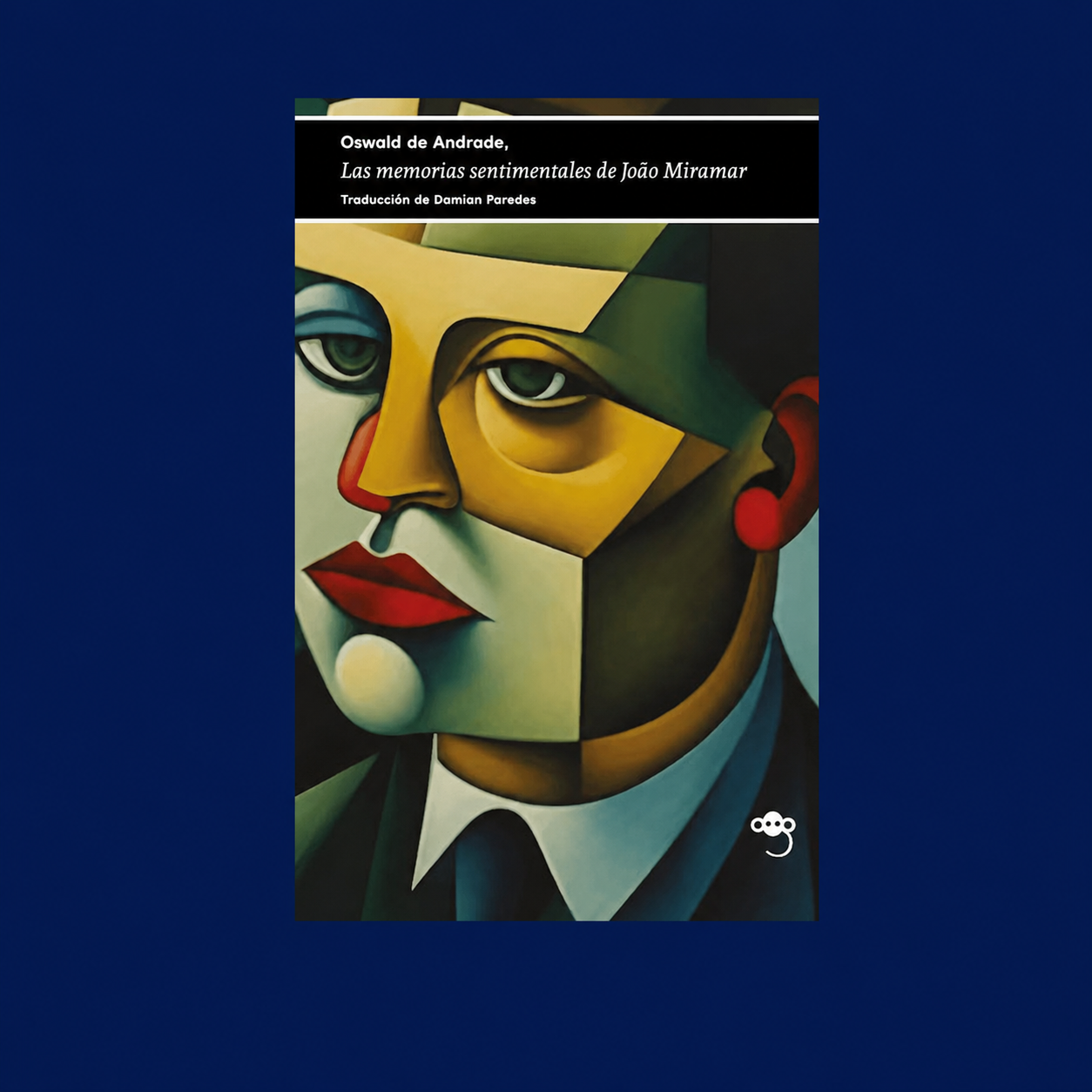
The Sentimental Memoirs of João Miramar, published by Oswald de Andrade (1890–1954) in 1924, occupies a singular place within Brazilian modernist literature. Composed of 163 brief fragments that trace the childhood, youth, and adulthood of its protagonist, the novel presents itself as a distorted autobiography, a satire of São Paulo’s bourgeoisie, and, at the same time, one of the most radical formal experiments in twentieth-century Latin American narrative. Its appearance came just two years after the São Paulo Week of Modern Art and constituted one of the boldest realizations of that renewing impulse.
Memory articulates the narrative drive of this book. Although João Miramar’s trajectory provides a recognizable biographical thread, the novel does not unfold through conventional progression. On the contrary, it seeks experimentation through a brutalist flow, a kind of wild montage. The comparison with Berlin: Symphony of a Great City (Walter Ruttmann, 1927) is pertinent: the narration advances through the accumulation of images, collisions of perspectives, and sudden associations. Scenes appear and disappear at an unusual speed, subjected to a system of cuts and assemblages that privileges discontinuity over explanation. Ellipsis does not function as an occasional device but as the organizing principle of the narrative. Each fragment seems to arise from the ruins of the previous one, leaving empty spaces that the reader must complete on their own.
The singularity of the novel lies precisely in that operation. Rather than constructing meaning progressively, the text seems to dismantle it and redistribute it constantly. Sentences are interrupted, condensed, or linked through barely suggested relations. The result is a prose in which narrative information is subjected to permanent tension. Instead of developing extended scenes, Oswald works with minimal nuclei of perception: an image, an observation, a conversation, a postcard, a travel impression, an isolated memory. The book incorporates diverse registers and places them side by side without concern for smoothing the transitions. Advertising formulas, newspaper headlines, travel notes, and fragments of conversation coexist in its pages, materials that Oswald integrates into the narration with a freedom unusual for the time. That fragmentation, which in 1924 must have seemed disconcerting, anticipates procedures that decades later would become common in various forms of experimental narrative.
Yet it would be a mistake to reduce João Miramar to a mere formal provocation. Amid the abrupt cuts and discontinuities, moments of remarkable expressive intensity appear. Where the narration seems to disintegrate, poetry unexpectedly emerges. Some images possess an evocative power that exceeds any immediate narrative function. The book itself offers flashes of that lyrical force in formulations such as “they departed, toward life between abysses and flowers” or suspended visions “in the red of dawns,” images that condense, in a few words, an uncommon breadth of resonance. Language then becomes more plastic, more attentive to echoes than to objective description. This poetic dimension does not contradict fragmentation; it is born from it. It is precisely in the intervals, in what the text omits or only barely suggests, that much of its power is produced.
The novel also preserves an evident satirical component. Through Miramar, Oswald portrays a social class fascinated by Europe, by imported cultural prestige, and by the outward signs of progress. The protagonist moves through travels, romantic relationships, enterprises, and failures while the narration records, with a mixture of irony and distance, the transformations of Brazilian society at the beginning of the twentieth century. But even this critical dimension appears filtered through verbal experimentalism. The character matters less as a psychological individual than as a point of convergence for voices, images, and discourses.
More than a century after its publication, The Sentimental Memoirs of João Miramar still retains much of its power to estrange. Considered one of the fundamental works of early Brazilian modernism and a precursor to the anthropophagic formulations that Oswald would develop a few years later, it keeps intact its will to experiment with narrative form. In its pages, satire, memory, poetry, and fragmentation coexist without ever stabilizing into a definitive form. There lies the persistence of this book: in having shown that a novel could narrate and decompose itself at the same time, and that among cuts, silences, and assemblages a singular form of poetry could emerge.
In one of its most revealing moments, the text itself alludes to “a wandering poetry, but full of soul,” a definition that could be extended to much of the reading experience proposed by the novel. The original edition included illustrations by Tarsila do Amaral and was preceded by an ironic preface attributed to the fictional Machado Penumbra, another sign of the provocative spirit that runs through the entire work. This Argentine translation is by Demian Paredes.


