
From a historical perspective, the schism initiated by Monsignor Lefebvre would regulate the political projection of Catholicism, performing a function equivalent to the Roman Empire’s relinquishment of Germania and its recognition of its present limits. Hence nominal questions are superficial, much like the contradiction inherent in Catholicism’s own universalist claim, which defines it as Catholic, although more through mechanical inertia than through genuine political will.
In this sense, one should observe that the assertion of Roman primacy is more defensive than truly governed by that aspiration, given the impotence of the other metropolitans before the emperor’s Caesaropapist ambitions in Constantinople. Likewise, the fraud of the Donation of Constantine resolves the concrete conflict produced by the abandonment of Rome, which remained the natural center of the former Western Empire even after its capital was transferred to Ravenna.
It is precisely this vacuum that Rome fills, replacing the Empire with its own pseudo-imperial structure and opposing the political excesses of the East, although it must justify itself not only through fraud, but also by distorting the Augustinian argument against Donatism. In this direction, however, the rejection of the Donatists is itself conditioned by imperial pressure and by a Church still organized according to the horizontal equilibrium of the pentarchy, which recovered an original tribalism. For them, communion with Rome meant communion with the imperial structure, not with the metropolitan of Rome. Curiously, this contraction, which follows the mechanics of orbital systems, also explains the Reformation, which would eventually transfer the original axial function to the economy through Calvin’s doctrinal excess.
What is involved, then, is a form of peristalsis in which systole naturally follows diastole, according to the Lezamian premise that, by proposing the passage from the systaltic to the hesychastic style, establishes the epistemic basis of Transcendental Realism. The gesture of Master Lezama—we may now begin—thus acquires liturgical dimensions, crossing a critical threshold at which the neo-African element of his ontological residuality emerges, liberated by the desynchronization of the West.
Lezama does not explicitly posit the neo-African, since the intuition that leaves his singular ontology incomplete does not carry him that far. He understands poiesis, not autopoiesis; he is teleological rather than probabilistic, yet he makes the adjustment that propels realism forward. This is what Transcendental Realism supplies beyond the deficiencies of Maritain’s realism, besieged as it is by idealism. For this is the materialist threat: a conception of the real so absolute that it becomes Hegelian and Kantian.
This, then, is the catalysis that produces the new state within the very emergence of Realism as Transcendental. It entails another understanding of the historical, grounded in its existential function rather than in a merely political one. The scheme is almost beautiful in its structural rapture, for the mystery of the proto-god becomes a physical rather than an ethical axiom, fulfilled in every reality through its determination within the axial function of culture, even when this appears as phronesis.
This should not mislead us. It merely adjusts historical expression to its own nature as an expression of the real. It is not a determination within the false ontology of the political, but only the expression through which the real realizes itself as historical. This is the mystery of the image, in its dissociation as form within the axiality of culture through religious practice, by means of which the real is resolved as human, as a specialization of reality itself rather than as its culminating apotheosis.
It does not matter that this practice presents itself as universal, since it actually responds to this determination in its punctual specificity. Arising from physics, it is resolved within a given structure as the exceptional fulfillment of that universality. Nor is this paradoxical—only God is great—if we appeal to the superposition of states, always states of matter, although at a level so exceedingly minute that it becomes imperceptible in its micropositivity and therefore appears metaphysical.
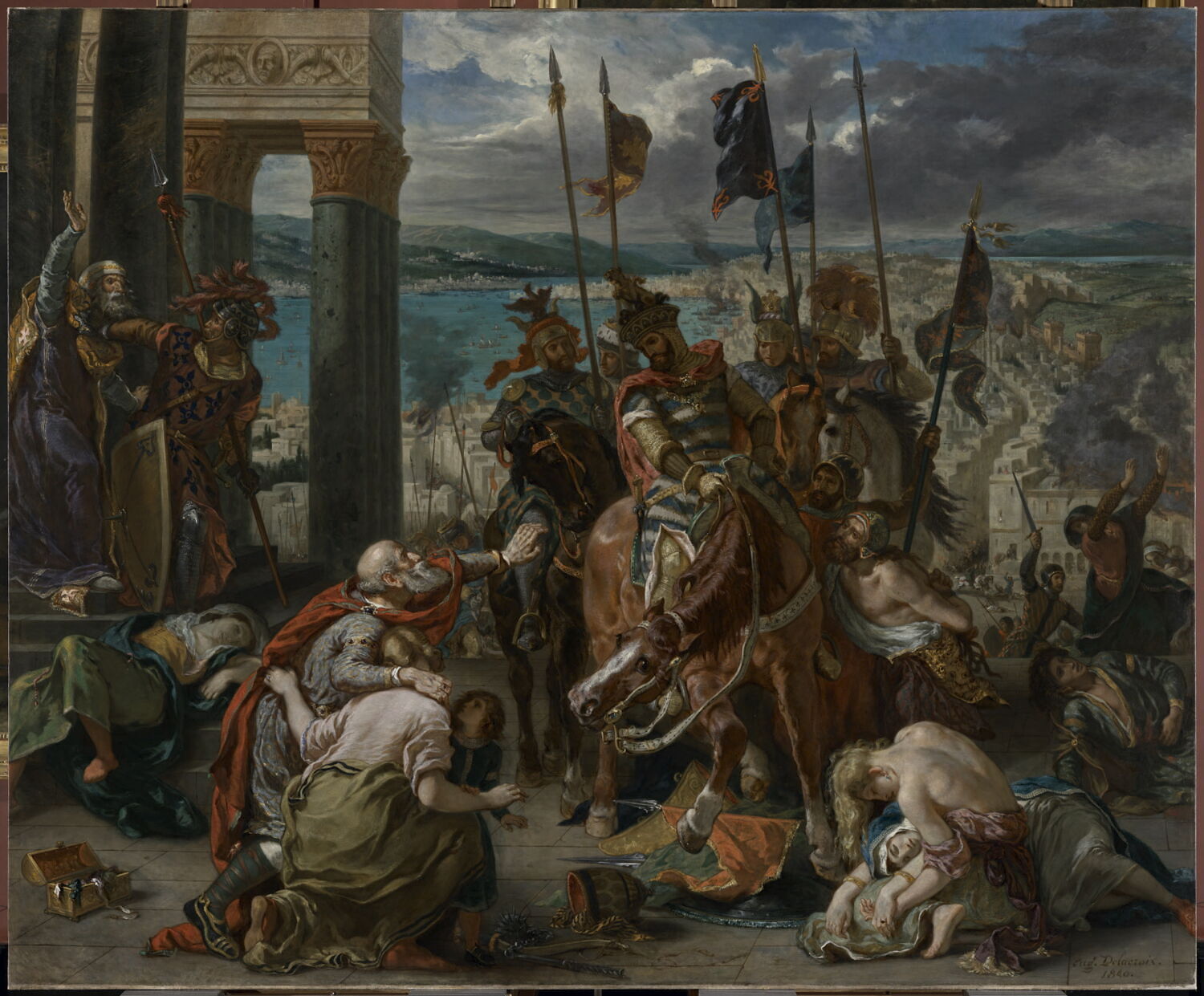
Image: Entrée des croisés à Constantinople (1840), by Eugène Delacroix. Musée du Louvre.


