
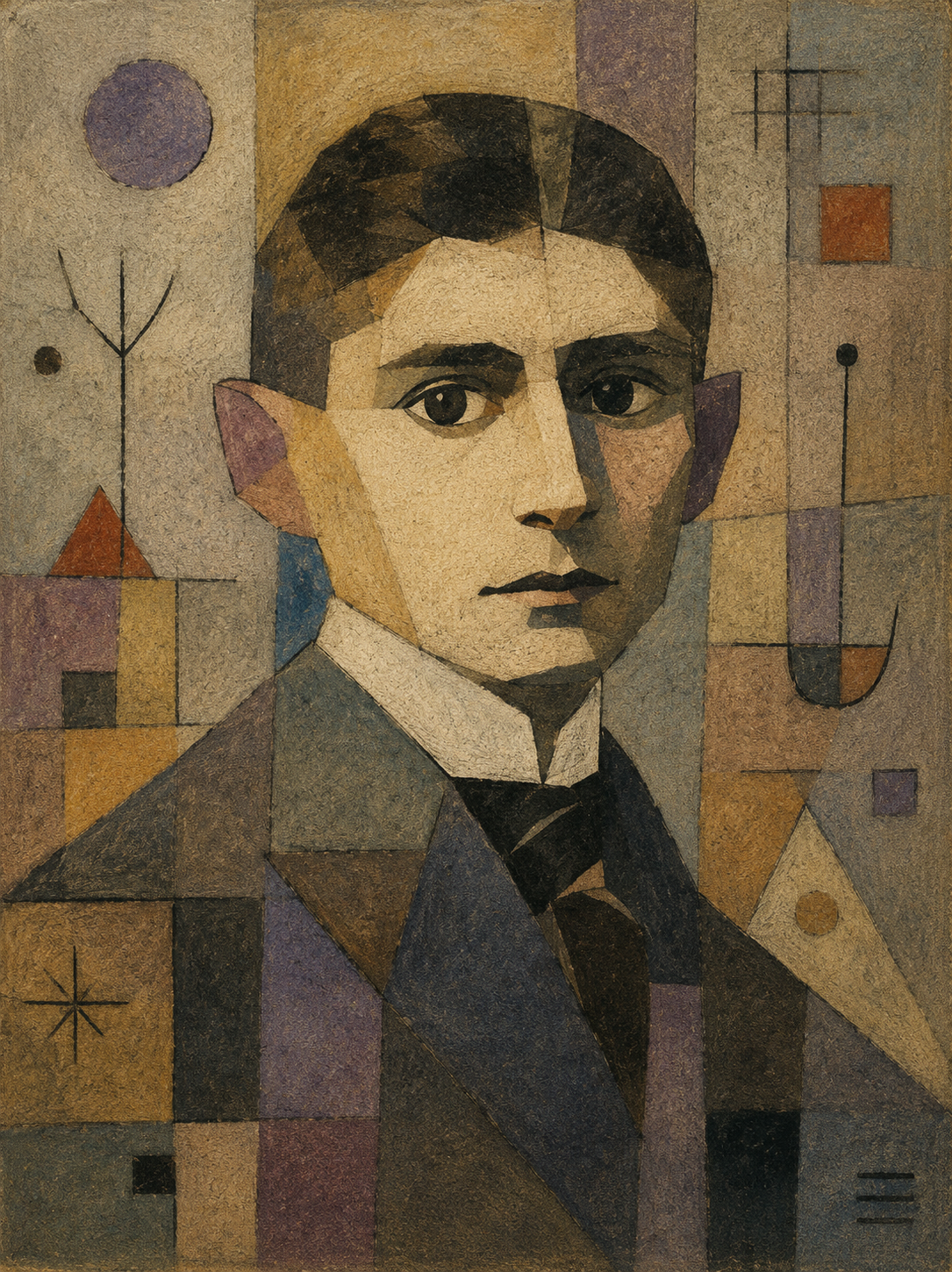
Citario. Derived from the Latin citāre —to quote— plus the suffix -ārium —repository—, similar to bestiario. A 21st-century neologism, coined by the Spanish-speaking scholars at Bookish & Co., with roots in ancient anthologies and florilegia. «Citario» is related to medieval books of commonplaces—such as those by Erasmus of Rotterdam—and to 19th-century proto-examples, such as Familiar Quotations. This “Citario Kafka” marks the 143rd anniversary of his birth through a constellation of phrases that encircle and explore the legacy of the man who made the boundaries of literary imagination more porous.
On January 16, 1922, while writing The Castle, Kafka made some comments in his diary about the concept of limits. The importance of these comments has often been emphasized, though they have not been linked to the protagonist’s profession. Kafka speaks of a collapse (Zusammenbruch) that had occurred the previous week, after which the inner and outer worlds separated and lacerated each other. The resulting unbridled frenzy (Wildheit) within him is described in terms of a “hunt” (Jagen), in which “self-observation leaves no representation undisturbed, but pushes them upward (emporjagt) only to be hunted in turn (weitergejagt) as a representation of a new self-observation.” At this point, the image of the hunt gives way to a reflection on the boundary between men and on what lies outside and beyond them: “This hunt proceeds in the opposite direction to humanity (nimmt die Richtung aus der Menschheit]. The solitude, which has mostly been imposed upon me since time immemorial and which I partly sought (but wasn’t this also a constraint?), now loses all ambiguity and goes to the extreme [geht auf das Ausserste]. Where does it lead? It can lead, and this seems inescapable to me, to madness (Irrsinn, etymologically linked to ‘irren,’ ‘to wander,’ ‘to err’)—nothing more needs to be said, the hunt passes through me and lacerates me. Or I can (can I?), even if only minimally, remain standing and thus let myself be carried away by the hunt. Where do I arrive then?” “Hunt” is just one image; I can also say “assault against the last earthly boundary” (Ansturm gegen die letzte irdische Grenze), and then an assault from below, from among men, and since this too is just one image, I can replace it with that of an assault from above, toward me.
All this literature is an assault on the boundary, and if Zionism hadn’t interfered, it could have developed into a new secret doctrine, a Kabbalah (zu einer neuen Geheimlebre, einer Kabbala). Ideas for it exist. But, of course, it requires an inconceivable genius to bury its roots once again in ancient times or to create them anew, without thereby consuming its forces; on the contrary, only beginning to consume them from this moment on.
Giorgio Agamben, “K” (2011)
◾️
To get closer to the moral of this fable [Josephine the Singer], one must examine a characteristic feature of Kafka’s stories: they almost always consist of two tales nested within one another. This is especially evident in stories like “In the Penal Colony,” where the narrative that commands attention concerns the torture-and-execution machine—a subject that has long occupied critics and interpreters—yet this story is framed by another: the administrative problem that has arisen in the colony. As if sensing that the “internal” matter might overly monopolize the reader’s attention, Kafka expanded the “frame” in other tales, making it the dominant element in some texts, such as “The Village Schoolmaster.” Indeed, the novels The Castle and The Trial are essentially descriptions of the framework surrounding a center that remains empty. Perhaps therein lies the secret of Kafka’s innovation—the key to the “Kafkaesque.” Throughout the history of literature, stories—whether short or long—have employed a secondary, incidental narrative to frame, present, or stage the primary invention; Kafka, however, ultimately eliminated this primary invention, while simultaneously outlining its shape through the secondary one. By remaining silent about this center (about what occurs inside the castle or the substance of the trial), he created a peculiar universe that feels formalistic and empty; from this emptiness radiates an anguished sense of futility that permeates the characters’ activities.
César Aira, “Kafka, Duchamp” (2021)
◾️
Waterfall, Ascending and Descending, Relativity, Print Gallery: in many of Escher’s lithographs, one can glimpse visual translations of Kafka’s parables and paradoxes. They do not make comprehension easier; rather, they elevate the bewilderment sparked by reading to a more harrowing and revelatory level.
It is hardly surprising that Escher and Kafka share an obsessive interest in certain themes: the Tower of Babel, metamorphoses, and absolute stasis amidst seemingly ceaseless change. By pointing to the non-existence or futility of movement, both hint at an Eleatic lineage. Confronting Zeno’s arrow, Escher offers his own variations: figures who neither ascend nor descend while climbing up and down stairs; birds occupying the very sliver of space they never vacate despite their perpetual flapping; stationary flights within a fixed space—flights performed by those same birds.
Kafka paralyzes his characters—and his readers—with processes that are meticulously reasoned yet devoid of sense, processes bent on reaching no destination other than their own irrational raison d’être: drawing ever closer—by half of a half of a half—to a goal that is infinitely elastic. Infinitely Eleatic. Hence those curious staircases positioned between two floors yet reaching neither; or that imperial messenger striving in vain for millennia to escape infinitely concentric chambers within infinitely concentric palaces amidst vast multitudes, all to personally deliver the message of an emperor long dead and surely forgotten. Neither his effort nor his message makes sense. Perhaps the only thing that holds meaning is the nightmare of imagining it. Imagining it is almost as disastrous as awaiting it. Could we, a few thousand years hence, decipher the message of the dead? And to dream thus of our own immortality—would that not be even more difficult than the obstinate messenger’s endless odyssey?
Octavio Armand, “Kafka’s Hall” (2016)
◾️
Kafka is not “Kafkaesque.” For twenty years, the Kafkaesque has nourished the most diverse literary currents, from Camus to Ionesco. Is the aim to describe the bureaucratic terror of the modern age? The Trial, The Castle, and In the Penal Colony serve as exhausted models. Is the goal to articulate the claims of individualism in the face of an invasion of objects? The Metamorphosis offers a fruitful resource. At once realistic and subjective, Kafka’s work lends itself to everyone yet answers no one. Admittedly, the work is rarely interrogated; for writing in the shadow of his themes is not the same as questioning Kafka. As Marthe Robert aptly puts it, do not solitude, alienation, anxious searching, and familiarity with the absurd—in short, the constants of the so-called “Kafkaesque universe”—belong to all our writers the moment they refuse to write in the service of the world of possession? In truth, Kafka’s answer is addressed to the very person who has questioned him least: the artist.
(…)
Kafka’s technique posits that the meaning of the world cannot be articulated; that the artist’s sole task is to explore possible meanings—each of which, viewed in isolation, is merely a (necessary) lie, yet whose multiplicity constitutes the writer’s very truth. This is the Kafkaesque paradox: art depends on truth, yet truth—being indivisible—cannot know itself; to speak the truth is to lie. Thus, the writer embodies the truth, and yet lies when he speaks: a work’s authority never resides in its aesthetics, but solely in the moral experience that transforms it into an embraced lie—or rather, as Kafka says in correcting Kierkegaard: one attains the aesthetic enjoyment of being only through a moral experience devoid of pride.
Roland Barthes, “Kafka’s Answer”
◾️
In Kafka’s works, the conditions in offices and in families have multifarious points of contact. In the village at the foot of Castle Hill people use an illuminating saying. “We have a saying here that you may be familiar with: Official decisions are as shy as young girls.’ “That’s a sound observation,’ said K., ‘a sound ob-servation. Decisions may have even other characteristics in common with girls.’ ” The most remarkable of these qualities is the willingness to lend oneself to anything, like the shy girls whom K. meets in The Castle and The Trial, girls who indulge in unchastity in the bosom of their family as they would in a bed. He encounters them at every turn; the rest give him as little trouble as the conquest of the barmaid. “They embraced each other; her little body burned in K’s hands; in a state of unconsciousness which K. tried to master constantly but fruitlessly, they rolled a little way, hit Klamm’s door with a thud, and then lay in the little puddles of beer and the other refuse that littered the floor. Hours passed… in which K. constantly had the feeling that he was losing his way or that he had wandered farther than anyone had ever wandered before, to a place where even the air had nothing in common with his native air, where all this strangeness might choke one, yet a place so insanely enchanting that one could not help but go on and lose oneself even further.” We shall have more to say about this strange place. The remarkable thing is that these whorelike women never seem to be beautiful. Rather, beauty appears in Kafka’s world only in the most obscure places-among the accused persons, for example.
Walter Benjamin, “Franz Kafka, On the Tenth Anniversary of His Death” (1934)
◾️
Some religions transformed the impossibility of death into immortality. That is to say, they sought to “humanize” the very fact that signifies: “I cease to be a man.” Yet only the opposite movement renders death impossible: through death, I lose the advantage of being mortal, because I lose the possibility of being a man; to be a man beyond death could only hold this strange meaning: to remain capable of dying despite death, to carry on as if nothing had happened—with death as a horizon and an equal hope—finding no other outlet than to “carry on as if nothing had happened,” and so forth. This is what other religions termed the curse of rebirth: one dies, but dies badly because one has lived badly; one is condemned to relive, and relives until—having fully become a man—one becomes, in dying, a blessed man: a man truly dead. Kafka inherited this theme through the Kabbalah and Eastern traditions. Man enters the night, but the night leads to awakening—and therein lies the misery. Or else, man dies but actually lives; he wanders from city to city, swept along by rivers, recognized by some but aided by no one, while the error of his former death laughs sarcastically at his bedside—a strange condition, that: he has forgotten how to die. Yet another believes he is living because he has forgotten his death, while yet another, knowing himself to be dead, struggles in vain to die; death is remoteness—the great, unreachable castle—just as life was remoteness, that native place abandoned for a false calling. Now, nothing remains but to struggle, to labor toward dying completely; yet to struggle is to go on living, and everything that brings one closer to the goal renders the goal inaccessible.
Kafka did not make that theme the expression of a drama of the beyond; rather, through it, he sought to grasp the immediate reality of our condition. He saw literature not only as the best means to describe that condition but also as a way to find a way out of it. High praise, indeed—but is it deserved? Admittedly, there is a powerful cunning in literature, a mysterious bad faith that—by allowing it to constantly play on two boards—gives even the most honest people the unreasonable hope that they might lose and yet have won. Above all, it also works toward the unfolding of the world; it is civilization and culture.
Maurice Blanchot, De Kafka à Kafka (1981)
◾️
Critics lament the absence of many intermediate chapters in Kafka’s three novels, yet acknowledge that these chapters are not essential. To my mind, this complaint reveals a fundamental misunderstanding of Kafka’s art. The pathos of these “unfinished” novels arises precisely from the infinite number of obstacles that repeatedly halt their identical protagonists. Franz Kafka did not finish them because the essential thing was for them to be interminable. Do you recall the first and clearest of Zeno’s paradoxes? Motion is impossible, for before reaching B we must pass through the midpoint C, but before reaching C we must pass through the midpoint D, but before reaching D… The Greek does not enumerate every point; Franz Kafka need not enumerate every vicissitude. It suffices to understand that they are infinite, like Hell.
Jorge Luis Borges, preface to The Metamorphosis (1938)
◾️
December 1910: a bleak and barren period. Kafka uses his diary primarily to record observations regarding his own inability to write. “With what argument shall I justify the fact that I have written nothing today? With nothing,” reads one entry. And then: “I constantly hear an invocation: Oh, if only you would come, invisible tribunal!”
With these words—as if invoking a potent spell of the left-hand path—Kafka crosses a threshold, entering the realm of The Trial and The Castle, as well as the rest of his body of work. It is a place of writing defined by the anticipation of a verdict or the delays of an interminable legal process. A tortuous place, yet the only one to which Kafka knows he belongs. Having just arrived at the village at the foot of the Castle—and already rejected and harassed—K. knows only that he has “come to stay here,” as if any other way of life were already impossible for him. And he repeats: “I shall stay here.” Then, in the tone of someone “talking to himself,” he adds: “What motive could have drawn me to this desolate land other than the desire to stay here?” The “desolate land” is the Promised Land. And the Promised Land is the only place of which one can say, as K. does: “I cannot emigrate.”
Roberto Calasso, K (2006)
◾️
Kafka’s taciturnity—his tendency to keep secrets even from his closest friends—must be understood as an exercise in obstinacy. He is not always conscious of his silence. Yet when his characters give themselves over to their verbose speeches of defense—in The Trial or, especially, in The Castle—one senses Kafka opening his own floodgates: he rediscovers words. As a rule, his obstinacy prevents him from speaking; but here, under the apparent guise of a literary character, he is unexpectedly granted freedom of expression. It is not like the confessions found in Dostoevsky; the temperature is different—far less feverish. Nor is there anything amorphous; rather, there are exercises in speed performed on a precisely defined instrument capable of producing only specific sounds—the speed of a meticulous yet unmistakable virtuoso.
The story of his resistance to his father—which cannot be explained by the usual banal interpretations—is also the age-old story of that very obstinacy. A great deal has been said on this subject that appears entirely mistaken; one might have expected that Kafka’s own masterful view of psychoanalysis would have helped to exempt him—at the very least—from its narrow confines. In essence, Kafka’s struggle against his father was nothing more than a struggle against superior power. His hatred was directed at the family as a whole; the father was merely the most powerful element of that family; and when the prospect of a family of his own arose, the struggle against Felice took on that same underlying motive and character.
Elias Canetti, Kafka’s Other Trial: The Letters to Felice (1969)
◾️
Maybe those sleepless weeks inspired him. There was, in insomnia, a terrible lucidity, which projected an empty halo around things and stripped them naked. He realized that if he wanted to get out of the dark room where the ghosts were holding him prisoner, he needed a “weapon.” There was no salvation in literature. He had to leave literature, which feeds ghosts: no longer be a wanderer, a wanderer, a stranger: and enter the land of Canaan, where real men and women live, and where he had always longed to live. It is true that he did not know Canaan. He had barely represented it in The Castle, through K.’s eyes: that “frankly miserable little town, made up of village houses” with the fallen plaster and the stone that seemed to crumble, in which his character managed to live only after death. It was not a comforting image. But what if he had represented Canaan with the eyes of ghosts? What if they had misled him? Thus, for a few months, I had begun to reread the Bible and read books in Hebrew; to take conversation classes in Hebrew; and to support and protect Jewish initiatives, including a daycare center, no matter how desperate they may seem to you. His goal was Palestine: where, otherwise, life was very cheap and the dry climate would do his sick lungs good.
Pietro Citati, Kafka (1987)
◾️
I once wanted to write a story in which someone, simply by developing acne, began to view everything through different eyes. That story was to be called *ACNE*. That was a long time ago, when my world was Kafka’s world and my hero was Dr. Franz Kafka. “All the accused are handsome.”
How I saw myself reflected in Kafka’s shame—no, not reflected, but discovered for the first time… and then forever reflected. And how faint-hearted, how fearful that shame seems to me today—how arrogant.
Perhaps that is why I often snooped through the documents, like a private eye, to see if Kafka had actually slept with women. The heat in his stories is somewhat like the heat of a dream: on one hand, animalistic—amidst puddles of beer beneath a tavern table—yet on the other, stifled by the fear of soiling the clean sheet that his mother might later see… The world Kafka describes was, in a way, an adolescent world; and as far as sexuality is concerned, an adolescent one.
Peter Handke, “About Franz Kafka” (2007)
◾️
Interruption—a major theme for Kafka—is the interference that prevents one from reaching the destination. Suspension, diversion, postponement: these are classic elements in his work; he narrates them constantly, yet they also define the very register of his writing. His style is an art of interruption, the art of narrating interference.
The writing itself is often left suspended in mid-air. The diary entry Kafka wrote on August 20, 1912, regarding his first meeting with Felice, breaks off in the middle of a sentence: “As I sat down, I looked at her more closely for the first time; once seated, I had already formed an unshakable judgment. How she… [Wie sich-.]”
“How she…” It sounds like the title of a Beckett story. In fact, the entire saga with Felice resembles a Beckett story.
The entry breaks off mid-sentence while he is speaking about Felice. He does not manage to finish speaking. What he was about to say remains incomplete, left in suspense.
We will never know what interrupted the entry. Yet that truncated sentence speaks volumes. Not because he was about to say something beyond what is already there (though we cannot know for sure, the opening is highly promising), but because it effectively signals that there is more—that there *could* be more: perhaps an explanation, who knows? Conjecture is possible; the meaning does not close off—or rather, it remains visibly open. Or better yet: not merely open, but cut short, suspended in mid-air.
There are many other examples in his work of this way of suspending the writing. Nor do we know why certain stories come to such abrupt ends. One of his great late texts, “The Burrow” (1923)—a story about confinement, about the construction of a burrow, about the need to isolate and defend oneself against invasion (a story that, in a sense, narrates and comments on the world of the cellar)—concludes thus: “My digging makes hardly any noise; but if [the animal] had heard me, I, too, ought to have noticed it; at the very least, the animal would have interrupted its work from time to time and pricked up its ears, but everything remained the same, the…”
Rather than ending, one should say that the narrative cuts off—it is interrupted. The same happens in The Castle.
Ricardo Piglia, The Last Reader (2005)
◾️
Anyone who breaks down Kafka’s work into a collection of biographical fragments will inevitably want to interpret it as autobiography. Yet the dilemma arises the moment one weighs the facts. Is it truly necessary to know everything? One might wonder whether we would read The Man Who Disappeared differently had the letters to Felice been lost. We would undoubtedly read it differently if we knew nothing of Kafka’s enthusiasm for Yiddish theater, for we would miss—among other things—an important dimension of the human gesture, which plays such a central role in his novels. But what do we gain from learning that Dickens’s David Copperfield contains a character resembling a minor figure in The Man Who Disappeared? Or that the doorman at 36 Niklasstrasse—in whose top-floor apartment Kafka wrote most of the novel—had previously worked as a hotel stoker?
The comical quality such details instantly acquire when stripped of their self-indulgent research context stems from the fact that they stand in utterly obtuse contrast to the persistent unease radiating from Kafka’s stories. They offer reassurance rather than fostering understanding. And they completely miss the true enigma these texts present: that, despite being saturated with the most private allusions, they stand on their own as aesthetic structures.
Reiner Stach, Kafka (2005)
◾️
Amidst the already vast body of literature on Kafka, nothing is more revealing for the reader of his novels and stories than the interpretation offered by the German essayist Hannah Arendt. She strips the work of its purely invented elements—its deus ex machina—and presents it within its social reality: “bureaucracy as the Leviathan of the age,” much like the papacy or the Chaldean priesthoods were in other eras. It was upon this bureaucracy that Kafka turned his brilliant gaze, warning of the dangers it posed. Hannah Arendt unravels this when she observes: “To the twentieth-century public, bureaucracy did not seem a sufficient evil to account for the horror and terror expressed in the novel. People were more frightened by the story than by the reality. The modern reader—or at least the reader of the twentieth century—fascinated by paradoxes qua paradoxes and drawn to mere contrasts, was not particularly inclined to see reason.”
Yet this very reaction from the audience was conclusive proof of the paramount importance that the element of fiction and invention holds in Kafka’s work. It exerts such a powerful pull—hovering over his writing—that it sweeps the reader into a delirium of reverie, of waking dreams, of nightmares experienced while fully awake; at the same time, it is so salutary that it has the power to cast aside that “horror of the present” and transmute it into the “delightful horror of the timeless.” That is precisely where a writer like Dostoevsky, for instance, falls short. In his work, the element of invention is virtually non-existent, while psychological complexity reaches astronomical levels. This well explains the fatigue that overcomes us when we attempt to read The Brothers Karamazov from start to finish; the novel offers no “flying carpet” for the journey, leaving us to trudge the entire path on our own two feet. Kafka, by contrast, offers us just such a vehicle in abundance. In his work, fiction and invention assume infinite proportions, to the point where the burdens of contemporary reality are themselves transformed into fiction and invention. Therein lies his entire secret.
Virgilio Piñera, “The Kafka’s Secret” (Orígenes Review, n. 8, Havana, 1945)
◾️
So, is The Trial a satire of the justice system? Far from it. Just as In the Penal Colony is not a military satire, nor The Metamorphosis a satire of the bourgeoisie, we are dealing here with autonomous works that offer inexhaustible scope for interpretation.
His loyal friend Max Brod—author of the beautiful afterword and the man to whose tireless efforts we owe the publication of this treasure and almost all of Kafka’s works—reveals that the book was left unfinished. It shows. And on this point, I find myself somewhat at odds with Max Brod. For in the work of this marvelous prose writer, I also perceive, here and there, a certain lack of balance. To my mind, the magnificent final chapter connects rather abruptly with the penultimate one—which, incidentally, is a masterpiece in its own right. At my request, Max Brod was kind enough to share his opinion of The Trial with me. It is as follows:
The process unfolding here is the eternal one that a man of refined sensibility must resolve with his own conscience. K., the protagonist, confronts his inner judge. These ghostly proceedings take place in the most nondescript settings, and in such a way that K. appears to be constantly in the right. Similarly, we always seek to justify ourselves when arguing with our conscience, while simultaneously trying to dismiss it as a mere trifle. It is this erroneous assessment of one’s own inner voice that is truly significant—a false judgment that becomes increasingly palpable as time goes by.
Naturally, one could never speak of interpretations with Kafka, not even in the utmost intimacy. He always interpreted things in such a way that the interpretation itself required a further interpretation—just as the process, too, never reaches a final resolution.
It is evident that this process—as can also be gathered from Brod’s comments in the epilogue—was never conceived as an allegory. The symbol took on a life of its own right from the start. And what a life it was…
Kurt Tucholsky, “The Trial” (1926)
◾️
The letters made public by Marthe Robert—most of them addressed to Max Brod—cover a brief but decisive period: from 1917 to 1921. That handful of texts sent to his friend from the sanatorium already contains all the essential themes of his stories and novels: solitude, the absurd, anguish, and the obsession with his father. At least three of these letters explicitly show that Kafka was aware of the antisemitic sentiment beginning to spread vilely around him—even within the sanatorium itself—a fact that aligns with the arguments of critics like Ernst Fischer and Garaudy, who view this as the result of a prophetic intuition regarding the looming racist cataclysm. Yet other letters bear clear witness to the perpetual sense of hostility that hounded the great writer—a feeling that can also be attributed to deeply personal conflicts involving family, sexuality, and the slow but relentless ravages tuberculosis was wreaking on his body.
Mario Vargas Llosa, “Unpublished Kafka” (1965)


