
What I would most wish to write, there lies the forbidden:
it brings no profit. Yet I cannot write the other thing either.
And so the product is a final hash, and all my books are patches.
Herman Melville (fragment from a letter to Nathaniel Hawthorne)
Herman Melville (1819–1891) devoted seventeen years to writing. He first became known with a fictionalized and autobiographical account from 1846, which he titled Typee, or the Marquesas Islands. It enjoyed moderate success. He was then twenty-seven years old. Popular in a short span of time and later excessively relegated because of strange narratives filled with symbols and allegories, the author of Pierre; or, The Ambiguities and Benito Cereno would not, in truth, be properly esteemed until after the Great War.
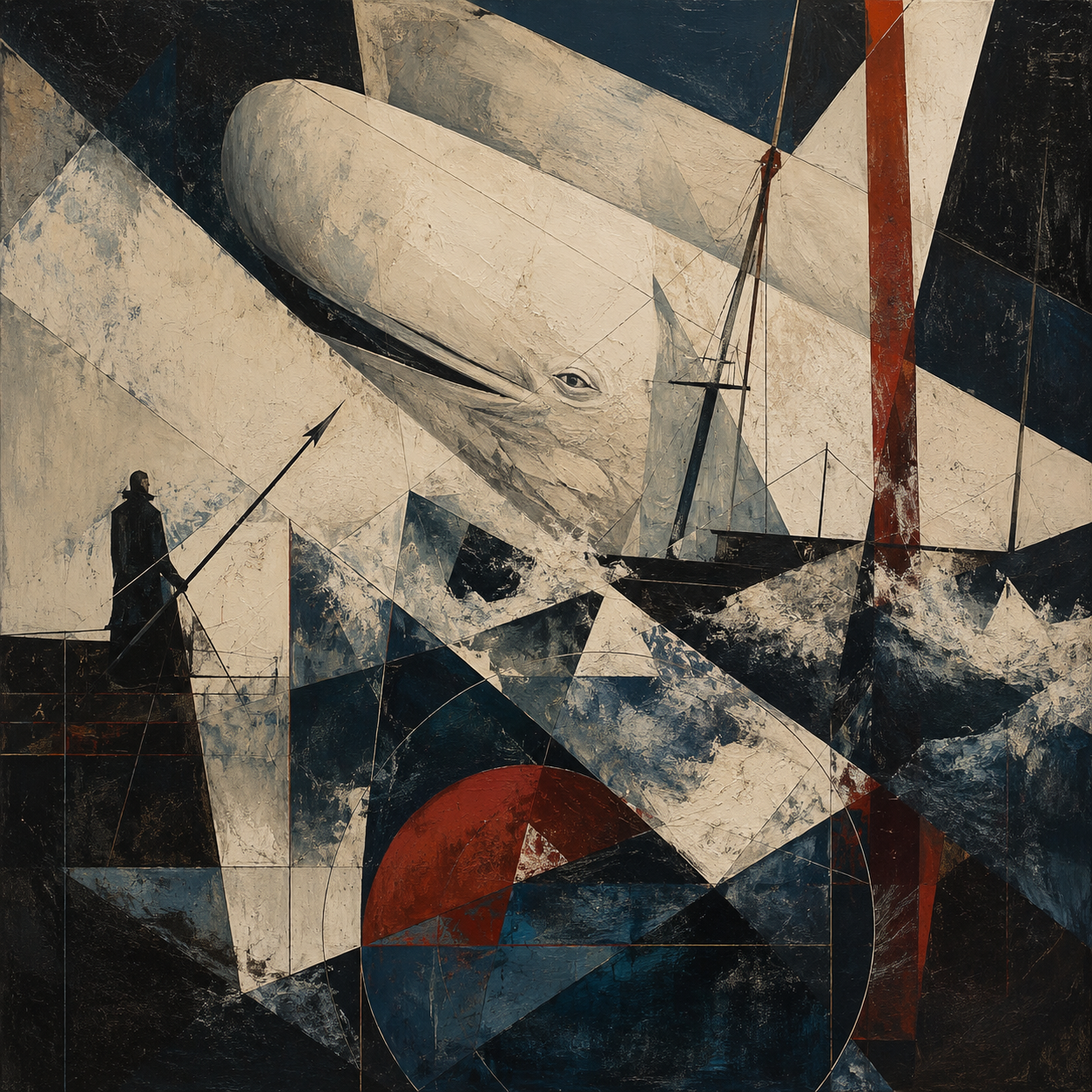
Readers and critics of the seafaring writer — who discovered on the high seas the most unsuspected physical and spiritual pleasures — agree that Moby-Dick; or, The Whale (1851) is his masterpiece. For a long time assimilated conventionally as an adventure novel, it would acquire new interpretations with the arrival of more resolute readers, more attuned to the story’s inner recesses. Perhaps there was a certain reserve when Melville began to conceive it. Yet, as Paul Auster states in his highly respectable essay Hawthorne at Home: “under the influence of the author of The Scarlet Letter, the book began to change, to deepen and expand, transforming itself through an unstoppable frenzy of inspiration.”¹ Not without reason does the dedication of Moby-Dick read: “In token of my admiration for his genius, this book is inscribed to Nathaniel Hawthorne.”
Although Moby-Dick condenses the experiences of Melville the sailor, the plot offered him an opportunity to express, directly and indirectly, everything he felt and thought as an interpreter of the world. He set allegories in perceptible settings, where symbols were abundant. After each book, he would reveal portions of his complicated personality. Albert Camus maintains that in Melville’s work, the symbol emerges from reality, and the image is born of perception. For that reason, the North American writer never separated himself from flesh or from nature, both shadowed in Kafka’s work.
The novel is covered by an allegorical mantle thanks to names and places that are anything but ordinary. The attentive reader manages to distinguish the accumulation of suggestions. Yet the greatest merit of this narrative does not rest in its language, as Aldous Huxley puts into the mouth of one of his characters in Art, Love and Everything Else:
And what prevents Moby-Dick from being a truly great book is, in effect, its pseudo-Shakespearean phraseology, which it employs in all its most tragic moments, a phraseology especially suited to comedy, though the exceptional success of Shakespeare himself, Marlowe, and others has unfortunately deceived their imitators.
What is perhaps most admirable is located in the dramatic tension within a context that deliberately motivates and defines the psychology of its characters. His characters act and undo, while the story advances. But Melville does not neglect their psychologies. In this, he was a master. Consider the existentialist charge of Ishmael, the insubordinate and hermitic subjectivity of Captain Ahab — the quintessential romantic and tragic spirit in this narrative — or the multiplicity of meanings the white whale can, and indeed does, possess. A multiplicity given in the form of symbols and allegories that, unlike W. Somerset Maugham, Jorge Luis Borges would indeed recognize.
Some readers might suppose they are facing a phallocentric or macho story because of the absence of women. Could one admit as much? They are distanced from work routines that appear to concern only men. Perhaps one presumes what the connection between women and fishing vessels was like in nineteenth-century North America. For his part, Melville could well have had access to reports from earlier periods, in which female representation in cetacean matters was attested. Juan Maura specifies in his precise article “Spanish and Portuguese Women in Whale Fishing (Newfoundland, Sixteenth Century)”² how much the role of women of all social classes meant in what constituted the social and economic fiber of Hispano-American society: the fishing banks. This matters, but the desirable or remembered women in Melville’s narrative founder. What concerned the New York narrator was registering, at the opportune moment, the romance between Ishmael and Queequeg. Through circumstantial justifications, these friends bring their bodies close and enliven them in one of the cabins of the vessel Pequod. In the narrative, Ishmael recounts:
Thus we had lain in bed, chatting and dozing at brief intervals, and Queequeg, from time to time, affectionately throwing his dark tattooed legs over mine, then withdrawing them, so utterly sociable, free, and comfortable as we were […]. His story finished with the last dying puff of his pipe, Queequeg embraced me, pressed his forehead against mine, and blowing out the light, we rolled over one another, this way and that, and very soon fell asleep.
One does not know how such a passage went unnoticed by the readers of the accelerated and puritanical nineteenth century. What is certain is that the homoerotic relationship between two men is another of the novel’s details.
Some believe it necessary to have already traveled far along the path of biblical and even Shakespearean assimilations in order to understand where this surprising book is really going. But the force of what happens, along with its characters, is enough to become enthusiastic about the reading. In a letter to his friend, the writer Nathaniel Hawthorne, Melville reveals: “The story of Moby-Dick is not yet cooked, though the hell-fire in which the whole book boils should rationally have cooked it long ago.” He doubted they would understand it, and still he completed it.
Four years before the commemoration of Melville’s bicentennial, In the Heart of the Sea (Ron Howard, 2015) was released. The feature film by the director also responsible for A Beautiful Mind, The Missing, Cinderella Man, The Da Vinci Code… is not another adaptation of the epic maritime narrative, yet it synthesizes and anticipates the spirit of Moby-Dick. In fact, its point of departure lies in the book Narrative of the Most Extraordinary and Distressing Shipwreck of the Whale-Ship Essex, by first mate Owen Chase. Nathaniel Philbrick also wrote a historical document titled In the Heart of the Sea: The Tragedy of the Whaleship Essex. Here, without disregarding Owen Chase’s vision, the maritime story is told from the point of view of the cabin boy Thomas Nickerson.
In Howard’s film, Melville (Ben Whishaw) visits an old and tormented Nickerson (Brendan Gleeson), who will recount to him the assaults of a terrible storm and the beastly offensive of the gigantic cetacean that would condemn nearly all the lives aboard the Essex, not without first humbling its crew. Nickerson would write The Loss of the Ship “Essex,” Sunk by a Whale, and the Tragic Experience of the Crew in Open Boats. It is another narrative. Found in 1960, it would not be published until 1984. The cinematic work supports the apprentice’s writing more than the first mate’s description does. Yet it is known that the manuscript lent on the high seas by Owen’s son to Melville, when the latter was still a sailor aboard the Acushnet, served him as a direct report of what had occurred.
Upon reading the document, Melville decided, out of ethics, to sidestep the explicit acts of cannibalism as they were described each time a castaway died. He configured — from a realist approach — a fiction of powerful symbolic charge in which literary references, references to the whaling trade itself, knowledge of cetology, and maritime life in general are closely linked.
Moby-Dick; or, The Whale³ embarks us toward a tense proximity between man and nature, between the known and the mysterious, between unease and concentration, control and violence. It is an enormous allegory of existentialist and metaphysical contrasts. In In the Heart…, we witness the plot of one of the worst survivals: that of maritime incommunicability and meteorological inclemency, of hunger and lack of water…; a survival comparable only to what someone might experience in the desert. Is the desert not, perhaps, an analog of oceanic monstrosity?
The narrative alternates between Nickerson as an old man (Gleeson) and as a young man (Tom Holland), Captain George Pollard (Benjamin Walker), and First Mate Owen Chase (Chris Hemsworth). The screenwriters show the good sense not to linger too much over the presence and satisfaction of Mocha Dick, as in Orca (Michael Anderson, 1977). She bursts in when she must. In the Heart… is the story of a group of survivors, not of a confrontation with a whale.
The extensive feature film succeeds in reflecting those first decades of the nineteenth century in the United States, when the whaling industry provided work for men and women. In this sense, the period recreation is very fortunate, distinguishing the social-climbing sailor from the professional committed to his companions in crossing and pursuit, to his vessel. The plot could not insist directly on the mistreatment of the cetacean, for what matters is to show the human being in his context of apparent security and dominion, and then, after the initial misfortune — the encounter with the whale — to display him adrift, powerless, and at the mercy of God. The albino sperm whale is not the antagonist of this story; the oceanic context is. The circumstances had to appear deeply adverse to life and hope. It is revealing, in an entire episode of the animal’s “humanization,” how it mercifully floats between the two remaining rafts and, after observing Chase, decides to desist from these men, who by then are emaciated and in agony.
The film alternates between the conversations of Melville and Nickerson and the events that happened to the crew of the whaling ship, with the director favoring the past. Technology makes it possible to imitate the fury of the sea, the appearance and entry into it of the impetuous mammal. It is essential to understand the consequence of the event in the novelist’s work. It was an unusual incident, worthy of being remembered. For his part, one should highlight that moment when the retired sailor asks Melville, the interviewer, about one of his secrets, and he answers that he is not as fascinating and notorious as Nathaniel Hawthorne. A splendid response from someone who could, let us not deceive ourselves, have seasoned it with something spicy from sailors.
In 1819, the year of the completion and exhibition of the imposing oil painting The Raft of the Medusa⁴, Théodore Géricault recreates the oppositions between life and death, beauty and ugliness, discouragement and hope through an event of resistance at the moment of the shipwreck, in 1816, of a French frigate. The work would scandalize its time. It was not understood that aesthetic appreciation in art differs from attention to a true and historical event, recognizable perhaps by the allusive title. Ernesto Sabato recalls that there Géricault represents the revolt of the self, the proclamation of the “rights of the heart.” The men of the Medusa endured thirteen days until they were rescued; those of the whaler Essex, more than ninety. The survivors did not even have strength left to die. In Ron Howard’s film, allusion is made to that dreadful fate in which the self is suffocated as never before; a timely memorandum for the detachments of the heart.
The writer would remain intent on establishing a personal delight through one of his dearest thematic obsessions: sailors’ sexual drive. Billy Budd (1924) once again attracts interest for its emphasis on life aboard the British warship Indomitable. Yet it is not the sea that matters, but what sails across it: the agreeable topman, who becomes uncontrollable. Under the command of high-ranking officers, a torrent of testosterone flows that, beyond the articles of war and the orders of Captain Vere, fixes relations of power. These are exploited by the despotic master-at-arms Claggart, representative of dark religious authority. He punishes anyone who does not obey him or looks at him with malice. The boy Budd, an unconscious seducer, arrives to enliven the internal confrontation. He is young, energetic, and handsome. He embodies masculine perfection. Despite his transient stammer, he is admired, and more than a few desire him. “The man-child” arouses a furtive discomfort that determines his tragic fall. That he is the instigator of a mutiny is not believed, even though his candor violates, antagonizes, wounds.
Budd — following the three classes of protagonists proposed by W. H. Auden in The Enchafèd Flood, or The Romantic Iconography of the Sea (the aesthetic, ethical, or religious hero) — is close to being an aesthetic hero, but because he does not succeed in being one, he succumbs. “He becomes an aesthetic hero who must be admired from a distance.”⁵ He was not conscious of his seductive nature, and therefore could not cultivate the advantages of aesthetic heroism, much less those of ethical authority, which he never possessed.⁶ For he cannot struggle against the hegemony of ethical antagonists or ill-intentioned observers. Auden is right when he argues:
The religious hero is one who commits himself to something with absolute passion; that is, for him it is absolute truth, his god. The emphasis falls so heavily on the absolute that even if he may be passionately attached to something that ethically — that is, on a universal level — is false, he is a religious hero and has religious authority over one who is lukewarmly or dispassionately related to what is true.⁷
Whereas Ahab is a religious hero and Ishmael an ethical one, Billy Budd is, without question, of an aesthetic distinction, although he lacks authority because he does not recognize and therefore cannot take advantage of his condition. He does not possess intelligence. In that oceanic isolation, where the overwhelming empire of the novel resides, the fabric of beauty and youth — the unsuspected aesthetic authority — cannot be incorporated into that miserable and confused mass aboard the vessel. The young man must “depart” through the application of an ambiguous justice. In this regard, Borges suggests something of the sort when he notes in Captive Texts that “Billy Budd can be summarized as the story of a conflict between justice and law, but that summary is far less important than the character of the hero, who has killed a man and who does not understand until the end why he is judged and condemned.”
Billy Budd (1962), Ustinov’s film, which, incidentally, is based on a play and competes more with the opera, with music by Benjamin Britten and an English libretto by E. M. Forster and Eric Crozier from 1951, than with the thirty chapters written by Melville, is striking in its screen staging. Except for an occasional suggestion in dialogue — such as Captain Vere’s when he says: “There are men who cannot tolerate such perfection. They see it as a disease that must be eradicated at the first symptom,” or the one uttered by the character called The Dane: “The master-at-arms generated malice toward a grace he could not possess” — the camera does not show, nor do the characters dare to represent — they cannot — the libidinous quality in the gazes of those who admire or desire the tender sailor. Sensuality is excluded from the cinematic work. By depriving itself of this key and notorious atmosphere, of what is essential, Ustinov’s film loses itself until it sinks completely. Were the restrictions of the then-current Hays Code what prevented an adaptation more in tune with the literary reference regarding the erotic deployment? Perhaps. But the justification is not enough. Had one not already learned with Rope (Alfred Hitchcock, 1948) to suggest rather than show? Even today, one may still await the docudrama about Melville that shows, at once, the complexity of the man and the writer’s obstinacy. John Huston’s Moby Dick(1956), especially the black-and-white version, remains more impactful than the original in Technicolor. Later adaptations have passed with much pain and no glory.
The Mexican Rodolfo Mendoza Rosendo, author of a very narrative prologue and one of the most analytical and complete that can be read on Melville (Bartleby, the Scrivener and Other Stories), recalls some of the features that the critic Robert Milder points out about Mardi, which would characterize Melville’s prose work, or “the growing obsession with the metaphysical dead ends that would occupy him throughout his life: the question of the existence of God and of His reach; the problem of evil; the limits of knowledge; the indifference of Creation.” Readers know of other constants that come from Melville’s experiences throughout the world: death and disillusionment, nostalgia and rebellion, concealed sexual propensities…
The former cabin boy could have detached himself from writing on many occasions. Yet he believed in it — or, rather, in himself. Few literary figures, struck by foreseen or unforeseen inconveniences, have been more tenacious than Herman Melville. He comments more than once on the cost of his writing, on intellectual sacrifice, and on the incomprehension of many readers. If one reads, for example, the story The Happy Failure: A Story of the River Hudson, one might gain access to that other simultaneous account of the solitary and often disheartening condition that the creative act entails. And despite all the troubles, there remains the author’s faith in his literary vocation, or in another kind of vocation: “glory can never be won without effort…, and besides one must strive against the current, just as we are doing now. The natural tendency of man, taken in the form of the mass, is to follow the universal current until reaching nothingness and oblivion.” Is that what Melville teaches us without concealing his bitterness? A critical bitterness on the personal, social, and even political plane, somewhat akin in spirit to the sense of defeat that the Spaniard María Zambrano would deepen. Earlier still, Virginia Woolf, when she read Typee and Omoo, recalled the importance of vital contrasts for the fruit of the creator.
Melville gave his youth to maritime life and to what it entailed: recurrent voyages, distance from home, the likelihood of contracting scurvy, nostalgia, camaraderie among men… In short, he learned a great deal about the sea and its mysteries, about vessels and their privileges for individual and spiritual learning. On land he wrote what had been forged in the oceans. Without fear of biographical ellipses, one might affirm that the sea represented for him a freedom glimpsed and elusive, for man has not been granted the privilege of making use of it as much as he would wish. So that no doubts would remain about all he missed from his lived episodes, he left in writing the following confession:
Give me the life of sea explorers, the joy, the trembling, the storm! Let me feel the touch of ice on the icebergs! Let me breathe you in, sea breeze, and neigh in your foam! (…) Let no vulgar land fall upon my coffin! Let my tomb be the one that swallowed Pharaoh and his army! Let me rest with Drake, where he sleeps in the depths of the seas!
Yet let the reader not be deceived: however much Melville followed ideas very much his own, having Whitman and Emerson as contemporaries intervened, for Nature — personalized in his work by the sea, likewise representative of the mind — is, at once, surprising and inciting, reserved and sublime, enchanting and terrible. Life and death. The writer admired the ocean without ceasing to fear it. He could not worship such ambivalent natural force.
Poor and unhappy, without fame and full of internal demons, Herman Melville died at the age of seventy-two in 1891. Accustomed to the reversals of existence and creation, he came to say: “Fame is a heavy patronage; let me be unknown.”
Fortunately, posterity could not oblige him.
Notes
¹ Paul Auster: Collected Prose, EPUB, 2003, p. 503.
² See Cuadernos Hispanoamericanos, No. 797, November 2016, pp. 3–13.
³ On August 20, 1851, a wounded sperm whale struck and sank the whaling ship Ann Alexander. The sinking of this vessel helped the sales success of Melville’s book, and he came to write to his friend Evert Duyckinck: “Oh gods! What a good commentator this Ann Alexander whale is! What it has to say is brief, juicy, and very much to the point. I wonder whether my diabolical art has summoned that monster.” (Melville’s Reflections, a page from The Life and Works of Herman Melville).
⁴ With, among other works, Fishermen at Sea (Cholmeley Sea Piece, 1796), Calais Pier (1803), The Shipwreck (1805), Burial at Sea (1842)… J. M. W. Turner precedes, accompanies, and extends The Raft of the Medusa with his convulsive seascapes, where man, awestruck, enters Nature to challenge it and succumb.
⁵ W. H. Auden: The Enchafèd Flood, or The Romantic Iconography of the Sea, translated by Ignacio Quirarte, Universidad Nacional Autónoma de México, 1996, p. 170.
⁶ According to Auden: “The ethical hero is the one who at any given moment knows more than the rest of the people. This knowledge may be any part of the truth, and not only what is commonly designated as ethics.” See ob. cit., p. 113.
⁷ Ibid., p. 116.


