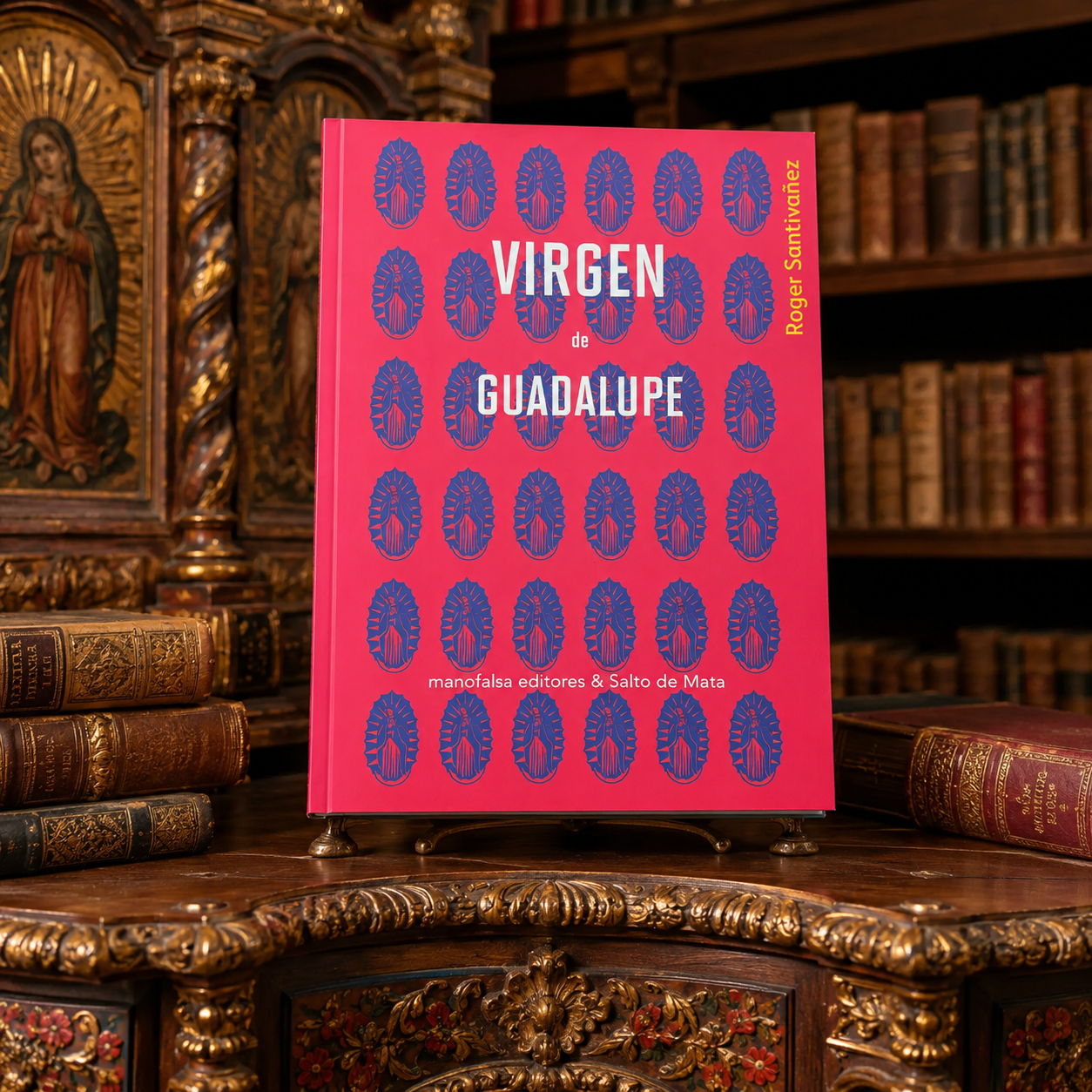
Roger Santiváñez’s recent book of poems, Virgen de Guadalupe, follows the trail of his characteristic incursions into the sacred terrain of language. For the author, writing is a sacrament, an act of faith and resurrection. In this sense, poetry borders on, adjoins, and coexists with the duality established between the sacred and the profane. The poems emerge from worldly experience and are treated and portrayed as a religious experience, a perception that tends toward the divine while avoiding any exact definition of it. Yet Santiváñez does not direct himself toward the soul, but toward the body, toward the beloved, passing through them and conferring upon them a celestial aura through poetry. In his verses, we can appreciate this solid amalgam of the spiritual and the corporeal. For example, in the second poem of the series, we read:
Sustitución del mimbre por el miembro
Armado e innombrado & elección de la
Más fina entrada, allí los bordes
Pueden ondular perpendicular & culear
[…]
Aquí la brisa viene de ti, sutil marino
Perfume exhala su misterio, levísimo
Aprendiz del viento me sostiene erguido
A classic mark of Santiváñez’s poetics is the association of words through their sonority. The refinement of his ear opens another path of meanings, reformulating verses through musicality, rhyme, homonymy, paronymy, and homophony. These devices help expand the poem’s meaning. They elevate it and distance it from triviality, enriching it through ambiguity and polysemy. In short, they lead language toward mystery, toward the terrain of the sacrum or, as he himself versifies it: “Subsistir en la brisa de un estilo / Alado condimento intermitente consumido”. In his poetry, contemplation and admiration of the female body elevate the poetic voice, lifting it to another level; in this state of wonder, the voice poetizes his beloved. She brings him closer to mystery, to the sacred, as occurred with the medieval troubadours:
Cascadas de sosiego centraban tu
Corazón envolvente en el misterio
Reunido sin ráfagas desoladas / solo
El susurro más cristalino / brote
Imperturbable de tu belleza sin calzón
Intangible surtiendo con pericia imágenes
Alojadas en la desesperación de mi arrechura
Compruebo la adoración que viene de ti
The “style” alluded to by Roger Santiváñez is dense, carefully worked both rhythmically and semantically. The reader should not forget the author’s stylistic trajectory: from his opening shot with colloquialism and urban themes to the recalibration of his gaze and his own search, which led him to turn toward neo-baroque poetry, passing through a more religious mode of versification, without falling into spiritualism. Hence, this book condenses his constant poetic evolution and mutation very well, in which the word generates symbols, some of which elude the reader’s understanding. As Tania Favela rightly notes in the prologue to Virgen de Guadalupe:
No sé exactamente a qué se refiere con ese ‘estilo alado’, pero leyendo su libro, me parece que su manera de escribir simula una danza en la superficie de la lengua, hay algo también de elevación y caída en el ritmo que va trazando. Las palabras encuentran, por decirlo así, el ritmo de su deseo: ese proyectarse para tratar de alcanzar lo inalcanzable. Los referentes se diluyen, se trastocan, toda mención nombra y la vez se escabulle, alza vuelo.
By way of conclusion, it is inevitable to ask what place Virgen de Guadalupe occupies within Santiváñez’s extensive and varied body of work. There is no doubt that it is a reaffirmation of a style forged over the course of an intense search. In many respects, this book displays greater maturity in its rhetorical and semantic handling of language: words sound and resound, signify and resignify. It is certainly less experimental than his previous collections, yet it never sets aside curiosity and linguistic labor. Its orientation toward the enigma of the sacred testifies to a poetry that tends toward elevation, a poetizing in which the word not only points, but levitates.