
I
Tradition has it that the Jews did not begin in banking, although the Catholic repudiation of usury was real; rather, they became moneylenders because they had the money for it, owing to an earlier, also ethnic, specialization in jewelry. That prior specialization would indeed have had that tragic origin belonging to one who may suddenly have to flee with everything he owns; for jewelry has the most advantageous ratio between value and volume, which facilitates that compulsory portability left to chance.
From that primordial and medieval specialization, there would then be born that marvel of luxury in the modern West, which only reaches perfection in North American exhibitionism, after passing through the moderation of English good taste. More or less, this seems to be the itinerary of literary form in Pablo de Cuba Soria: a display of power that survives and leaps from the graceful dithyramb, beautiful in its grace, to this other gratuitousness of the pure literary essay.
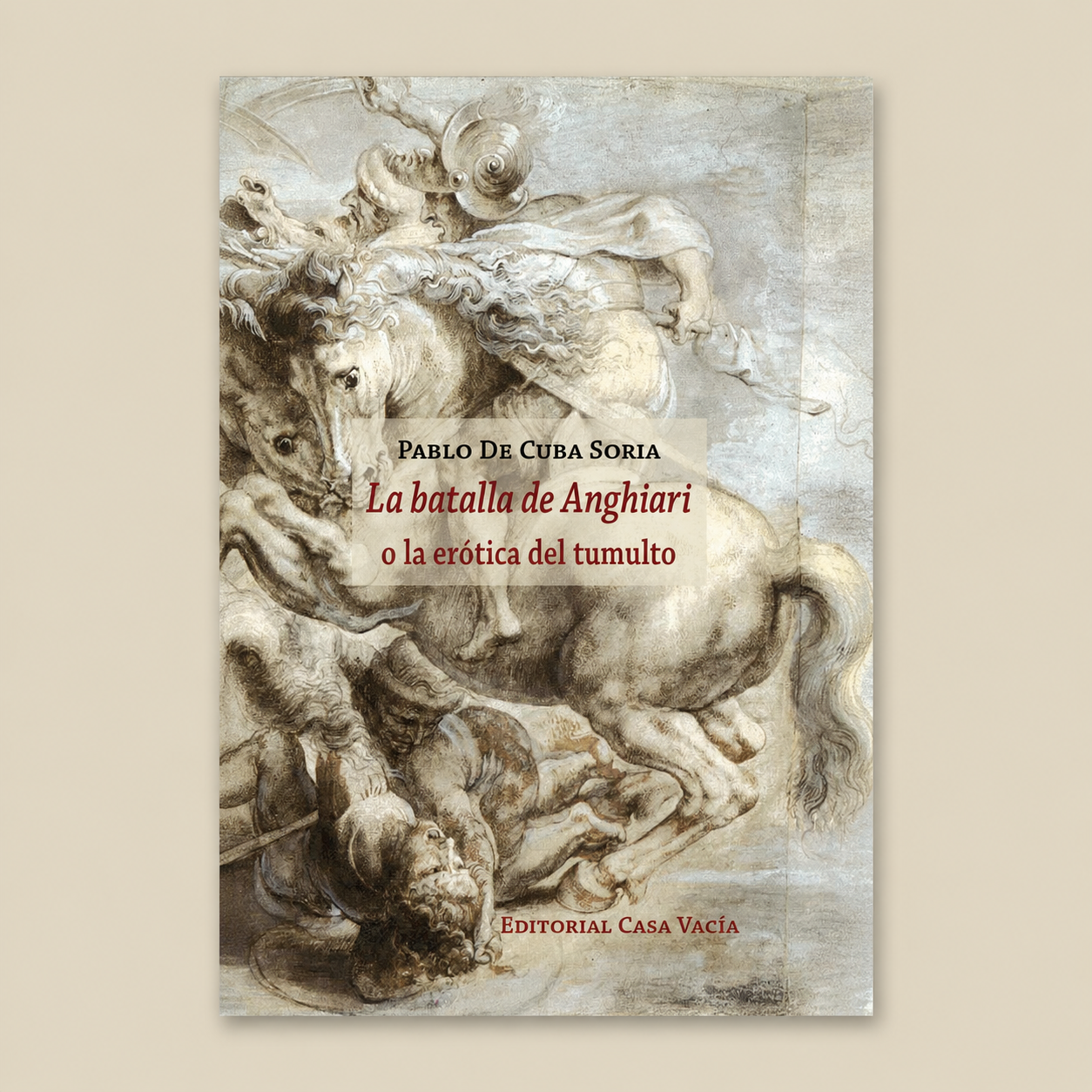
That would explain Soria’s approach to The Battle of Anghiari, under a premise that reveals his anxiety: “More than the victory of one side,” he states, “what matters in Anghiari is the threshold every form must cross in order to attain intensity”; this intensity is consistency, through which form rises as art in itself, in its own sufficiency. Later, Soria turns to Carponi to cite Machiavelli’s concept of virtue, explaining the agony of the Renaissance experience; virtue here is a practical concept, like the protocols of politics in the imperial court of Chinese absolutism.
It is therefore a matter of an “effective capacity to dominate events and bend fortune,” and he recalls that, for Machiavelli, the republic needed a mirror in which to remember the supremacy of the state. This is, then, the other anxiety of the political, which permeates and transmutes modern art as a new religious axiality, bringing with it the arrogance that condemns modern humanism, with the Promethean weight of its tremendous humanity.
Soria states categorically that the relevance of Anghiari lies not so much in anticipating styles as in introducing a crisis; and it is this crisis that he narrates with the fever of one possessed, as a holy man exiled to Patmos at the dawn of Christianity. The arrogance of the artist himself is not foreign to this, since he reveals his own humanity, no matter how much he may aspire to divinity; as in that striking ending, barely before the middle of the book, when the inglorious fate of the painting is revealed: condemned to disappearance by the artist’s own purism, for he could not foresee the inadequacy of his technique.
The same had happened to The Last Supper, deteriorated by that stubborn unconventionality of his experiments; as though he cared not even for the ethical commitment of work already paid for, but always only for the experience itself. The series of conclusions Soria draws from this estrangement is also vertiginous, like that experience; and then the perfect communication between the original artist and his final consumer is revealed, like that vertigo of twisted horses. Centuries later, inspired by Rubens, the Cuban Carlos Enríquez expresses his deranged sexuality through horses, and one understands that the point is derangement itself, like a forced Italianism meant to express the Renaissance transition.
There is no doubt that these waters have brought us these muds, but also those arts no longer made, like this one surrounding the Battle of Anghiari, which transcends its object like a dance of quanta. This ambiguity that fascinates the artist, as God’s sovereignty fascinates the monk, is the anguish of Platonic aestheticism; and thus it manages to become contemporary, twisted into a baroque—not neo but classical—yet, in all its coherence, sufficient reality.
Soria’s book is thus a manifesto in defense of that art, in a Parnassianism aware of its Romantic ancestry; it may seem Symbolist, perhaps it also believes itself to be so—oh, Valéry!—but it exudes that beyond of Margaret in Faust. This is the dilemma of Soria’s art, contorted as the sketches da Vinci describes, not the clarity of Michelangelo; and it unfolds as a jewelry of clean prose that expresses an intricate thought, achieving the perfect state of superimposition.
This sufficiency appears in the glaring contradiction between the intention of the political power that commissions art and that art itself: the sublimation of power by the former, and its raw and ignoble portrait—not critical but truthful—by the latter. This sufficiency, against the obstructive rationality of the political, is what nourishes Romantic protest; and it is, therefore, what reveals Soria’s lineage, regardless of whether he believes in that classicist placidity of Symbolism.
II
Pablo’s intention—not his transcendent end—is to communicate that vertiginous experience before the power of art; a mystical ecstasy that, for that very reason, is inexplicable, causing the anguish of the saint, who does not know how effective he is. It is not that he wants to know and cannot know whether he is effective, but that he has no time to know it in the rapture; it is not, therefore, a book necessary in the Kantian manner, but inevitable in its hedonism, as another form of realism.
One should not be too absolute about this matter of clean prose, which suggests a rational simplicity impossible for the beauty of this book; a beauty that, in its descriptions, reaches that calm exhibitionism copied by the one who signs as Bernal Díaz del Castillo from Homer. The latter establishes the canon with his description of the inventory of ships in the Iliad, and the former copies it with relish in his history of the New World; Pablo brings them both up to date in the descriptions with which he continually interrupts his narration—and, by God, how beautiful it is!
This is one of the most surprising moments in the book, which he perceives only as an appropriation of the painting, without noticing that this appropriation allows him to deploy his own formal power in the most absolute functionalist sobriety. He points offhandedly to the artist’s property as a simple philosophy of inventory, which he then proceeds to recreate continuously, without realizing that he not only highlights the plastic convergence of literature but also lends himself to reconciliation.
With this book, Pablo therefore rises as the legitimate heir of the Lezamian image, which so often turns to Paul Valéry, not as cult—which is legitimate, but common and lesser—but in the synthesis that updates it as its meaning. Yes, Lezama organizes an ontology proper to the Caribbean, probably the first; Soria establishes a metaphysics of the political, on the same epistemological basis of the image, but with the premise that Tempels attributed to the Bantu.
One must not forget that, after all, this is a duel, as a tension resolved in contrast with Michelangelo, and in which Leonardo’s sfumato profiles recall the seniority of Heraclitus and his archē in the mobility of fire. There are several moments of this tension throughout the book, in vignettes that underscore da Vinci’s disdain for Michelangelo; each may be read separately, like singular stones in a single necklace that nevertheless possess their own meaning.
This, then, is what establishes the epistemological possibility of the image in its systemic reflection of the real as hermeneutics, in which Soria corrects the Lezamian Platonism that, like the original, did not ignore the Heraclitean, but subordinated it. It is in this that Soria is a realist: in that epistemological function of the image that the other takes from common devotion; a subtlety ignored by the pernicious Lezamism that weighs down insular literature in its stubborn insularism. The Battle of Anghiari is thus more than a philosophical postulate or a book on art: it is a catauro that reconciles both species; not in a multidisciplinarity—the very term is horrible—but in an alchemical synthesis, as a hermeneutics of reality.
III
In 1925, Bertrand de Guégan published his edition of Aloysius’s Gaspard de la nuit, which included his Complements, texts not included in the 1842 edition because they were variations that even duplicated motifs from the original. The complements would remain, then, as a new style—not literary but editorial—gathering the excesses of authors too immersed in the creations they extend to consent to the violence of amputation, no matter how repetitive.
This book extends itself in its own complements, like jewels swaying in the pocket of the medieval Jew; only rarer still, they admit the suspicion of an inverse order, in which—as with Oppiano Licario and Paradiso—they may have given birth to the main text. It is, in effect, a series of vignettes, not careless, but with the texture of notes bearing their own plan for a book, which, for whatever reason, would have been surpassed by the marginal texts that explained them.
Whether or not that is the case, it is another book that accepts the condition of the appendix, refusing formal independence, and thus extends the already precious body of Soria’s The Battle of Anghiari, with its lateral approaches to Leonardo. One could swear that this is the true order, like those inverse giants who astonished Renaissance sailors, giving rise to fantastic literature, as these give rise to intelligent contemplation, returning in a post-postmodernity.
As already—not neo—baroque goldsmithing, it is a filigree of superimposed gratuitousness, with meaning in the form itself; and the book ends with its series of notes on Leonardo, like a litany that invokes him through innumerable men. It is a marvelous way to bring the book to a close, with that crude power of banking, raised upon chance and danger, which in this case is the danger of writing such a book, as formal and gratuitous as it is complete and beautiful in its decadence.


