
When the Qin empire rose from the ruins of the Warring States, it did so in a gesture of purification: the elimination of everything that might mediate, soften, or disperse authority, which was to be absolute. The state was conceived as an unambiguous machine, and its radical violence consisted of emptying the Yin space; the Dowager Queen Zhao was the last remnant of that principle, of the feminine as a mediation between the celestial and the terrestrial.
The fall of the queen mother marked the symbolic closure of that cycle of the feminine in archaic Chinese politics; and with Qin Shi Huang, the Empire becomes a total masculine body, without mother or wife, without shadow, Yang. But this very gesture—the suppression of the reverse—inaugurates a void in its excess, which will cause the system to collapse; power became rigid without mediation, incapable of absorbing the pressure it generated in that excess.
The end of the Qin was, before being a military defeat, a structural implosion, a yang without a yin to reabsorb it; and the rebellion that produced this collapse had no program or doctrine, as a natural result of that excess. All the potency expelled by that Yang violence found its point of convergence in Liu Bang; but the founder of the Han was not a nobleman but a rogue without lineage, who turned this lack into a principle of mobility.
The power of Liu Bang did not reside in law, but in resonance, in his ability to articulate heterogeneous energies; and faced with the crystallized despotism of the Qin, his roguishness was a power of attraction rather than one of hierarchy. With him, the empire becomes possible again, not by coercion but by the circulation of energy that he fosters; which, if not formalized, ultimately dissolves into itself, and this is where Lü Zhi, the first empress of Han, erupts.
The power of Lü Zhi does not come from the Mandate of Heaven, the army, or lineage, but is illegitimate by definition; in a patriarchal order that had been reorganized in the Yang excess of Qin Shi Huang, the masculine archetype. However, this illegitimacy is precisely the source of her potency, as a space of condensation; lacking a place of her own, she thus attracts the foundational chaos, which coagulates in her as it did in the roguishness of Liu Bang.
The ferocity attributed to her—that reputation for being implacable—is not a moral trait, but a structural mechanic; through which she acts as a gravitational force, absorbing into herself all residue of indeterminacy. If Liu Bang had been the expansion, she is the contraction; if he generated turbulence, she produces symmetry; because the power of yin here is not softness, but precision, the intelligence of balance, unstable yet persistent.
Lü Zhi does not usurp masculine power; she reintroduces the mother, no longer as a body, but as a principle of form. She is the device for the reabsorption of dissolved forces, from which the Han state is born in a resurrection; not in the victory of yang over chaos but in the return of yin, as an organ of condensation. The history of the Han dynasty will show that this principle does not disappear, but is refined, it becomes subtler.
Three figures mark the stages of this transformation, which is always of Yin as nature: Lü Zhi as coagulation, in which it is structured as potency, from which the fear of chaos as feminine emerges. Then there is Empress Dou, in the organization of that principle, who silently sharpens her tiger’s claws; and Wu Zetian, who projects it institutionally, establishing herself as a source of legitimacy in her own right.
If the process is put into perspective, the Han dynasty not only succeeds the Qin, but structurally corrects it; Qin had established an absolute state, and Lü Zhi and her heirs reinstate maternity as a formal principle. The feminine function ceases to be anatomical and becomes political, in its power to absorb the excess of the law; and in that sense, the feminine always reappears whenever energy needs to be reintroduced into form.
From the scandalous Yin of Zhao Ji to the reflective Yin of Wu Zetian, the progressive formalization of the reverse unfolds; first as a danger, because it shows the permeability of the order, and then as the guardian of that permeability. The power of Lü Zhi—so feared and denigrated—is the moment that consummates this transit, from the expelled yin to the constituent yin; making the state be born twice, from the lightning of Liu Bang, and the gravity of Lü Zhi, which gives it form.
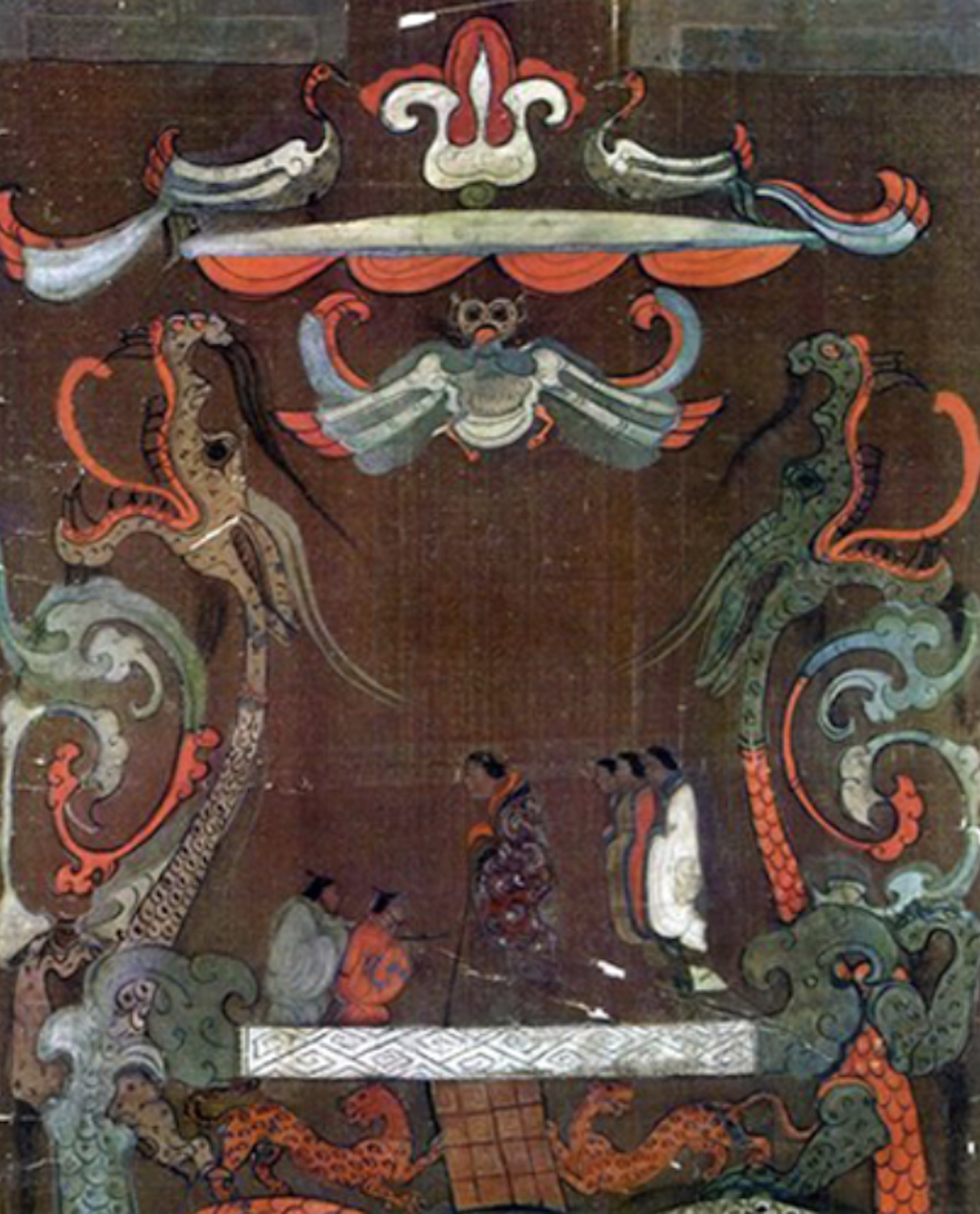
Image: Lady Dai and her attendants (detail), Funeral banner of Lady Dai (Xin Zhui), 2nd century B.C.E.


