
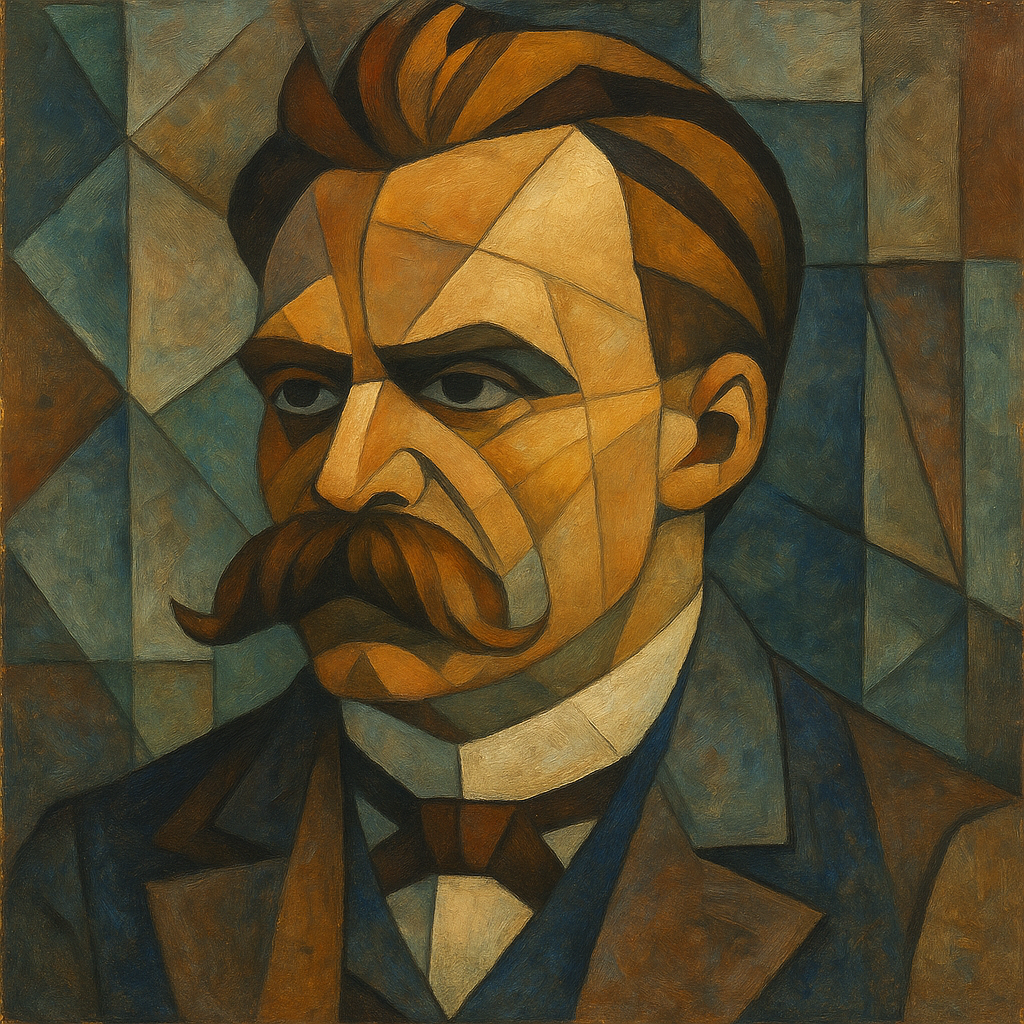
Citario. Derived from the Latin “citāre” (to quote) plus the suffix “-ārium” (repository), similar to “bestiary”. A 21st-century neologism, it arose among the Spanish-speaking scholars of Bookish & Co., with roots in ancient anthologies and florilegia. “Citario” is related to medieval books of commonplaces (such as Erasmus’s) and nineteenth-century proto-examples like “Familiar Quotations”. This Citario Nietzsche celebrates the 181st birthday of the thinker who, with a philosophical hammer, demolished moral idols, invoked the overman as the horizon of the will to power, and bequeathed an arsenal of incendiary aphorisms that continue to challenge the conformism of the herd, inviting us to look directly into the abyss of existence.
From Nietzsche we receive an initial, provisional indication to guide our search for an answer. In a note from his lectures at the Collège de France, Roland Barthes summarizes it as follows: “The contemporary is the untimely.” In 1874, Friedrich Nietzsche, a young philologist who until then had worked on Greek texts and who, two years earlier, had achieved unexpected fame with The Birth of Tragedy, published Unzeitgemässe Betrachtungen—the Untimely Meditations—through which he sought to settle accounts with his time, to take a stance toward the present. “This consideration is untimely,” we read at the beginning of the second Meditation, “because it seeks to understand as an evil, an inconvenience, and a defect something of which the age, justly, feels proud—namely, its historical culture—because I think that we are all consumed by the fever of history and ought, at the very least, to become aware of it.” Nietzsche thus situates his claim to “relevance,” his “contemporaneity” with respect to the present, in a disconnection and a temporal disjunction. Truly belonging to his time—truly contemporary—is the one who does not coincide perfectly with it, who does not conform to its pretensions; and precisely for that reason, from that distance and anachronism, is more capable than others of perceiving and grasping his time.
This non-coincidence, this dischrony, does not mean, of course, that the contemporary is someone who lives in another time—a nostalgic soul who feels more at home in Periclean Athens or in the Paris of Robespierre and the Marquis de Sade than in the city and time allotted to him. An intelligent man may hate his time, yet he knows nonetheless that he belongs to it irrevocably; he knows that he cannot flee from his time.
Giorgio Agamben, Nudities (2010)
◾️
If Nietzsche wanted anything and believed he had achieved it, it was precisely to force an exit from the enchanted castle of metaphysics, which he himself had already defined, in a purely Heideggerian sense, as a place of marvelous spells whose inhabitants only know how to live within the spell. It is true that, upon leaving such a place, he was not trying to find quiet country paths, but the desert—the desert that grows endlessly, that easily swallows, in which no dreamed goal exists.
Roberto Calasso, The forty-nine steps (1991)
◾️
In a certain sense, with Nietzsche, rebellion ends once again in the exaltation of evil. The difference is that evil is no longer an act of revenge. It is accepted as one of the possible aspects of good and, with greater conviction, as part of destiny. Thus, he considers it something to be avoided and also a kind of remedy. In Nietzsche’s mind, the only problem was ensuring that the human spirit would bow proudly before the inevitable.
However, we know his posterity, and what kind of politics would later claim the authority of the man who called himself the last German antipolitical thinker. He dreamed of tyrants who would be artists. But tyranny comes more naturally than art to mediocre men. “Better Caesar Borgia than Parsifal,” he exclaimed.
Albert Camus, The Rebel (1951)
◾️
Whoever has read even a single page of Nietzsche has felt probed to the depths, has felt provoked to give assent to a burning question: some do not forgive this intrusion, others erase the impression, others react with ardent participation. In these writings we see him follow, even through the tiniest fragments, the jagged sequence of Nietzsche’s works, weighing them each time both for the unheard-of elements they introduced and for the retreats they revealed; accompanying them through euphoria and depression, theoretical daring and immoralist fury, literary forays and flashes of prophecy.
Here speaks an absolute intimacy with that thought — and at the same time the distance that allows one to judge its passages from the vantage point of another thought: Colli’s own, destined to emerge ever more clearly in its solitary greatness. And it is precisely in this coexistence, within the commentator, of “ardent participation” and the “pathos of distance” that we recognize a trait profoundly kindred to the author being commented upon.
Giorgio Colli, After Nietzsche (1974)
◾️
In 1881, after losing his post as a professor at the University of Basel due to his increasingly unbalanced health and self-exiling in Genoa, Nietzsche ordered from Denmark one of the first typewriters (then considered very effective in teaching the deaf-mute). He had not written for five years.
When he began to experiment with the machine, he discovered that he could write with his eyes closed—that words could travel from his mind to the page without distraction. He dedicated an ode to it (“The typewriter is a thing like me / made of iron but easily damaged / patience and tact are required in abundance”) and informed his friend Overbeck that he had begun writing again. Overbeck traveled to Genoa to see for himself and discovered that, thanks to that damned machine, Nietzsche’s style had become tighter, more telegraphic, more metallic and pounding. Nietzsche snorted: “Do your thoughts not depend on the quality of the paper and the pen you use? Our writing tools influence the formation of our thoughts.”
Nietzsche was fascinated by the story of when Saint Augustine met Saint Ambrose, the man who converted him to Christianity: Augustine arrived at Ambrose’s cloister in Milan, found him reading silently to himself, and was astonished that he did not need to read aloud in order to understand. Both the Greeks and the Romans preferred to have a slave read to them rather than read themselves—it was easier to understand by listening. Ambrose, however, treated reading as an act of introspection—solitary, meditative.
Nietzsche maintained that Augustine experienced a revelation: he asked himself what it would be like to “write” as Ambrose “read”—with that same absorption, withdrawn from the world—and suddenly realized that in doing so, it would be possible to write things that no one would ever dare to dictate to a scribe.
Juan Forn, “The Paradox of My Tribe” (Los viernes, 2015)
◾️
To this man, who surpasses himself, Nietzsche gives a name that is easily misunderstood. He calls him the overman (or superman). But Nietzsche is not referring to a type of man attainable through breeding. The overman is the man who first takes the full measure of the abyssal character of all being-in-the-world. He is the man who, from those abyssal depths, creates new ground upon which to stand. The overman is the man who founds Being anew — in the rigor of knowledge and in the grand style of creation.
The existing man, thus determined and secured in his essence, must be made capable of becoming the future master of the earth — to wield, with high purpose, the powers that will fall to future man through the technological transformation of the earth and of human activity. The essential figure of this man — the rightly understood overman — is not the product of a frenzied, degenerate imagination plunging headlong into the void.
Martin Heidegger, Nietzsche (1961)
◾️
When Nietzsche analyzes morality, he regards it as just another phenomenon, another interpretation rather than a truth. Taking one step further in the Enlightenment critique of prejudices, the philosopher reproaches his predecessors for having taken morality as something self-evidently true and for having sought only to ground it, since it was assumed that the fact of morality was already given. For Nietzsche, on the contrary, morality is just another form of falsehood, an error among other errors. Therefore, he does not seek its justification but rather attempts to uncover the value of that interpretation — the result of a particular configuration of forces. He wants to see what is meant by the meaning that moral interpretation provides, since, like all valuation, morality presupposes an interpretation that is a “symptom of certain physiological states, as well as of a certain intellectual level of dominant judgments” (Nachlass, autumn 1885–autumn 1886 [1901]).
Morality, seen in this way, is an interpretation of our affects or drives that reveals a physiological state. That interpretation, like any other, is a situation reached through the movement of instincts; it therefore has an origin. To see the origin and development of our affects means to assign meaning to something that already has a sense of its own; it means to discover what is doing the interpreting within us. This is what Nietzsche calls genealogy, which has a psychological aspect, insofar as it uncovers our affects; a physiological aspect, since it also determines which bodily states underlie those valuations; and a philological aspect, since all expressions of the will to power are interpretations of a text — and of that text, none is correct, for the text itself — the forces — admits innumerable interpretations.
Agustín Izquierdo, introduction to the Spanish edition of On the Genealogy of Morality (2000)
◾️
“Not so much for his evangelizing as for the incomparable generosity of intellect I found in him.” Nietzsche has exerted a more lasting and formative influence on modern French thinkers than any other European philosopher outside France. Gide, Sartre, Céline, Camus, and I myself have on numerous occasions acknowledged our genuine and profound debt to the German (1844–1900), whose virile and frenzied notions of creative activity, physical energy, heroic effort, and cultivation of an elitist mentality are central to existentialist ethics as well as to other subjective beliefs of the present age. […]
Imbued with a grand sense of history, I emphasize an unconditional admiration for the German philosopher’s cultural and historical ideology, an impulse intensified by the chronological proximity of the two writers. […] Passion is born of a sense of the tragic, of the darkest deprivation transformed into a triumphant response to life’s harmful afflictions and vicissitudes.
André Malraux, Anti-memoirs (1967)
◾️
We do not know where evil begins — in words or in things — but when words become corrupted and meanings grow uncertain, the sense of our actions and our works also becomes unstable. Things depend on their names, and names on things. Nietzsche begins his critique of values by confronting words: What do virtue, truth, or justice really mean? By uncovering the meaning of certain sacred and immutable words — precisely those upon which the edifice of Western metaphysics rested — he undermined the very foundations of that metaphysics. Every philosophical critique begins with an analysis of language. The ambiguity of all philosophy depends on its fatal subjection to words.
Octavio Paz, The Bow and the Lyre (1956)
◾️
In early January [1889], the incident occurred in which Nietzsche threw his arms around the neck of a horse to protect it from its driver’s blows. In a letter to Jakob Burckhardt, dated January 6, he wrote: “First of all, I would much rather be a university professor in Basel than God; but I have not dared to carry my selfishness so far as to give up the creation of the world. You see, one has to make sacrifices, no matter when or where one lives.”
After reading this letter, Burckhardt went to see Overbeck and asked him to take care of their friend. Overbeck immediately traveled to Turin and wrote back from there: “I saw Nietzsche crouched on a sofa, reading […]. The incomparable master of expression was no longer capable of expressing his joy except through trivial phrases or through grotesque movements of dancing and leaping.” Overbeck managed to bring Nietzsche back to Basel, where he was confined to a clinic for nervous disorders. His mother came and took him to Jena, where he was placed in the city’s psychiatric hospital, remaining there for a year. In May 1890, his mother brought him to Naumburg to care for him herself. After her death in 1897, Nietzsche’s sister moved him to the Villa Silberblick in Weimar.
During Nietzsche’s final months, August Horneffer visited him and reported the following: “Of course, we never knew him in the days when he was well; we only saw him when he was already ill, in the final stage of his paralysis. Nevertheless, the moments spent in his presence belong among the most precious memories of our lives […]. Despite the dimmed gleam of his eyes and his drowsy appearance, despite the fact that the poor man lay with contracted limbs, helpless as a child, there emanated from his person a charm, and in his appearance there was revealed a majesty that I have never again found in any other man.”
Nietzsche died on August 25, 1900.
Rüdiger Safranski, Nietzsche. A Philosophical Biography (2000)
◾️
At the time when Nietzsche was beginning to bring to light, from beneath every will to know, a will to power, the old German Social Democracy was calling on its members to participate in the competition for power that is knowledge. Where Nietzsche’s opinions aimed to be “dangerous,” cold, and free of illusion, Social Democracy manifested pragmatically and displayed a formative tendency of a Biedermeier stamp. Both spoke of power: Nietzsche, by vitalistically undermining bourgeois idealism; the Social Democrats, by attempting to establish a connection, through “education,” with the bourgeoisie’s possibilities of power.
Nietzsche taught a realism that had to facilitate for future generations of bourgeois and petty-bourgeois the farewell to idealist nonsense that hindered the will to power; Social Democracy attempted to participate in an idealism that had until then carried within itself the hopes of power. In Nietzsche, the bourgeoisie could already study the refinements and the clever roughnesses of a will to power lacking an ideal, while the workers’ movement still glanced askance at an idealism that better suited its still naive will to power.
Peter Sloterdijk, Critique of Cynical Reason (1983)
◾️
Nietzsche’s chosen correspondent in Venice was a musician, Heinrich Köselitz-rechristened as Peter Gast by the philosopher-in whom he placed immense hopes for a renewal of music. He stood up to Wagner and composed an opera entitled The Lion of Venice. Nietzsche idealized Gast, signing feverish letters to him, traveling to see him, and very quickly employing him as a critical editor and proofreader. The friendship reads like a novel of passion.
For instance, in Venice on March 13, 1880, Nietzsche started to dictate to Köselitz the aphorisms of The Dawn (under the title L’Ombra di Venezia). Initially, he felt the city was hostile: “Venice is the city of rain, wind, and dark alleyways. Its greatest qualities are calm and excellent sidewalks.” Later: “Venice has the disadvantage of not being a city for walkers-I have to walk six to eight hours in open country.” But Venice has another name: Music. “When I seek another word for music, I always find only the word Venice.”
Philippe Sollers, Venice. An Illustrated Miscellany (Plon – Flammarion, 2014, translated from the French by David Radzinowicz)
◾️
The omnipresence, in the 19th century, of the various forms of the ideology of progress is reflected in the exasperation that this intoxication arouses in Nietzsche. His hostility toward Christianity is matched only by his sarcasms against the revolutionary spirit, whose archetype he sees in Rousseau. Nietzsche’s blows spare neither the socialism that originated in the French Revolution nor the ideas defended by Constant, Chateaubriand, or Lamennais, who in various ways affirmed a shared conviction regarding the links between progress and the expansion of Christianity. Nietzschean critique (the overturning of values) takes on the aspect of systematic inversion. If a return to the past is impossible, it is because decadence is irreversible. […]
Is that prognosis irrevocable? Might there, after all, exist a “true” progress, another kind of progress? How could it be defined? In the fragments from the 1880s, one reads: “Progress? The strengthening of the type, the aptitude for the great will: everything else is a misunderstanding, a danger.” As we can see, Nietzsche speaks as a moralist when he evokes decadence, but as a “physiologist” when he diagnoses degeneration, or when he desires “the strengthening of the type.” It is for this double reason, and in this hybrid language, that On the Genealogy of Morality considers the “active” and “reactive” attitudes in quite some detail. Most of the time, Nietzsche sticks to adjectives (“active,” “reactive”) without hypostatizing action and reaction. In the pages where he resorts to the word “reaction,” it is in the sense of physiology rather than political thought, but associating the physiological image of reaction with the moral notion of ressentiment. (How significant is, here, the new incorporation of the prefix re-!)
Jean Starobinsky, Action and Reaction: The Life and Adventures of a Couple (1999)


