To Álvaro Galmés, the great humanist of our Zoom
Philosophy opens with two great mysteries. Plato never said anything in his own name. He seemed more interested in staging thought—where the street-corner discussions of Socrates and dialogues with his disciples at the Academy are dramatized. Aristotle, in his testament, never mentions his texts: he attends to all manner of details, but not his literary legacy. According to legend, the principal corpus of his works came down to us by pure chance. The anonymity of Plato’s own voice finds its parallel in Aristotle’s distance from authorship itself. Perhaps that explains the multiple and collective character of his texts.
Aristotle builds his thought on a register where aporia and solution coexist without being eliminated. He adopts in Book III (Beta) of the Metaphysics the aporetic strategy, deploying tensions and contradictions, while in Book IV (Gamma) he assumes a magisterial and doctrinal tone. This perspectivism demands that we inhabit the diversity of registers in his œuvre without reducing it to a single voice or a linear evolution—as Werner Jaeger attempted—or turning the aporetic into the absolute core of the system, as Pierre Aubenque proposed, two of the most influential interpreters of Aristotle in the twentieth century. The Metaphysics cannot be explained by biographical stages of Aristotle, organized according to his proximity or distance from Plato, as Jaeger proposed. Nor is it merely an intertextual game that dismantles itself, as Aubenque read it. It is rather the outcome of a collective philosophical practice born both in the Academy and in the Lyceum, where multiple voices and perspectives intertwine in tension and harmony.
The science that is sought—what Aristotle calls first science and sophía, and which Andronicus of Rhodes baptized with what is perhaps the most felicitous title in the history of thought, Metaphysics—must be understood within the framework of the great Aristotelian philosophical edifice. Philosophy, for Aristotle, is not mere longing for a lost knowledge, as it was in Plato; it is a systematic organization of knowledges that include the theoretical (physics, mathematics, ontology-theology), the practical (ethics and politics), and the productive (craft and art). Within this system, sophía holds a privileged place: it does not encompass all of philosophy, but it constitutes its foundation by studying being qua being, first causes, and the unmoved mover.
Now then, this eagerly sought science is born with an epistemological deficit: unlike physics or mathematics, it cannot demonstrate its principles. It can only show them and refute those who deny them. This condition gives it a more precarious status than the demonstrative sciences.
Let me clarify what I mean. Aporia, as is clear in Book III of the Metaphysics—and again in Book VII—constitutes the starting point of metaphysical-logical knowledge. Thought begins at the stumbles of tradition, at the dead ends to which it has come. Tradition, in this sense, is an error—but an exemplary error: without its failures, without the path already traveled, even if that ends in a cul-de-sac, thought could not carry on its work. Aporia is then a starting point, not a point of arrival.
Hence it is mistaken to say that the Metaphysics has an aporetic structure simply because it cannot ground the principles that sustain it. Those who seek to ground every principle—even those of first science—are precisely those who, like the sophists, keep thought in perpetual aporia. First science, by contrast, is a science that is sought: it can never close, it can never give a definitive account of the principles that sustain it and, with it, the rest of the sciences. First science is the opposite of aporia: an ever-open path.
Its object, being qua being, cannot be reduced to a genus; it lacks the common space that genera provide. Aristotle distrusts the idea of a supreme genus, for what is overly general leads to empty discourse. Genera mark limits: at one end, the concrete—existent but lacking intelligibility; at the other, excessive abstraction, which dissolves the real into mere verbiage. The Metaphysics, therefore, must chart a paragenic field: that of pollachôs légetai, that which is said in many ways, irreducible to any supreme category.
Here appears ousía as the privileged category. It names the individual and concrete, even though science only attains the universal. The tension is inevitable: ousía underpins the whole categorical system, for all the other categories (quantity, quality, place, time) are predicated of it; yet it is not a logical universal, but what is most one’s own. Among the candidates for ousía—matter, composite, form—Aristotle gives primacy to form, because it actualizes potency and endows being with intelligibility. The individual, as such, is not knowable, but the intelligible only becomes present in the concrete and singular; and in that union lies the role of form as entelecheia.
The universality of this science, therefore, is not defined as what is common, but as what is radically unique: the separate principle, pure actuality, which has no potency or accidents and on which everything depends—the unmoved mover. The unmoved mover, as Nous, thought thinking itself, is a unity without fissures that sustains the multiple senses of being. The unmoved mover, as ousía prôtê, reduces homonymy to zero, thus granting the minimal synonymy required so that being does not dissolve into pure equivocation.
Sophía is thus the equilibrium between the multiple and the one: it organizes the plurality of modes of being—principle, cause, category, potency, and act—and ensures that the “wild equivocity” of what is simply there finds a channel through the multiple ways in which being is said, sustained at the same time by a single meaning that prevents the system from shipwrecking. First science is not the knowledge of everything—for such a thing does not exist—but rather the wisdom that keeps the philosophical edifice standing.
That equilibrium between infinite plurality and the unique principle is not only the object of sophía, but also the mode of composition of the text itself. The Metaphysics is written in a double register, where the logical-linguistic and the ontological intersect: sometimes they coincide—as we have mentioned, where the multiple ways of saying being involve multiple ways of being—and sometimes they diverge, as when “being” and “one” are universal predicates at the level of language, yet do not constitute independent entities at the level of reality. Hence the puzzle-like character of the work, which responds not only to the problems of composition signaled by Jaeger nor to the editorial labor of Andronicus of Rhodes, but to the structural tension that constitutes its proper mode of thought.
It is worth remembering, however, that the dialogues which made Aristotle famous in Antiquity as a major writer—and which even made Cicero sigh—have for the most part disappeared or reached us only fragmentarily. The Aristotelian corpus we read today is composed of mutilated books, like the Poetics, or of the notes he used in his lectures. The great literary author that Aristotle was has been swallowed by time. But in those drafts of writing, in the echo of the intense debates that shaped them, there lives the full spirit of the one whom, for centuries, they called the Philosopher. The destructive fury of the time of men—which we know by its more glorious name, tradition—was, for once, right.
Author’s note: Note. The two essays that will appear in Bookish are part of a book on Aristotle that I am currently working on. The book I will compose with them, which will have between 15 and 20 essays, will be a kind of dictionary, but in which each entry will function as an independent text that can be read on its own. The essays would touch on each other, but in an oblique way. None will be longer than 2,000 words. In it, I will address the topics of Aristotle that interest me, connecting them with contemporary literary and philosophical problems. The book will be titled Aristotle is said in many ways. The structure of a puzzle that indirectly, almost secretly, comes together to form a whole; I believe it does justice to the way in which Aristotle’s corpus has come down to us: mutilated books, such as the Poetics, writing sketches, course notes.
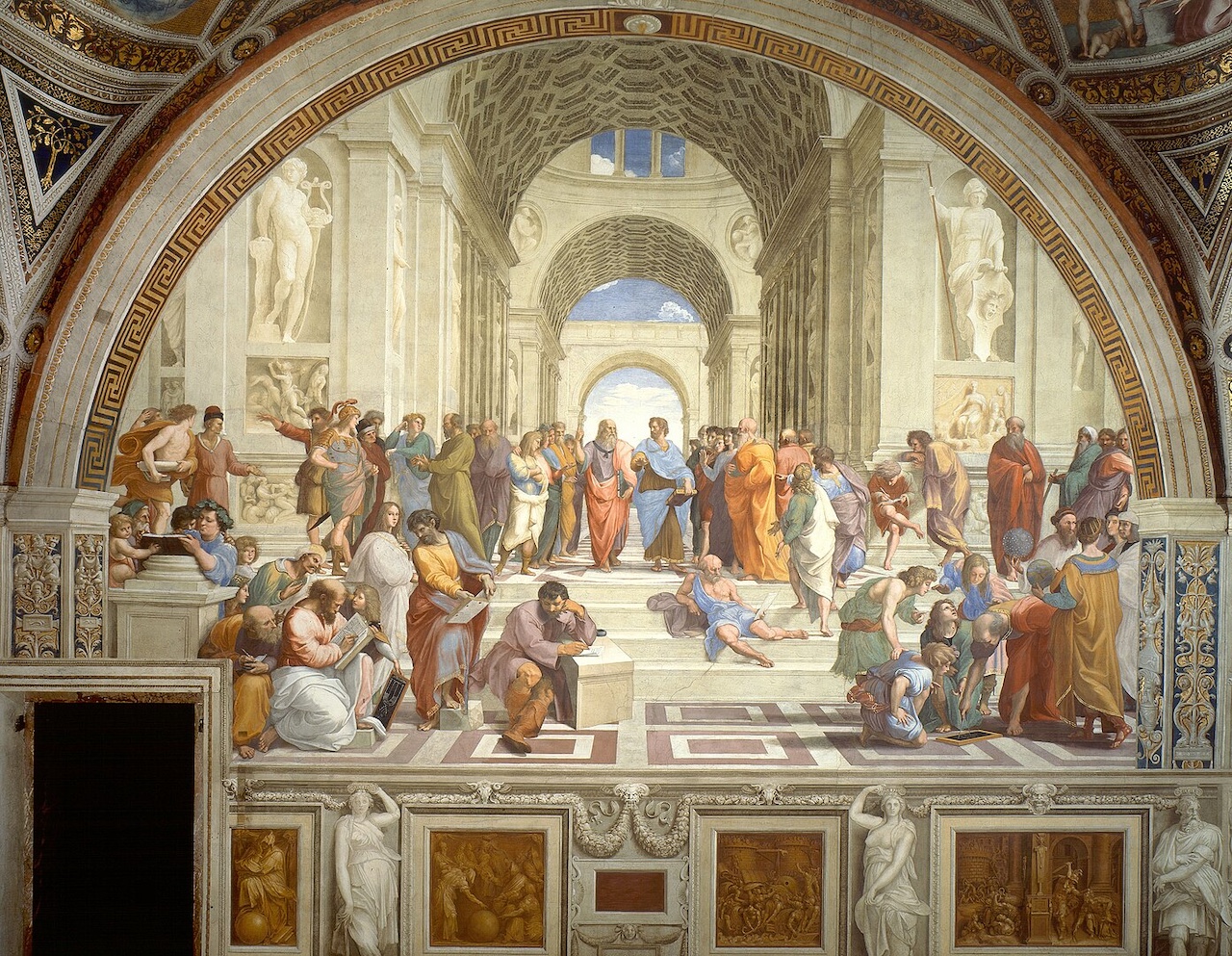
Image: The School of Athens (1512), by Rafael Sanzio.