

Unica Zürn liked to be tied up.
She liked to be tied up, rolled up, spat on, cloistered, encapsulated, and punished face down until they finally took a picture of her.
She liked to be raped.
In Primavera sombría (Gloomy Spring), her histrionic, self-indulgent account of her adolescence, she recounts how she developed her desire, that desire for everything that confronts the dark, and how she discovered fear… How she wanted to be raped countless times by different men (she calls them Chinese, Arabs, blacks, and Indians) and how that rape always had to end in the pleasure of the other when he slit her throat.
That pleasure is only comparable to the twisting of a chicken’s neck.
Unica Zürn liked to be a chicken.
A chicken that had to be penetrated with a long knife until it could finally lay an egg.
The curious thing is that chickens hardly appear in her work.
There are cats, snakes, two- or three-headed figures, monsters, cytoplasms, but never “the mother hen,” as a character in Boris Pilniak calls the obtuse feathered creature.
The mother hen.
No, in the graphic work of Unica Zürn (and in some ways in that of her husband Hans Bellmer, who always photographed her in the same way, to the delight of both), a hen never appears.
However, since childhood, and during her various stays in the asylum, where she ended up due to schizophrenia (one of those types of schizophrenia that appear around the age of 40, one of the ages at risk for the disease), Unica Zürn only felt that she was and would become a hen.
One of those big white farm hens.
One of those that are always raped by a brutal, zoophilic mongoloid, just as she longed for “her man-raptor.” One with a dog’s tongue and dog’s eyes and a dog’s snout, who would hand her over to others, until fear made her urinate with pleasure on a table.
Isn’t this exactly what reveals Unica Zürn’s chicken identity, that desire to find herself through objectification at the hands of another?
Unica Zürn spent long periods in the asylum saying “clo-clo-clo,” like a chicken. In fact, this was the nickname given to her by her doctor, Dr. Ferdière, who was also an acquaintance of Bellmer and used to admire the art of both: Zürn, the farm chicken.
The mother hen in her farm “being.”
An existence that, if we think about it, is very well situated and even goes beyond the discussion of female identity at the time. This identity became very clear in Simone de Beauvoir’s well-known book, The Second Sex (some of this discussion also appears in her interesting, though little-read novel The Mandarins), when she says, “One is not born a woman, one becomes one,” taking for granted the mental, identity, political, and anti-biological process of the construct of woman in a society—twentieth-century Europe—that rather than accepting them as spaces for discussion, reduced them to gynecology ad usum…
Knowing that she never had anything to say about the relationship between genitals and metaphysics.
But why does Unica Zürn, the writer, painter, and wife of the brilliant photographer Bellmer, go beyond this discussion, which, as we have already said, reached its most lucid point in the work of Beauvoir, and why should she be judged as a “plane of obscene intensities” rather than as a “female construct”?
Very easy…
Not only because in her memoirs, written in the third person and with enough distance to suspect that we are witnessing a kind of Brechtian monologue, she invents herself as a trans-loca, someone who simply no longer conforms to certain “normal” standards and needs to spend time in an asylum so that others can interact with her…
But also because in those images she created with Hans Bellmer, she managed to give substance, in the truest sense of the word, to that pain, that border between fantasy and animality, that jouissance that had haunted her since childhood, and made her, for example, in Primavera sombría (one of the best stories ever written about trauma), write fragments such as this:
“She desires with all her might a violent and brutal man. At night in her room, she imagines a black room glowing in the light of torches (…) She finds herself lying on a block of black, cold marble with sharp edges. Her kidnapper has tied her up. She is naked. She trembles with cold and excitement. (…) The circle of men dressed in black closes around her. Feverish eyes stare at her through the holes in their grim masks. Many of them wear shiny helmets. When they remove their masks, she sees the fierce faces of Arabs, Chinese, Blacks, and Indians. She prefers the men of color. None of them look like anyone she knows. She remains silent and almost motionless. She is afraid of them. Fear is very important to her.”
However, Unica Zürn will never be more rigorous than in those moments when her jouissance (or her plane of obscene intensities) becomes present and turns into cartography.
She will never be more rigorous than in those photos where her entire work overflows.
Photos where Zürn is seen entwined as if she were an animal or a badly wrapped package with some small animal inside.
Photos where we see the mother hen that Unica Zürn always wanted to be.
That one, with feathers, who is devoured and cornered and used and transformed and chopped up by others before being repeatedly raped by what she called the raptor man.
So, can we apply to Unica Zürn’s life‘s work that motto of Beauvoir that marked an entire era and which the German artist surely laughed at?
Her photos, her books, her relationship with that extraordinary sadist from Katowice with whom she lived for much of her life, prove that she did not. Unica Zürn was not interested in becoming a woman: she already was one, one might say.
She was not even interested in becoming a female object or subject.
The question of identity must have seemed obsolete or misguided to her. One of those questions that only give life to those who do not know her most private or personal reality: that self-gnawing fang that Bataille spoke of.
No.
Unica Zürn was interested in becoming something else.
A chicken with feathers perhaps (the sacrificial chicken!), as she demonstrated several times in the asylum in front of Dr. Ferdière trying to hatch eggs, and as many of the reflections in her books show, although there was still a lot of irony in her feathered split personality.
The chicken that is sent as a parcel to a distant city…
(Note that she is always tightly bound with a thin rope of the kind used to pack small boxes, but which must surely have left deep, bloody marks on her skin).
Apart from experiencing fear (the cold and fear, she says), what interested Unica Zürn most was multiplicity, the possibility of dividing something into millions of pieces, into obscene “tetobios.”
The possibility of disfiguring, joining, and corrupting…
For example, if we segment a breast, an immense breast, a round breast, into thousands of stumps of flesh, does it continue to be the appetizing and unique breast that motherhood calls a breast?
Can the breast or the anus or the esophagus or the vagina become something else?
Hans Bellmer:
“…the section that connects the mouth to the anus, the esophagus, and the intestines, that inner surface seems to pass through the entire depth of the organism to become, in full light, like a turned glove, the epidermis of the body; in the place where the first vertebra is located, that is, in the skull, the teeth will be placed to crown the whole.”
And he concludes:
“In order to give her a tongue, two hands, four breasts, a thousand fingers, it is obviously necessary that such a multiplication has first been experienced in the organism of the beholder, that it belongs to his memory.”
Anyone who has ever seen the dolls Bellmer made will know that in his particular physiology everything can be connected, that legs (no matter which ones) can grow out of the head, and an ear or a thigh will never again be just that, but rather what Unica Zürn dreamed of: multiplicity, fear, and the apotheosis of reality itself.
The obscene.
Isn’t it exactly, in detail, the obscene, that which remains when the parts are disconnected and the different fragments can finally be seen as a sum or a whole; when you can see a leg or a foot in its exact reality as a leg or foot and, for greater jouissance, connected to other legs or feet whose only meaning will be to dislocate the human machinery and show us the physiological and political eros of the leg-foot in its absolute mnemonic loop?
Unica Zürn enjoyed being tied up…
(Bellmer admits in an interview that his wife always asked him not to show her mercy.)
She enjoyed it so much when they tied her up that she was often left breathless and in pain, having to accept that moment, the moment when pain produces delirium, only as a drug…
Like a hyperplane of “complex” chicken pox.
In Grim Spring, she recounts how she trained her dog to come and lick her crotch when she was afraid (afraid of a rather turbulent family reality—her parents lived with their own lovers in the same house—and afraid of her own fantasies).
Hard and fast, like a finger.
This tongue, which was also a knife and a worm and a hoof, was her own encounter with herself, with that body that needs its chicken self-identity to feel complete before being led back to the masses.
The masses she always felt alien to and rarely found satisfying.
The masses that tend to uniform people in an unaesthetic way.
Her work, her texts, are one of the few examples in the first half of the 20th century of a trans-identity based on the construction of the Self and a consciousness that had to pass through its animal stage to reach its deepest level.
A level that Hans Bellmer would call “the fold,” several years ahead of the poststructuralist school and phenomena such as Araki and Romain Scolombe, both masters of body photography.
A level where only pain in its highest form is possible: that of memory and writing as a testimony to anomaly and violence.
The pain of the chicken.
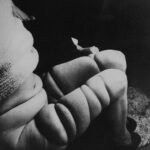
© Hans Bellmer
Bibliography
Hans Bellmer, Anatomía de la imagen, Ediciones de La central, 2010, España.
Unica Zürn, El hombre jazmín, Siruela, 2006, España.
————-, Primavera sombría, Siruela, 2005, España.
Cover image: Hans Bellmer, “Tenir au frais (‘Keep Cool’),” maquette for the cover of Le Surréalisme, même #4, pp. 126–127, 1958. Collage of vintage gelatin silver prints & gouache on masonite. 9 1/4 x 9 5/8″. Ubu Gallery, New York & Galerie Berinson, Berlin. © ADAGP, Paris.


