
In Asian civilizations, the code of honor is not founded on a teleology of glory as an existential value, but would instead exhaust itself in itself, as a practical nature, through its immanent function within that existence. What in the West appears as destiny and apotheotic fulfillment, Asia understands as a harmony proper to the real, through which things are fulfilled in that realization, neither ideally nor as apotheosis, nor yet as transcendence.
The difference is barely tonal, yet it transforms the experience of death and the meaning of life within existence, which in the West, from Homer to Christianity, consecrates the hero through his death insofar as it is glorious. In the West, death is a form of perpetuation, with variants of the same symbolic operation: whether for the homeland or for the faith, the individual transcends himself in sacrifice, attaining that perpetuity of the symbol.
Thus, life in itself lacks plenitude, which is reached only in the overcoming of the limit, through that transcendence; the hero remains in memory, and his death does not close the cycle, but opens it to eternity, as teleology. By contrast, in the Asian imaginary, death is neither a door to another existence nor a consecration: from Confucius to the samurai or the Buddhist monks, death is only a just point of closure, one that does not alter existence.
In Asia, existence does not seek to perpetuate itself but to complete itself; life is only form, fulfilled in movement and therefore stopping at the moment when it still preserves its integrity, without corrupting itself through effort. For that reason, ritual suicide or the renunciation of the elderly do not have a tragic tone but an harmonic one, of fulfillment; they are the final gesture that preserves the consistency of the world, preserved in form, without the excess of an extension.
To die with serenity is not to deny life, but rather not to appropriate it, in the detachment of true maturity; which is disconcerting, because it is not nihilistic, but a different understanding of the real, without idealism. In that context, the individual does not try to transcend his existence, but rather not to overflow it, which is the modest thing; to live beyond it —without honor— is disproportionate and fractures the order of the cosmos, distorting its harmony.
In the Chinese tradition, this harmony is expressed in the notion of li (礼), which is gesture, ritual composure, maintaining the balance between the human and the celestial, not as morality —not even as a referent—, but as practice. Li does not say what is right or wrong, but how to sustain the Mandate of Heaven (Tianming), which is the real; and politics is, therefore, transcendental, because the social reproduces and expresses that cosmic order that contains it.
The individual, however, is immanent; he does not realize transcendence, but aligns himself with it in his immanence; and from there arises the difference with the heroic death of the West, which aspires to eternity as its only fulfillment. Heroism justifies existence on a higher plane, which is what grants plenitude, as a special nature; and, by contrast, the Asian conception recognizes transcendence only in the political, because the individual is sufficient.
For this reason, in the East one dies at the right moment, when form can no longer sustain itself by itself; and this difference is not only ethical but ontological, explaining its existential function as that of immanence. In Christian humanism, the person is defined by a transcendent identity, which fulfills him as a person; in the Asian vision, the individual possesses nothing that is not his form, and this form is transitory, a flow of life itself; and merit does not lie in the coarseness of projecting oneself beyond that limit, but in living within it with perfection.
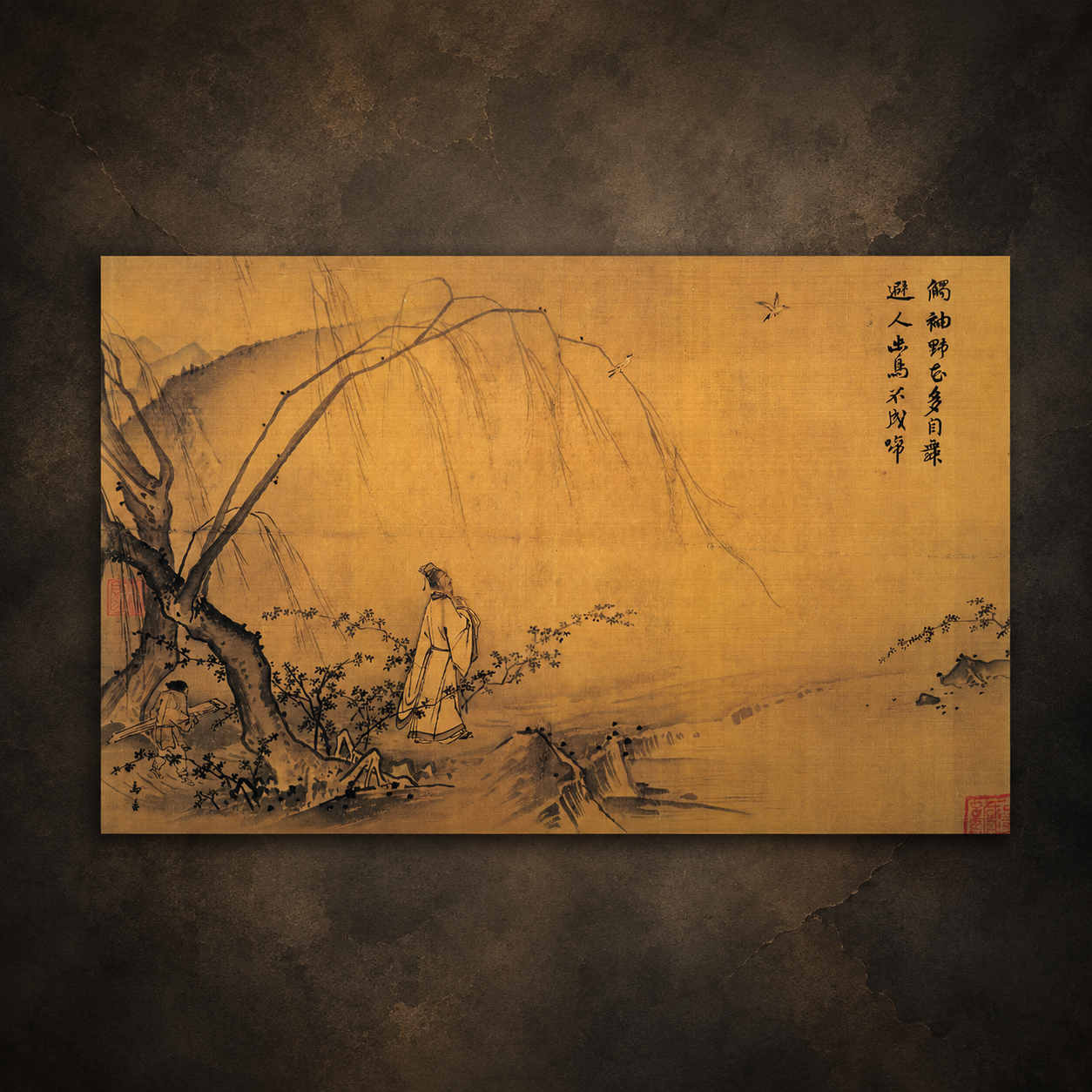
Asian art contains that heavy and dense lightness of a peasant carrying the world on his shoulders, not sustaining it with Herculean arms, but balancing it, with the cosmos as counterweight. Hence those watercolors, which reflect the ephemeral, and those kilometer-long books, which recount dynasties and not men; both portray the complexity of the real, but without that excess of an uncontainable baroque, calm in their sufficiency.
Image: Walking on Path in Spring by Ma Yuan (c.1190 – 1279), a Chinese painter of the Song Dynasty.


