
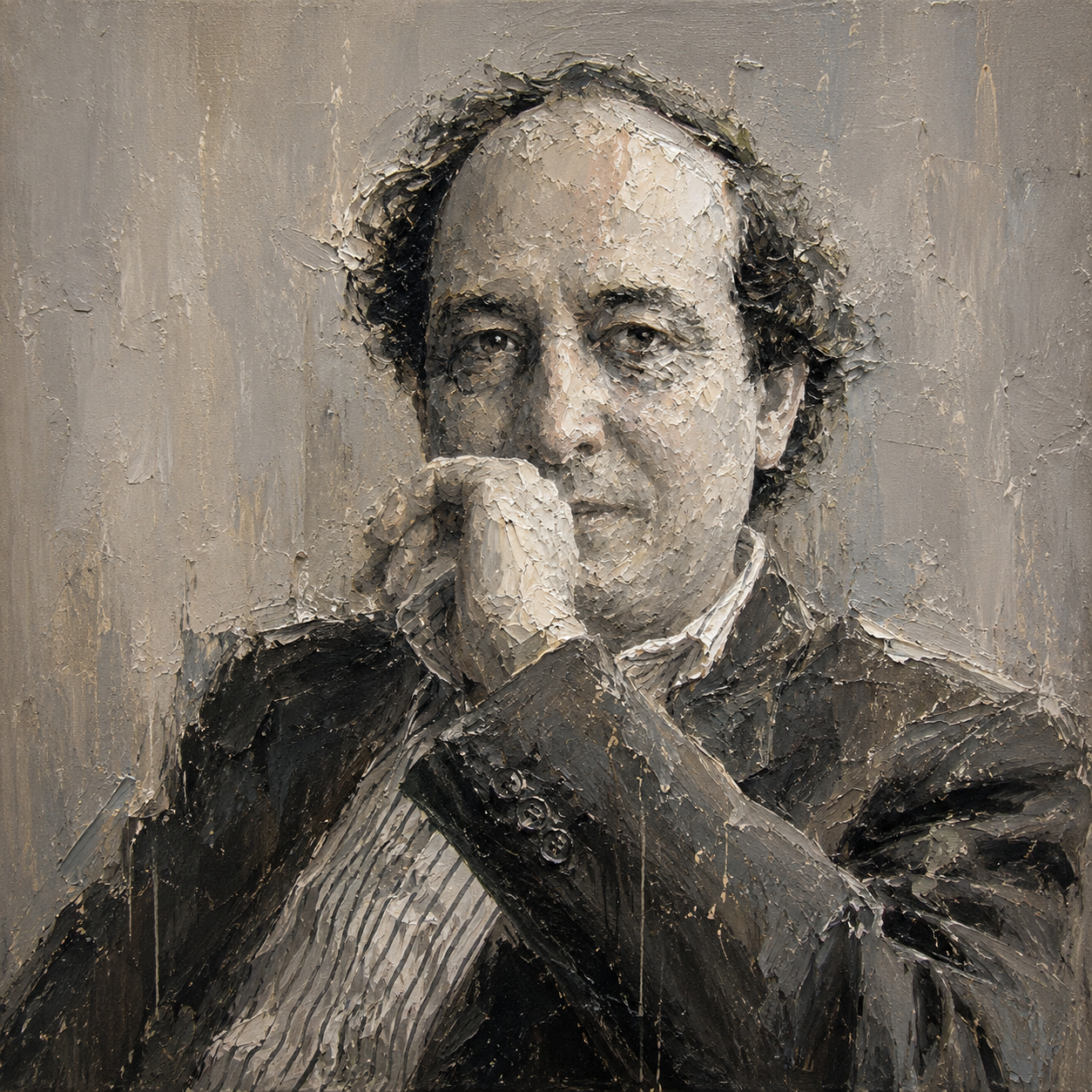
Onduras. It derives from onda, from the Latin unda (wave, movement of water), together with the abstract suffix “-ura,” which designates a quality or effect. A word that suggests depth, resonance, and propagation: that which leaves a trace as it expands. A neologism coined by the editors of Bookish & Co. to name certain literary birthdays. These Onduras of Roberto Calasso celebrate an oeuvre made of sentences that advance like luminous remnants among myths, gods, sacrifices, books, and images. Each quotation preserves the tension of an expansive reading, an intelligence that returns to the ancient in order to make it unprecedented in the present.
It is a commonplace and, like all commonplaces, a blinding truth and therefore difficult to treat, that our century and the sixteenth century are akin. Specular, perhaps, more than akin: considering, for example, that in the seventeenth century a new observation of nature and a different conception of the visible were becoming institutional, while today, with nature itself dissolved in the hands of scientists, it seems as though another path were returning us to the search for the invisible foundation of its manifestation. Thus the circle seems closed and one might say that, on another plane, we are traversing the sixteenth century backward. All this, naturally, does not occur without a feverish contact of sensibility, a deep involvement in that past. Perhaps for this reason as well, studies on the seventeenth century have been especially rich in recent decades: whole strata of that age have been rediscovered and the context of many works has proved surprisingly complex.
The century of ashes and of Vanitas, Babel-like and necrophilic, embalmer of the past in precious remains that appear and disappear on the mobile stage of a Universal Theater, inventor of machines, wits, and anatomies, in few other cases surfaces so fully as in the pages of Sir Thomas Browne. The entire apparatus of the sciences and philologies, the inspiration and the surliness, the imaginative fury and the dispersion seem filtered into his prose.
As with Donne, it was not chiefly literature that stimulated his imagination; cosmological hypotheses, cartography, accounts of unknown worlds, and the natural observation of every species did so much more. Many have claimed that Browne is a bookish author, and that would indicate a defect and a limit, at least for those who worship “free creativity.” Perhaps it is necessary to examine this definition, undoubtedly exact, more carefully. In fact, Browne’s page sometimes has the appearance of a cento: it presents heaps of references, data, quotations; even, and above all, in Urn Burial and The Garden of Cyrus, which are his two masterpieces. Yet that procedure was a fundamental element in his method of composition. His prose — one might say — tends toward the Chinese poetics of ji jù, that is, “gathering of sentences,” which prescribed compositions in which each phrase had to be drawn from different works by others. Browne himself had elegantly defended his conception: “A complete and valuable work might be deduced from the centos of all ages, just as all the beauties of Greece give rise to one single and beautiful Venus.”
The Hieroglyphs of Sir Thomas Browne
◾️
To free oneself from God it is not enough to kill him. Although the gesture may be lightning-fast, the agony extends for years and years, because God has a capricious relation to time. And then, in the murderer’s quadrilateral of mirrors — D.F. Flechsig? P.E. Flechsig? D.G.M. Schreber? D.P. Schreber? — they realized at once that the divine rays, even after God had been stripped of his cadaverous sheath, demanded another. To kill means only a displacement of energies. And God is always the best way to get rid of God, some insinuated. But now where could the beams of light be projected? With D.F. Flechsig and D.G.M. Schreber dead and P.E. Flechsig destined for demiurgic functions, who remained of intact substance to receive the blinding globe, the nervous tangle lost in space? “Yes, I know well, it will fall to me,” the President said in a low voice: for days he was rummaged through in all his fibers. A thousand times his organs were destroyed and recomposed. He became the new divine pole.
The Impure Madman
◾️
If we truly must find a discrimination between what can be said of the modern and everything we encounter in any preceding age, might it not perhaps be a certain capacity to let oneself be swept away by form or by gesture, to ignore the limit even when one explicitly defends it, to invade everywhere all reserved areas, even with the excuse of guarding them from any outrage? Why do we see Joseph de Maistre as so akin to his hated Voltaire, why does Pascal converse fraternally with the most incredulous moralists? It is a certain not thinking of consequences, moving by the impulse and pleasure of wandering, rapacious, heedless movement, eris palpans in meridie.
The equitable and balanced tone of Sainte-Beuve cost him a continual obstruction of black humors in the circulation: his capillaries became poisonous corals. Torn out, we find them in the Cahier vert that Sainte-Beuve wanted to fall “only into friendly hands,” and it has fallen above all into indifferent hands. Few have noticed that “very black and heavily loaded palette ground,” which served equally to fix gossip that could not be published, out of bienséance, and to thicken some clot of a confession that could never have dissolved into a discourse, out of bienséance. In exchange, those isolated words conceal, in their laconicism, a pathos that suspends them in the void, or at the bottom of his “arsenal of revenges,” like the fleshless little chapters of the only novel Sainte-Beuve wrote: the Cautious Journey of a Delicate Soul toward Desolation…
In the courtyard of the retirement home for single ladies, governed by little nuns devoted to the perpetual adoration of the Sacré-Coeur, near the Rothschild hospital, where the Parisian outskirts court desolation, Brother and Sister were seated on a wooden bench. The Sister, a guest of the home, was receiving a visit from the Solicitous Brother. Above the melancholy protuberance of the eyes, the hair remained a memory of the garçonne; on her wrists and around her neck a few jewels surviving from the family defended the dignity of the lady en retraite. The Brother awaited the moment to speak of accounts and receipts. From a pocket he took out a ring case, empty. He offered it to the Sister, perhaps it might be useful to her. The Sister slowly ran a finger over the silk lining: “It is well preserved,” she said. But they also had to pretend to be talking about something else. On the bench they were waiting for the keeper, who guided loose groups through the cemetery of the “victims of the Revolution,” just behind the fence of the retirement home.
—Who does the cemetery belong to? —said the Brother.
—To the Société Immobilière et Civile de l’Oratoire du Cimetière de Picpus —said the Sister—. They are the heirs of the victims. Only they can be buried in the cemetery. They are the relatives of the aristocrats.
—But there were not only aristocrats. While I was waiting, I was looking in the chapel at the list of victims in the common graves. There is everything. Merchants, lawyers, common people…
—Ah, yes, by then they had already eliminated almost all the aristocrats…
—There must have been so many reckonings, jealousies, denunciations…
—They transported them from the Nation on carts. There are one thousand three hundred and six…
—At the end of the war too there must have been many reckonings, jealousies, denunciations. Then they eliminated them, and no one spoke of it anymore…
The Ruin of Kasch
◾️
But how had it all begun? Having arrived in Argolis, the Phoenician merchants spent five or six days selling their goods, which came from the Red Sea, from Egypt, and from Syria. The ship was anchored, and on the shore the local people looked at, touched, and handled those objects born so far away. The last goods were still to be sold when a group of women arrived, and among them Io, the king’s daughter. They continued bargaining and buying. Suddenly the merchant sailors threw themselves upon them. Some managed to flee. But Io and others were abducted. This is the abduction to which the Cretans later responded when they abducted the king’s daughter, Europa, in Phoenicia. The Phoenicians, however, tell the story differently: Io had supposedly had love affairs with the commander of the foreign ship. She was already pregnant, and ashamed of it, when she herself decided to embark with the Phoenicians.
From these events history was born: the abduction of Helen and the Trojan War, just as, much earlier, the expedition of the ship Argo and the abduction of Medea, are links in the same chain. A summons oscillated between Asia and Europe: at each oscillation a woman, and with her a gang of abductors, passed from one shore to the other. But Herodotus observed that there was, nevertheless, a difference between the two sides: “Now, abducting women is considered the work of evildoers, but to concern oneself over abducted women is the act of fools, while the act of the wise is to be unconcerned with the abducted, since it is clear that, had they not wished it, they would not have been abducted.” The Greeks did not behave like wise men: “For a woman of Sparta they gathered a great expedition and then, having arrived in Asia, overthrew the power of Priam.” Since then, the war between Asia and Europe has not ceased.
The Marriage of Cadmus and Harmony
◾️
Moving in the pathetic orbit of the German [writers] exiled in America — it should be remembered that they were officially designated as “enemy aliens” — and frequently marginalized as importunate beggars, Brecht looks with evident resentment at the group of the Frankfurt Institute led by Adorno and Horkheimer, as though it were a gang of hysterical university men eager to receive funding, servants of capital, therefore. But precisely in those years, with unsurpassed lucidity, Adorno and Horkheimer had managed to outline for the first time in American reality the features of a culture industry, with regard to which Brecht’s analyses prove rudimentary and, above all, vitiated by his irritating certainty that he was defending what was just.
Even in his relations with Benjamin, who is the incomparably most brilliant reader, as well as the most devoted, that Brecht ever had, rather odious aspects can be perceived, as emerges from the notes Benjamin left us on his stay in Svendborg. When Benjamin hands him his admirable essay on Kafka, Brecht comments on the manuscript by saying that “this essay carries water to the mill of Hebrew fascism” (once again, the obsession with enemy readers). If he sees Benjamin reading Crime and Punishment, he immediately bursts into one of his provocative condemnations: “Brecht attributes to Chopin and Dostoevsky an especially pernicious influence on health.” Finally, when news of Benjamin’s terrible death reaches him in America, Brecht notes the fact in his diary without a word of farewell to the friend and immediately goes on to comment, with punctilious self-sufficiency, on the manuscript of the theses On the Concept of History, the last one Benjamin had sent to the Institute of Sociology, concluding: “In sum, this brief essay is clear and clarifying (despite its metaphors and its Judaism).”
“Brecht the Censor” (The Forty-Nine Steps)
◾️
When the Nazis occupied Paris, in June 1940, Stalin flew the flags, as a sign of celebration, over Moscow’s public buildings. Between June 9 and 13, two million people fled toward the South, Benjamin among them. With efforts and delays, he had managed to obtain a visa for America. Now it was a matter of crossing a border. In Marseille, in September, he shared with Koestler his supply of morphine, “enough to kill a horse.” On the morning of September 26 he set out with a small group to cross into Spain. They reached the border after twelve hours of painful marching. But it had been closed precisely that day. The visas were no longer valid.
That night, Benjamin poisoned himself. The next morning, he sent for a friend and gave her a brief letter for Adorno. Then he lost consciousness. The remaining companions, after various negotiations, managed to cross the border. The friend had Benjamin buried in the cemetery of Port Bou. A few months later, Hannah Arendt would search in vain for his grave: “The cemetery looks out over the small bay, directly over the Mediterranean; it is made of terraces cut into the stone; and in these blocks of stone the coffins are also placed. It is, by far, one of the most fantastic and most beautiful places I have ever seen in my life.” Years later a grave would appear, isolated from the others, with the name Walter Benjamin carved in the wood. According to Scholem it was an invention of the cemetery keeper, greedy for tips. “It is true, the place is beautiful; but the grave is apocryphal.”
“An Apocryphal Grave” (The Forty-Nine Steps)
◾️
They called him King Soma. He was a king and he was a substance. We know little of his deeds. But we know that he was the object of the deeds of others. He was abducted, intercepted, rescued, sold. Or squeezed, filtered, murdered. These are the facts that are told about Soma. More than a king, Soma is that which allows someone to become king. He is sovereignty. He is what all those who wanted to become kings have sought. He is a radiance submerged in water. His custodian is a Nymph-Serpent. Later they were a Nymph and a Serpent. Or only a Serpent and only a Nymph. No one who aspires to the condition of sovereign can reach it except through the Serpent and the Nymph. The Nymph can bite that substance, chew it, and then transmit it with a kiss into the mouth of the hero, the god, the man who suddenly arrives.
Ka
◾️
The manifestation of the gods is intermittent; it follows the expansion and the refluxes of what Aby Warburg calls the “mnemonic wave.” The expression, which appears at the beginning of a posthumous essay on Burckhardt and Nietzsche, refers to those eventual shocks of memory that strike a civilization in its relation to its past, in this case to that part of the Western past inhabited by the gods of Greece. All European history is accompanied by this wave, which at times overflows and then recedes; the two cases chosen by Warburg correspond to a polarity of reaction, that is, to a moment in which the wave is powerful and overwhelming. Burckhardt and Nietzsche shared, according to Warburg, the fact of being necromancers in their way of approaching the past. But their attitude toward the “mnemonic wave” was very different, even opposed. Burckhardt wanted to maintain until the last moment a meticulous sense of distance, guided as well by a precise perception of the danger, of the terror that accompanies that wave. Nietzsche, for his part, abandoned himself to it to the point of becoming the wave, until reaching the days when he signed the notes sent from Turin with the name Dionysus. One of them was addressed precisely to Burckhardt, and concluded with these words: “Now You are — thou art — our great, our greatest teacher; since I, together with Ariadne, must be only the golden equilibrium of all things, because at every step there appear those who are above us….” Signed: Dionysus. But it can be said that, from the Orti Oricellari of early-fifteenth-century Florence — frequented by Ficino, Poliziano, and Botticelli — down to the present, everything is a succession of blows and falls. The deepest trough of the wave perhaps occurs at a certain moment of the seventeenth century in France, when with the same impudence and hilarious pomp the childish Greek fables, the barbarous Shakespeare, and the sordid biblical stories, held to be the invention of solemn priests to stifle the nascent Enlightenment, were mocked. It could also happen that this multiple guffaw emanated from the same wit: that of Voltaire.
Literature and the Gods
◾️
Kafka intuited that only a minimal number of the elements of the surrounding world were named. A sharp Occam’s razor sank into novelistic matter. To name the minimum and in its pure literality. Why? Because the world was becoming once again a primordial forest, too laden with unknown sounds and apparitions. Everything had enormous power. For that reason it was necessary to confine oneself to what was closest, to circumscribe the area of the nameable. In that circle all the power would flow, otherwise dispersed. In what is named — a tavern, a carriage, an office, a room — an unheard-of energy would be concentrated.
Kafka speaks of a world prior to every separation and denomination. It is not a sacred or divine world, nor a world abandoned by the sacred or the divine. It is a world that must still recognize them, distinguish them from the rest. Or that no longer knows how to recognize them, distinguish them from the rest. There is a single link, which is only power. Good in its fullness is interpenetrated there, but also evil in its fullness. The object about which Kafka writes is the mass of power, not yet dissociated, separated into its elements. It is the formless body of Vrtra, which contains the water, before Indra pierces it with the blaze.
K.
◾️
When moderns and Greeks speak of possession they are referring to totally different realities. But not because the Greeks were unaware of the pathological forms of possession: in fact, from Plato to Iamblichus they have left us descriptions of astonishing clinical precision. Rather, it is the moderns who have lost the sense of what possession puts at stake for knowledge. When one speaks of possession the first false step is to believe that it is an extreme, exotic, and in any case murky phenomenon. Professor Karl Oesterreich, while working on his otherwise appreciable and very influential book on possession, one day felt obliged to experience personally what he was writing about. He obtained a certain number of laurel leaves and began to chew them tenaciously, since according to the ancient texts this was what the Pythia did. After a time he had to conclude that the effect was nil. He did not think that it would have been far more effective to observe his mind in the most banal and normal circumstances. Nothing less, nothing more is in fact required in order to have some grounded experience of possession.
For the Greeks, possession was above all a primary form of knowledge, born long before the philosophers who name it. One might even say that possession begins to be named when its sovereignty is already declining. That is why it is curious to observe with what certainty scholars such as Dodds affirm that Homer was ignorant of possession. But he was ignorant of it simply because it was everywhere. All Homeric psychology, of men and of gods, this admirable construction that only the naïveté of the moderns could have judged rudimentary, is traversed from end to end by possession, if possession is above all the recognition that our mental life is inhabited by powers that dominate it and escape all control, but can have names, forms, and profiles.
“The Madness that Comes from the Nymphs”
◾️
If someone is asked: what is a publishing house? the usual answer, and also the most reasonable one, is the following: it is a secondary branch of industry in which one tries to make money by publishing books. And what should a good publishing house be? A good publishing house would be — if the tautology is granted to me — one that is supposed to publish, as far as possible, only good books. That is, to use a quick definition, books of which the publisher tends to be proud, and not ashamed. From this point of view, such a publishing house could hardly prove to be of particular interest in economic terms. Publishing good books has never made anyone frightfully rich. Or, at least, not to a degree comparable with what can happen by supplying the market with mineral water or computers or plastic bags. Apparently a publishing enterprise can produce notable profits only on condition that good books are submerged among many other things of very different quality. And when one is submerged, one can easily drown — and thus disappear completely.
Then, it will be good to remember that publishing has on numerous occasions proved to be a quick and sure way to squander and drain substantial fortunes. One could also add that, along with roulette and cocottes, founding a publishing house has always been, for a young man of noble origins, one of the most effective ways of wasting his fortune. If that is so, the question is how the role of publisher has attracted over the centuries such a high number of people — and continues to be considered fascinating and, in a certain way, mysterious even today. For example, it is not difficult to realize that there is no title more coveted by certain powerful figures of the economy, who frequently conquer it literally at a high price. If these people could claim that they publish frozen vegetables, instead of producing them, they would presumably be happy. One can then arrive at the conclusion that, besides being a branch of business, publishing has always been a matter of prestige, for no other reason than because it is a kind of business that is at the same time an art. An art in every sense, and surely a dangerous art because, in order to practice it, money is an essential element. From this point of view, one may well maintain that very little has changed since Gutenberg’s time.
“Publishing as a Literary Genre” (The Madness that Comes from the Nymphs and Other Essays)
◾️
The question to be answered: why is the imbalance between the divine and the human corrected with a slaughter?
Man is the only being in the animal kingdom that has abandoned his nature, if by nature one understands the repertory of behaviors with which each species appears to be provided from birth. Strong, but not so strong as not to have to recognize his defenselessness before other beings — predators — man decided at a certain moment, which may have lasted hundreds of thousands of years, not to oppose his adversaries but to imitate them. It was then that the prey became predator. He had teeth and not fangs, and claws insufficient to tear flesh. He could not dispose of a venom produced by his organism, like snakes, formidable predators. He therefore had to resort to something no one else had: the weapon, the instrument, the prosthesis. Thus were born the flint splinter and the arrow. At this point, two decisive steps had been taken that all the rest of history would try to reason through, down to today: mimesis and technique. Looking back, the imbalance produced by the first step — that of mimesis, by which men decided to imitate, among all beings, precisely those by whom they were frequently killed — is incomparably more radical than any later step. Sacrifice was a response to that upheaval. In this way, a behavior incongruent with any other recognizable in the animal kingdom ended up manifesting itself everywhere. Sacrifice was the response to that enormous disturbance inside the species, the attempt to give new equilibrium to an order that had been forever wounded and violated.
Ardor
◾️
Among the Latin poets, Ovid was the most shameless with the gods, but also the most versatile in naming the divine. Aphrodite appears to him and offers him “a leaf and a few berries” of myrtle, which she tears from the crown that encircles her head. That is enough to perceive the numen: “Sensimus acceptis numen quoque,” “As soon as I received them I felt the divine.” Suddenly, everything changes: “Purior aether / fulsit et e toto cessit onus,” “The air became purer / and luminous, and every weight of the heart vanished.”
Where could frivolous women buy wigs in Rome? “Under the eyes of Hercules and before the chorus of virgins.” This should be understood: in the Circus Flaminius, before the statues of Hercules Musagetes and the group of Muses who follow him. Wigs and statues: Ovid was the best guide for finding and combining them. The various cults were also a pretext for the eye to single out the most attractive puellae, the girls who seem to have arranged to meet in those places. “In Rome is gathered everything that exists in the world,” said Ovid, with a formula similar to one used in India in the Mahābhārata. “They go to the theater to look and to be looked at.” But the same could be said of ceremonies. There was no need to choose between “the Sabbath rites celebrated by the Jews of Syria” or “the Egyptian temples of the heifer dressed in linen,” dedicated to the cult of the goddess Isis, or also other ceremonies that Ovid does not specify. He equates them all, for the purposes of amorous hunting, with the “murmur of the Forum,” there where the jurisconsults held forth beside the Nymphs of the Appian fountain. A sign of total availability and ductility toward every form of the sacred and the profane. This was Ovid’s presupposition — the situation he preferred, which could only manifest itself in the age of Augustus.
The Celestial Hunter
◾️
The foundation of terror is the idea that only slaughter offers a guarantee of meaning. Everything else seems weak, uncertain, and inadequate. To that foundation are then added the various motivations that vindicate the act. With that foundation there is also connected, in an obscure way, one that implies a metaphysics, bloody sacrifice. As if, from age to age and in the most diverse places, an inescapable necessity of slaughter imposed itself, which may even appear gratuitous and irrational. Ominous specular character between the origins and the present. An enchanted mirror.
(…)
Unlike all other regimes, democracy is not a specific thought but a sum of procedures that claim to be capable of welcoming any thought, except the one that proposes to overthrow democracy itself. This is its most vulnerable point, as was demonstrated in Germany in January 1933. Thus secular society proved agile and ingenious in the reabsorption, within itself, and under false garments, of those powers it had just expelled. Theology ended up transforming itself into politics, while theology itself was relegated to the universities.
(…)
July 22-23, 1935. Céline is in Badgastein, in a hotel, with two of his lovers, Lucienne Delforge and Cillie Ambor. Lucienne is a pianist and takes lessons with a teacher. Cillie has joined them in Vienna. Both women take walks in the mountains. Céline is bored, exasperated. The “regularity of life,” in its hotel and pre-Alpine variant, is not made for him. In those days, Céline had also continued his correspondence, increasingly bristling, increasingly impossible, with Élie Faure. It was the occasion to say what he thought of the people: “Dear Élie, in all this the misfortune is that there is no ‘people’ in the moving sense in which you understand it; there are no exploiters and exploited, and every exploited person wants only to become an exploiter. He understands nothing else. The heroic egalitarian proletariat does not exist. It is an empty dream, a SHAM, hence the uselessness, the absolute, nauseating stupidity of all those imbecilic images, the proletariat dressed in blue, the hero of tomorrow, and the evil smug capitalist with his gold chain. They are both trash, one as much as the other.” Céline added at the end an annotation that touches the essence of literature: “It is necessary to give oneself entirely to the thing in itself, neither to the people nor to Crédit Lyonnais, to no one.”
(…)
April 1945. The soldiers of the Red Army, who had come through very hard years and from a country in which few things worked and those few inspired fear, looked around as they advanced through Germany. According to Grossman, “it was in Germany, particularly here in Berlin, that our soldiers really began to ask themselves why the Germans attacked us so suddenly. Why did the Germans need this terrible and unjust war? Millions of our men have now seen the rich farms of East Prussia, its organized agriculture, the concrete sheds for cattle, spacious rooms, carpets, wardrobes full of suits… Millions of our soldiers have seen the well-built roads that go from village to village and the German highways… Our soldiers have seen two-story residences with electricity, gas, baths, and beautiful gardens. Our people have seen the villas of the rich bourgeoisie of Berlin, the incredible luxury of castles, properties, and mansions. And thousands of soldiers repeat that same question when they look around in Germany: ‘Why did they come against us? What the devil did they want?’”
The Unnamable Present
◾️
Saul appears looking for some she-asses that had strayed. He had traveled a long way accompanied by a servant from his household. But the she-asses did not appear. When they reached Zuph, Saul said to the servant: “My father will no longer be thinking of the she-asses, but will wonder where we are.” They had walked three days in search of those animals. They climbed the mountain of Ephraim, passed through the land of Shalishah and then through the country of Shaalim. They did not find the animals. And they felt disoriented, not knowing which road to take back. Then the servant said he had heard of a seer who lived in Zuph. Perhaps he could help them. Saul agreed, but they no longer had even a crust of bread left in their saddlebags. What could they offer the seer? The servant said: “I have found in my hands a shekel of silver. We could give it to the seer and ask him the way.” The biblical text adds explanatory words: “In former times, in Israel, when a man went to consult Elohim, he expressed himself thus: ‘Come, let us go see the seer!’ The one today called ‘prophet’ was formerly called ‘seer.’”
A group of girls had come out through the gate of Zuph to draw water from the well. And so fatal encounters happened, around a well. As with Rebecca, as with Rachel, as with Demeter at Eleusis. This time too there was a swarm of girls. They saw the two strangers going up toward the city gate. “Is the seer here?” the two unknown men asked. The young women answered at once: they would find him immediately, but they had to hurry, because he was about to leave the city. You must meet him, they said, “before he goes up the hill to eat, because the people will not eat before he arrives. It is he, in fact, who blesses the sacrifice, after which the guests eat.” Shortly afterward, Saul saw a man coming out of the walls through the gate of Zuph and said to him: “I beg you to show me where the house of the seer is.” Samuel replied: “I am the seer.” And he invited Saul to follow him to the hill: “Today you shall eat with me.” And he added: “As for the she-asses lost three days ago, they have already appeared.” For a priest like Samuel, the first obligation was to perform the sacrifice and distribute the meats of the sacrifice that were eaten. Saul received the best portion and Samuel said: “Here is what was kept, it has been set before you, eat! It was set apart for you when I invited the people to the feast.” The portion is moîra, “destiny.” Saul’s destiny was already arranged, reserved for him. They had been waiting for him.
For those who do not know it — and not everyone knows it — the lost she-asses are the ones that allowed the meeting between Saul and Samuel. If Saul’s father had not sent his son to look for them, Saul would have remained with his family, in the smallest tribe of Israel. He was a handsome young man, a head taller than his companions, and had shown no sign of any particular vocation. Thanks to the lost she-asses, he one day found himself away from home without knowing the way back. He was prepared to pay with a silver coin anyone who showed it to him.
This is the situation in which Yahweh caused him to cross paths with Samuel. The lost she-asses were the stratagem that made the encounter possible. And those she-asses would be recovered. Not by Saul, but — no one knows how — by Samuel himself, the seer who would make Saul the first king of Israel. Yahweh too was allegorical. The lost and found she-asses also symbolized the people who longed for a king but would not have been capable of choosing him, had the seer Samuel not anointed him with the oil he kept in a flask.
The Book of All Books
◾️
It is not necessary for books to be in order — nor in disorder — in order to reveal something to their owner. They may even be in barely opened boxes. In any case, something will be revealed.
The first person to set foot in the apartment where I still live, in Milan, was Jacob Taubes. I did not know him, although I knew who he was, through Frederic Rzewski, to whom Taubes had given De la Tyrannie, the burning exchange between Kojève and Leo Strauss; and through Ingeborg Bachmann. Ingeborg was the one who suggested to Taubes that, in Milan, he get in touch with me. It was December 1968. Taubes directed in Berlin the most subversive seminar in Europe, although he took good care not to present it that way. He only said that he sought to attract “the best,” and kindly invited me to move there to teach for a time. Adelphi was then taking its first steps, so I declined the invitation.
Taubes was an irresistible and fascinating conversationalist, and he did not want to speak only of his seminar. We were seated in a room that still had no furniture, occupied in large part by boxes of books newly arrived from Rome. For Taubes — it became evident to me immediately — talking with someone meant above all entering the landscape of his library. That day such a thing was not possible. But the impulse was strong, so Taubes stretched a hand over one of the boxes and pulled out the first book that protruded: Vom Kosmogonischen Eros, by Ludwig Klages: “But how can you…?” (understand: how dare you?), he said to me immediately, with an expression of complicity I never forgot. All this today is scarcely comprehensible: Klages was then one of the “forbidden” names. He had been the model for Musil’s Meingast in The Man Without Qualities, but in the first place he was associated with everything that the students of Berlin, including those in Taubes’s seminar, felt obliged to avoid and despise: the soul (The Spirit as Adversary of the Soul was the title of his most important work), Nietzsche, graphology, Bachofen, the realm of the Mothers, tellurism. Not to mention the cosmogonic Eros, the title of the book Taubes had in his hands. In a word, Klages was the “irrational,” the horrible irrational, mortal enemy of all “Aufklärung.”
I never saw Taubes again after that day, although I heard a great deal about him. Above all from Scholem, who had ended up abhorring him and considered him a demonic figure; and from Cioran, who held him in high esteem. As I write this, I realize that exactly fifty years have passed since that autumn day in 1968 and Adelphi is publishing the correspondence between Carl Schmitt and Taubes under the title On Opposite Sides of the Barricade. Then a memory returns: Taubes, who liked to disconcert his rebellious and timid students, invited Kojève to his seminar. The students listened to him, frightened. At the moment of farewell, Kojève said that the next guest would be Carl Schmitt, the person who interested him most in Germany.
How to Arrange a Library
◾️
In Baudelaire the verses flowed irregularly, sprouting by means of a creaking mechanism, frequently jammed, partly rusted. One of his peculiar virtues was a certain lack of “ease” in the production of verses (to Poulet-Malassis: “Do you perhaps think I have Banville’s ease?”). It is not hard to believe him when he writes: “I am fighting against some thirty insufficient, disagreeable, badly made, badly rhymed verses.” By contrast, in his friend Banville the word flowed at will. He was an automatic dispenser of verses, which today glide over the reader almost without leaving a trace. Whereas Baudelaire’s verses are jinn that occasionally emerge from a laboratory full of exposed wires and bottles of dyes. In a corner, an unmade bed.
Baudelaire wrote numerous flat, unsalvageable verses, confused within the versified mass of his age. But precisely that faded, generic, anonymous background makes his other verses stand out more, those that take shape like his unattainable passerby in the midst of the crowd, the one who has in her gaze “the sweetness that fascinates and the pleasure that kills.” They are verses — or even fragments of verses — that establish an osmotic relation with the reader; they irresistibly resurface, above all there where they were born and still wander like protective genii, among “those streets and those hotels that have adopted the yellow patina of the insomnias they sheltered” (Paris according to Cioran). Thus the young Barrès noted: “Bitter pleasure, and among the sweetest, that of repeating to oneself a certain verse of Baudelaire from the morning to the Parisian night, in the cut-out shadow of the now scarce carriages and of the ever paler light of the streetlamps, along the deserted boulevards, while a weariness of exhausted nerves, a memory of insipid hours, of mistaken complicities and of the struggle so petty and so vain invades you, always the same, dragging with it an unsatisfied ardor, an irritation that contaminates.”
La Folie Baudelaire
◾️
Six hundred books in a single collection is an enormity if one thinks, for example, how much less numerous were the libraries housed in Montaigne’s tower or in Spinoza’s study. With six hundred books one could compose a broad and varied mental landscape. Perhaps one of those Flemish landscapes in which the most significant events are seen in the background, in the distance, in little-frequented areas, where we see tiny figures stirring. It is a landscape in which it would not be difficult to lose oneself.
The Publisher’s Mark
◾️
We know little of Tiepolo’s life, and what we know refers only to his activity as a painter. Almost nothing has been told to us of his personal life, despite the fact that he was famous from his youth. His life was transparent, like glass. No one noticed it. Everyone looked at the landscape that extended behind it. For this reason too Tiepolo was willing to adopt the role of epilogist of painting, just as in a performance there is an actor whose function is limited to appearing at the end and making an unsurpassable bow to the audience. Thus painting took leave of us, at least in that peculiar, singular, unrecoverable sense it had adopted on European soil for nearly five centuries, when there had been innumerable painters sustained by a single painting, which moved all together like those obese actors, of immaculate grace and lightness, like a Sydney Greenstreet. During those centuries, painting was first of all a task assigned by the world, through diverse and ultimately indifferent procedures. It was only necessary that a commission arrive from outside, as for a messenger the order to set out. Perhaps Tiepolo never painted except on commission, and where one suspects there was none (as in the series of the Scherzi or the small final canvases of the flight into Egypt), the work exhales an irresistible perfume of secrecy and of something forbidden. Afterward, the artists remained. It is true that commissions, public and private, continued to exist. But something had been exhausted, irrevocably. Painting progressively became a monologuing activity, a tranquil delirium that resumed and closed each day with the hours of light behind the windows of a studio. The artists remained, full of humors, caprices, inspirations, phobias. In the end they too ran the risk of disappearing.
Tiepolo Pink
◾️
Practically throughout Italy, beginning in 1945, the black beast was the irrational. Bazlen simply ignored those disputes. He thought they were a waste of time. He preferred to speak of what is recognized already by its sound. That was the decisive point. Bazlen often said: “It does not sound right” — and it was understood that there was no discussion. The “anxieties” that were covertly reproached to Bazlen generally referred to the capacity to recognize that sound, which in him was complete.
Bobi


