
Memory raises time.
Borges
I
In one month I read more books by Natalia Ginzburg than by any other woman writer in my entire life as a reader. And I would hate, a couple of years from now, to run into the reader I am, that is, the one who no longer remembers what the story of Sagitario or Querido Miguel was about, as I know will happen. Such is the clumsy life of the profuse reader.
There is much of the family miniature in her novels. A world lying desolate at the feet of History. Her life was one of suffering—I do not like to be categorical, but there is quite a bit of truth in that—and yet she knew how to strip her prose of every curl of sentimentalism, and also of stereotyped versions of rural and village Italy.
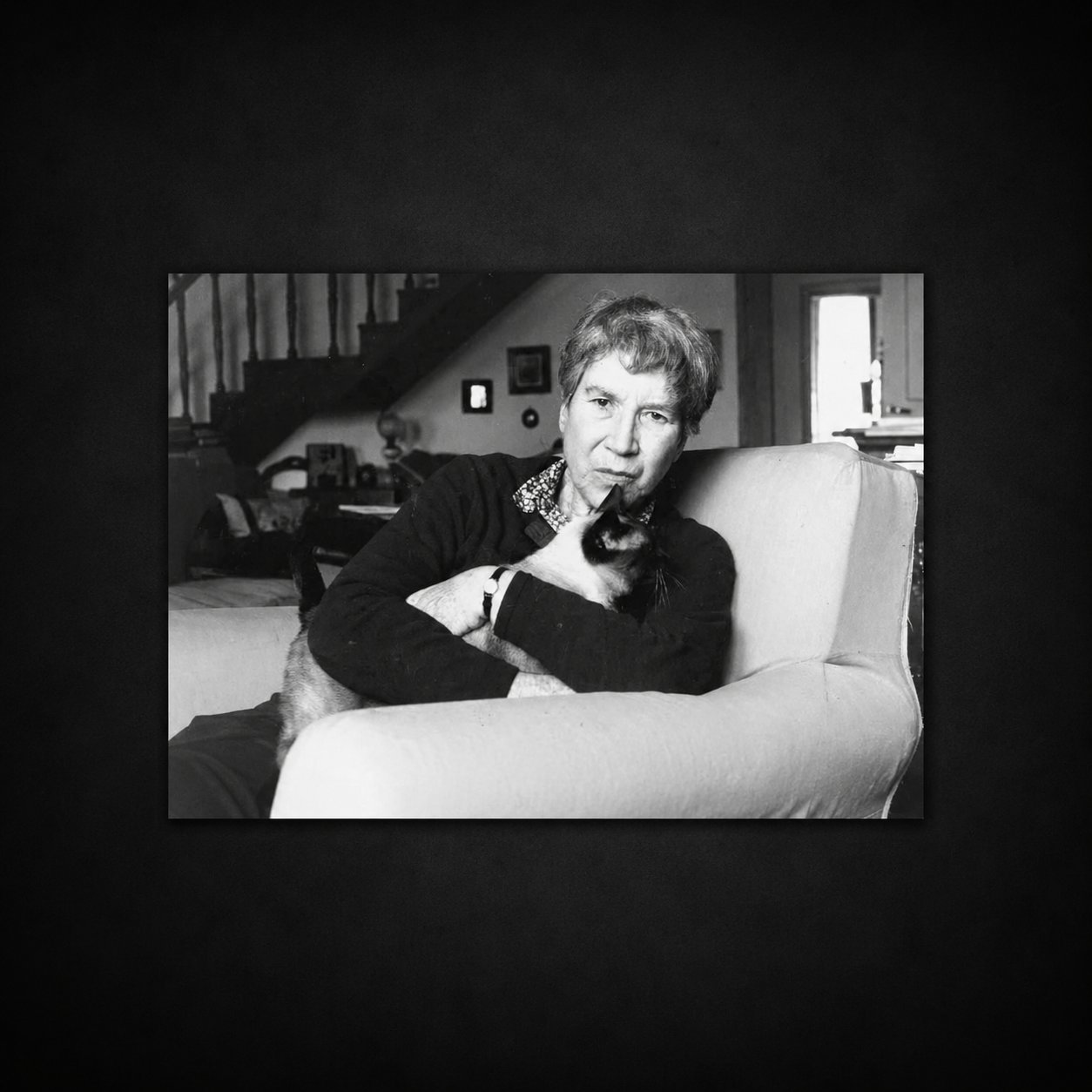
There is a photograph of Ginzburg on the cover of an Einaudi edition that shows her smiling. I do not think she was a beautiful woman. I thought it might be the only image in which she does not appear with that intelligent but devastated gaze she knew how to pour over her writing. Everything she narrated in her books is transfixed by that melancholy, by a summary of absences and lacks.
The years took care of darkening everything, of adding folds to a face, wrinkles to a skin, pain to a body. And her character? Few testimonies remain. Cesare Pavese was harsh when he wrote in his diaries that Ginzburg aroused antipathy in him, that he did not like people who took everything for granted because it was a sign of the absence of a tragic sense. Absence of a tragic sense in her, a woman who lost everything? She knew few men as well as she knew Pavese. She left behind a splendid essay on him in Las pequeñas virtudes, and also writes about him in Léxico familiar. Rereading it after finding that sentence in the diaries leaves an aftertaste of suspense, as if a conversation never quite closed because of time and suicide. She never ceased to admire him. He was the second great absence in her life after Leone Ginzburg.
To enter Ginzburg territory is to gain access to levels of asceticism rarely explored. That reader in search of grandiloquent phrases, or phrases suitable for embedding in a poster to circulate on literary-promotion pages, would do better to pass by. Her written body serves other resonances. Andrés Trapiello, translator of Las palabras de la noche, considers it “an almost poetic book, prosaic and weightless.” Her voice is innocent, but with a tragic innocence, a funereal silence, the end of a terrible time that gives way to the uncertain, to the incurable. Even so, there are always glimpses of an icy humor that examines people and things with the conviction that the world is closing inexorably over our heads, beneath our feet, and before our eyes.
In Ginzburg there is a rather particular use of memory. In her imagination, it is in the past that the true dimension of the present resides, and it is there we must go in order to obtain tools for understanding the phenomena of today. A writer who traveled very little—she seldom left Italy, even once she was already a recognized writer—her gaze always turns inward, toward the interiors of a newborn republic, and she cannot afford to be complacent about what she sees. She connects better with the desolate, open, battered countryside than with the worldly noise of cities, although she always lived in them: Turin, Rome, and something of Florence belong to the primordial map of her life, excepting that period of confinement in the Abruzzo, D’Annunzio’s land, with Leone, her husband at the time.
We know from Tolstoy, and because we have lived it, that we are not promoters but victims of history. Ginzburg’s books abound in victims; she herself is a survivor, though deeply damaged by absences, deaths, suicides. In her brief essay “Verano” included in Domingo, published by Acantilado, she recounts an attempted suicide by overdose of sleeping pills while living in Rome after Leone’s death. And it is possible that, if there is such a thing as a suicidal profile, Ginzburg fits it. Too many blows. Too much introversion and introspection. Too much distrust. Her voice is sometimes hesitant, though firm. Are these traits part of the personality of a suicidal person? We could not know. She survived everything and still had the strength shortly before dying to join electoral lists to run for deputy, to travel for campaign commitments, to write a monographic essay on the Manzoni family and then another book on the case of an adopted girl that shook Italy in the eighties.
Few authors represent precarious life with greater rawness. What has been a constant theme in twentieth-century narrative finds in Ginzburg’s fiction a radical explicitness. The twentieth century was the century of the most accelerated development in almost every sense, but also the one that most closely observed precariousness. In that precariousness one has seen a way of externalizing anonymity before demanding frameworks of recognition and prosperity. To die is to finish dying, Quevedo said, or more: to be born is to begin to die. In one of her novels, Y eso fue lo que pasó, that precariousness becomes even more evident. What is already a commonplace in her work returns, the impossibility of marriage to generate happiness, but above it appears the tragic sense of living.
Ginzburg wrote that novel almost entirely in the offices of the Einaudi publishing house in Turin, where she had begun working after the outcome of the war and Leone’s disappearance. Alone and overwhelmed by the effects of a tragedy, she fixed her eyes on the terracotta heaters that smoked up the place and began writing a novel “full of smoke, rain, and fog.” Calvino wrote in the prologue what constitutes a hallmark of her narratives: that first person who gives body to a woman trapped in the thickest tedium, without the strength or the capacity to attempt a search for meaning in her life. “I wrote this story to feel a little less unhappy,” she wrote in a brief introductory note. “I wanted to write, I found a gunshot and followed its trail,” she says, alluding to the pistol shot with which the novel begins, another shot in a landscape of fire, disappearances, desires for revenge, and open graves. Many decades later, the sound of that shot still resonates in the theater of the world.
II
NOTES OF A NOCTURNAL READER
Natalia Ginzburg, audazmente tímida: Una biografía
Maja Pflug
Siglo XXI Editores, 2020
Mediocre. To consider it a biography at all is already to grant it too much. Poorly edited in its digital version. It is full of long fragments from N.G.’s essays and chronicles, and one is left with the impression that it did not explore other materials sufficiently. There are too many gaps in a life that was by no means innocuous, though it may appear so. How did the change occur in N.G., from being politically disillusioned to assuming her role in active politics as a deputy? This is explained far better in her essays, not in this biography. What was the real nature of her relationship with Einaudi, so full of light and shadow and not-so-veiled reproaches? There are books by N.G. that are not even mentioned. Of the others, there is no personal view of them. Can one write a biography without reading the books of the person being biographed? The best part: the photographs.
§
Léxico familiar
Editorial Lumen, 2017
With this story of her family she won the Strega Prize in 1963. Do not look in her books for a substantial summary of biographical moments or gossip about the lives of Pavese, Einaudi, Calvino, Leone Ginzburg, and others. Her books are not for that kind of reader. In an essay from another book she reproaches Einaudi for not being more explicit in his reconstruction of certain events in the history of the publishing house. It would have to be said that Ginzburg is not especially generous either when it comes to narrating events from her own life. But her books, and this one in particular, are the enormously personal map of a past time that finds its only resting place in a voice like hers.
§
Sagitario
Acantilado, 2021
Another of Andrés Barba’s translations for Acantilado. The story of Sagitario has links with an earlier story, “Mi marido y yo,” and I also notice a certain stylistic influence from García Márquez, whose most renowned novel Ginzburg had praised in an essay in Las tareas de casa. The narrator is a young writer overwhelmed by the vital whirlwind of a controlling mother recently arrived in the city. The Ginzburg universe is expressed here through the profound approach to the feminine environment. There is one mother who is swindled and another who is a swindler. But death is now a much more present character; it has colored everything. It is a world of specters. The human has been emptied out. Men move through these stories like zombies. Women, in their desolate and interior space, try to stay afloat with nothing at hand. A mother has invested some money in shares, but this means nothing. She will lose it very soon because life is a theater of death without paraphernalia. And yet in her attitudes there is a being resistant to mourning, a desire to alter the course of her journeys into the void.
§
Las tareas de casa y otros ensayos
Editorial Lumen, 2016
The great human landscape of a thought. It gathers texts published in magazines and newspapers of the time, although a few, some four or five, were unpublished. The most enjoyable are her accounts of lived episodes: the search for a house in Rome, her memories of childhood and her first writings, her trip to Boston, her distance from what she does not understand. These are the best moments of the book, where she recovers the tone of those memorable essays in Las pequeñas virtudes.
There are interesting notes on her participation in political life, where she shows her interrogating gaze on the transformation of the world, the disappearance of “her” world, that of a generation unable to understand the drift being taken by the great political and social questions, especially from the sixties onward.
The book includes several evocations of writer friends: Pavese, Carlo Levi, Italo Calvino, Mario Soldati, Sandro Penna, the editor Giulio Einaudi. I enjoyed them greatly because they are portraits transfixed by affection, but also by distance and transparent lucidity, as if they had been written by that girl who waited, reading in the mornings and in solitude, for the arrival of the home tutor in Turin in the twenties.
§
Domingo. Relatos, crónicas y recuerdos
Acantilado, 2021
The stories: Brief, without much development. The one about the Germans and “Domingo” are the best. Except for these two, the rest revolves around the fantastical universe of children. It shows that where the author moves best is not in the short story, although she has some notable ones, not in this book, but in that kind of rather brief novel such as Y eso fue lo que pasó, El camino que va a la ciudad, and Las palabras de la noche.
The chronicles: Quite impressive in the first two chronicles is the description of the peasant class in Italy in the years before the war, the poverty and indigence of a layer of the population in the Abruzzo that does not desire well-being because it does not know it, and words like rights and social justice would provoke boredom and fear in them. There is no distinction, she says, between poor and rich peasants; they all live badly, suffer cold, eat poorly, dress in rags, and have lice. Progress and civilization advance only a few steps away, but they do not notice. She holds the same view of Matera in the fourth chronicle, and especially of its poorest part, called Sasso.
“Verano”: Confession of an attempted suicide with sleeping pills because of the tedium of summer, the unbearable reality of losing her husband, and the distance of children whom she feels removed from her and from her poor and sad maternal condition. She also wanted to pretend she was a man.
“Infancia”: The theme of childhood years returns, constant in her books, the quarrels among siblings, her withdrawal, her relationship with God and religion. There are three consecutive chronicles that are directly disposable, since they denounce the pauperized condition of workers in factories in the Italian interior and are evidently the result of political inquiries. “La casa” is included, a great text that had already been collected in Las tareas de casa, though translated by another person.
“El miedo”: Once again life in Pizzoli, the war, the armistice, the absence of Leone, who has gone to Rome, although now she incorporates other characters and places, such as the terrace of the Hotel Victoria, that she had not mentioned before. The genesis of the story “El paso de los alemanes por Erra”?
§
Las palabras de la noche
Editorial Pre-Textos, 2017
The story of several families condensed into a hundred pages. An Italy of countryside and small town where the war is a muffled presence. To reach the final story, the most fascinating in the whole mosaic, that of Elsa, Ginzburg’s alter ego, and Tommasino, one must peer into the fate of that sad rich family of the town, marked like all the others by the terrible, by its portion of fatality.
Ginzburg’s capacity to capture a way of speaking, which is in itself the principle of so many renunciations that mark these characters, is the first thing that should be emphasized. Prose of brief strokes and yet far from all coldness. “The city I loved has not changed at all,” she says of her friend Pavese in Las pequeñas virtudes. “My order and my disorder are full of grief, remorse, complex feelings,” she says later, remembering that she wrote in the afternoons, in the little free time life left her.
Dear Elsa, nothing has changed; disorder is still there, like a shadow of our false order.
A novel made of successive flights.
§
Y eso fue lo que pasó
Acantilado, 2019
Leaving aside Léxico familiar, which is not fiction, this book would be, along with Las palabras de la noche, the best I have read by Ginzburg. Because of its narrative rhythm, which is fast-paced, almost vertiginous, and because it is where she best represents precarious life, the author’s seal. Here that precariousness becomes even more evident, one more character. What is already a commonplace in her work returns, the sense of the tragic mentioned above. The marriage has a girl who dies shortly after birth—I am not spoiling anything; we learn of her death in the novel’s opening lines—in an atmosphere of many affective lacks and of scarcity of the most basic minimum needed to guarantee adequate medical care.
§
Querido Miguel
Acantilado, 2020
A decade passed between Léxico familiar and this book. In those ten years, Ginzburg produced several plays, essays, and columns for the press of the period. “A novel of voices,” Minna Proctor, her English translator, calls it, in order to place the focus where the author wants it as a transfer from dramatic art: the supremacy of what “is said” over what “is narrated.” Although the title of the book somehow declares Michael as the center, in reality the light is centered on those who have been left behind: the mother, the father, his sisters, a girl who was his lover and has had a child, a friend suspected of having been in love with Michael, and a few others.
The story is familiar: Michael is a young man of uncertain passage through life; he escapes from Italy to England supposedly for political reasons; sexually questioned, without a partner, and when it seems he has found one, he disappears again, ending his days in a confused protest in Holland or Denmark. His mother, how much of Ginzburg the mother is there in the character?, writes him long letters to which Michael never replies, or replies only with brevities. His father has died without seeing him again and has left him as inheritance a tower that no one knows what to do with.
The novel does not seem structurally well resolved. It uses the epistolary style a great deal, but from time to time a narrative voice intervenes.
What is once again very clear is that in Ginzburg’s narratives, the family is an inhospitable place, one that expels more than it gathers, mutilates more than it regenerates.
§
El camino que va a la ciudad y otros relatos
Acantilado, 2019
A book of stories for which we are grateful, another one, to Andrés Barba’s work as translator. Forgive me if I spoil anything. The first story, the longest, recalls the settings and passages of Las palabras de la noche. The adolescent girl lost in life returns, now deceived by a boyfriend from a well-to-do family. Tragedy falls on Nini, cousin of the protagonist, Delia, and her true love. The ever-innocent gaze of the characters, which the author pours over every scene and speech. Family life, gossip, quarrels among family members themselves. It was also conceived and begun in Pizzoli during the confinement. It is said that she wrote it after reading Caldwell’s El camino del tabaco, and published it in 1942 under the pseudonym Alessandra Tornimparte, since her Jewish surname could not be used.
Three stories follow: “Una ausencia,” “Una casa en la playa,” and “Mi marido.” Once again, the theme of frustrated, unhappy marriages. Matrimonial happiness is not possible in any way. Every life story is a dead end. The characters seem convinced of the futility of existence. The best of the three is the last, “Mi marido,” also written during the confinement in Pizzoli in 1940. The story in broad strokes: A woman in her thirties marries a doctor without really knowing him. Soon afterward her husband confesses that he has a lover, a poor girl from the town, from whom, however hard he tries, he cannot separate. The story ends in a tragedy already announced at the beginning: a relationship condemned to unhappiness. Chekhovian echoes. The model for the character of the doctor was the pediatrician of the author’s children.
In Lomas de Arkansas, winter 2023–Houston, Texas, 2026.
Part of this essay was published in the journal Parva Forma, no. 5, 2023.
Photograph: Paola Argosti


