
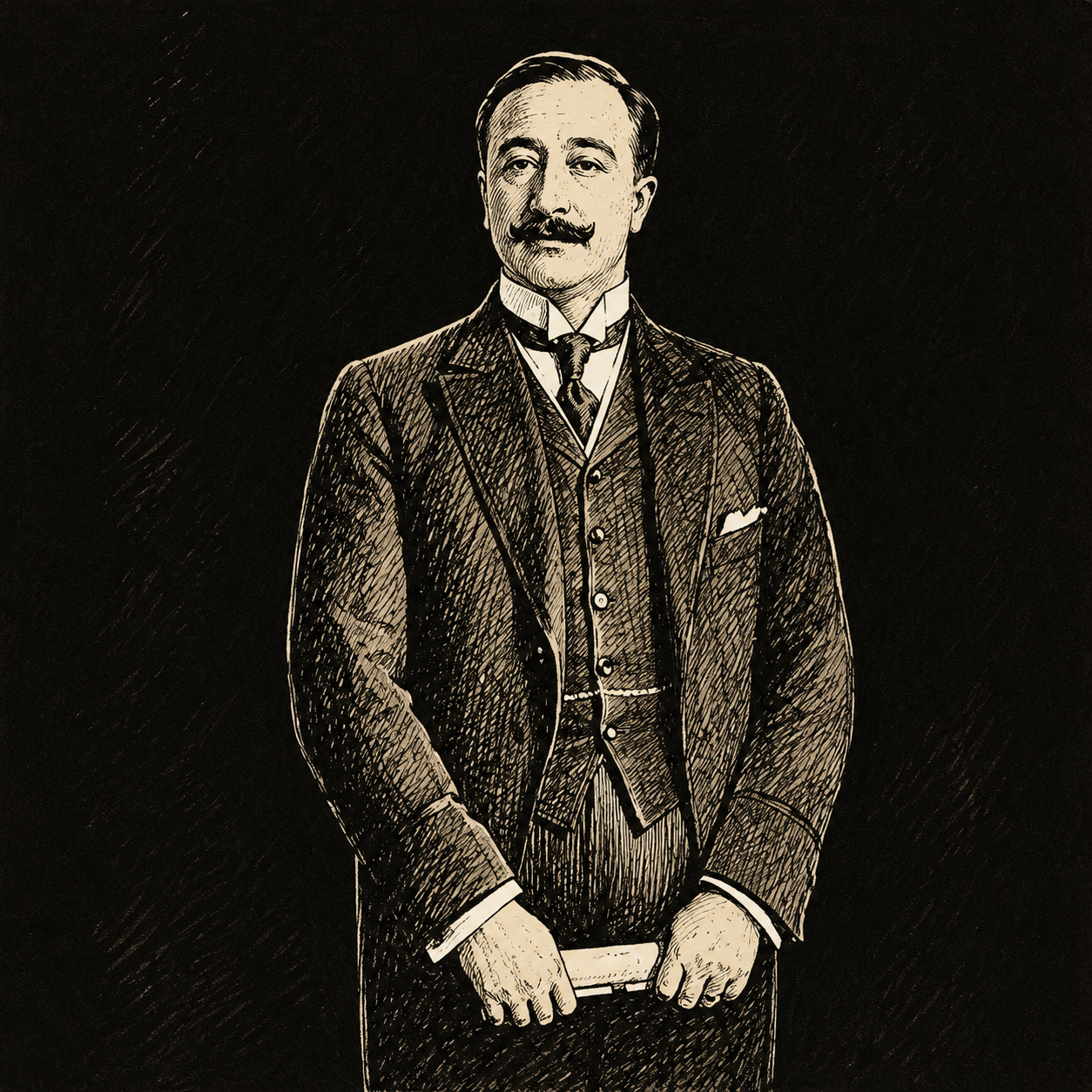
At the end of 1940, Orestes Ferrara arrived in Madrid. In his portfolio he carried a brand-new appointment as Cuban ambassador to the former metropolis, signed by the then president Federico Laredo Bru. The purpose was to remove him from the Island after the assassination attempt he had miraculously survived, which left ten bullet wounds in his body. Despite his status as a delegate to the Constitutional Assembly, he would not be able to attend its final sessions; he had enemies in Havana who were far too bitter.
The Italo-Cuban jurist was unable to present his credentials. Franco’s government had downgraded the level of diplomatic relations with the island because of the virulent criticism heaped upon it daily by the pro-Republican press. Nevertheless, he was received with affection and settled in the Spanish capital, from where he could easily travel to France, Italy, and other parts of Europe.
As had happened during his recent period as ambassador of Gerardo Machado’s government in the United States, he devoted himself to visiting archives and libraries. Bibliographical research would occupy him for several years. This led him to reject offers from several businessmen who proposed that he work as a financial expert in exchange for millionaire profits. Although he never stopped making extremely fortunate investments, he was absorbed in a larger project: a broad study of those events of the fifteenth and sixteenth centuries that helped forge modern Europe.
Ferrara had published a text on Machiavelli in Havana in 1928, which was soon reprinted in Chile by the Pax press under the title Maquiavelo o la escuela del poder. With more information and analysis, he rewrote it under the title Maquiavelo, la vida, las obras, la fama, and had it printed by La Nave in 1943, followed by an expanded reedition in 1949.
The figure of the author of El príncipe, with his pragmatic philosophy of power, is assessed and essentially justified by the diplomat. He seeks to strip him of the black legend surrounding him; he undertakes to justify his acts and writings through the contingencies of his time, while also affirming the contemporaneity and validity of many of his ideas on the art of governing.
It must be remembered that the man writing was not a cloistered scholar, nor even merely a lawyer with literary concerns, but someone who had been a politician with a meteoric career. The young law student inclined toward anarchism, who had arrived on an expedition to Cuba in 1896 and immediately joined the troops of Máximo Gómez and later those of José Miguel Gómez, earned his military rank thanks to his reckless conduct.
His relations with the Villareño caudillo helped him become a loyal member of the Liberal Party. He took part in electoral rallies just as readily as he carried out violent actions, as occurred during the uprising of José Miguel and his followers against the fraudulent reelection of Estrada Palma. When members of the Moderate Party assassinated the liberal Enrique Villuendas, Ferrara burned down the town hall of Vueltas in protest against the crime.
Once Gómez came to power, he rewarded the young lawyer with the presidency of the House of Representatives and later with the position of special ambassador to the United States in 1912, in order to prevent an intervention in Cuba under the pretext of the insurrection of the “independents of color.”
During the administration of the conservative Mario García Menocal, he preferred to remain in the United States, and under the following government, that of Alfredo Zayas, he resumed his diplomatic work in Brazil.
His great political opportunity, however, came in 1925, when an old acquaintance from Villareño liberalism, General Gerardo Machado, reached the presidential chair. Ferrara would return as ambassador to the United States between 1927 and 1932. When the Pan-American Conference was held in Havana, with Calvin Coolidge in attendance, Ferrara shamelessly defended North American interventionism in a speech, in opposition to other delegates who had outlined certain criticisms.
In the final period of his government, Machado wanted him very close by, as secretary and trusted man. Orestes remained loyal to him to an absurd extreme. The historian Ramiro Guerra Sánchez and the stubborn Neapolitan were the last officials to abandon their posts in the Presidential Palace, when the dictator had already escaped to Nassau and the settling of scores had begun in the streets. Once again, his skills proved useful, for, pursued closely by members of the opposition, he managed to board a seaplane bound for Miami with his wife.
Although he returned in 1938 to place himself at the head of the Liberal Party, and was elected by that party as a delegate to the Constituent Assembly of 1940, where he delivered some brilliant interventions, Ferrara was already a figure of the past who did not fit into the new political parties. He was pursued, yes, by the fierce rancor of certain anti-Machadistas, eager to settle accounts with a past they could not bring to a close. Although his name was no longer among those who would stand out in the new republic, it was impossible to dispense with his experience as a diplomat, which explains why he was entrusted with Cuba’s representation before UNESCO from the time of Cuba’s incorporation in 1947.
In 1943, the same year in which he delivered the expanded version of his Maquiavelo to the publishing house La Nave, the biography that would bring him greatest fame also appeared: El papa Borgia. I remember with a certain nostalgia the place the purple-bound volume occupied in my Cuban library, its spine bearing the title of the work and the pontifical emblem of the tiara and keys stamped in gold characters, as if ready to be deposited in the Vatican Library itself.
This was a daring undertaking for the writer. Liberal historiography had already accumulated by then veritable mountains of writings in which the Valencian Rodrigo de Borja, who occupied the papal throne under the name Alexander VI, was accused of an entire mountain of crimes that also implicated his relatives Cesare and Lucrezia. That surname was one of the preferred resources of anticlerical campaigns.
The Neapolitan writer was not exactly religious, although he had married in the parish of the Sacred Heart in Vedado; but rescuing that figure from the mud extended his ideas about the politics of the Renaissance. His biography was not exactly an apology for the character in order to redeem him from a religious point of view, but rather a critical evaluation of Borja’s life trajectory from a human point of view and always in light of the habits and conventions of the politicians of his time.
The work exerted an authentic fascination among readers in Europe and America. The biographical subject had a forbidden and, at the same time, passionate flavor. Many who finished reading that thick volume had the feeling that it was a great sophism, that some of the premises put forward were false, but they found attractive the presentation of the arguments and the construction of a life with a more human flavor, one that allowed them to identify with certain attitudes of the prelate. In a short time it was translated into several languages, and in addition to the paperback edition, a hardcover version was offered for bibliophiles. Several universities in France and the United States took an interest in this novel material and included it in the supplementary bibliographies for those studying that historical period.
More controversial, and even dangerous for the author, was the publication of another of those works that brought back into the light a matter that official and school histories attempted to disguise or silence. This was Un pleito sucesorio; Enrique IV de Castilla, Isabel la Católica y la Beltraneja. In the Spain of the Caudillo, the figures of the Catholic Monarchs had been mythologized by considering them the parents of Spanish unity, and Isabella in particular was regarded as an emblem of national Catholicism, to such an extent that a religious order promoted the process of beatification of the sovereign, a cause that did not advance in its time but has been raised several times up to our own day by traditionalist Catholic groups and conservative parties.
With the hand of a wicked Italian prince—learned in poisons—he plunges into the murky waters of the kingdom of Castile and especially into the War of the Castilian Succession (1475–1479), in which Juana of Trastámara, represented by her husband Afonso V of Portugal, disputed the crown against the supporters of Isabella, Juana’s aunt, although Isabella maintained that Juana was not the daughter of her brother Henry IV, but rather the fruit of his wife’s infidelity with the king’s favorite, Beltrán de la Cueva. The war was fought not only in lands that today belong to Castile or Extremadura, but also in places as distant as the Gulf of Guinea, since the Portuguese king wanted to control the gold and slave markets of that region of Africa.
No violation of religious or political rules is hidden in the work: the defamatory campaign of Isabella and her faction against her niece, whom they nicknamed “la Beltraneja”; the falsification of the papal bull so that the Infanta of Castile and Ferdinand could marry; the pope’s mediation through his envoy to Spain, none other than Cardinal Rodrigo de Borja, who carried an authentic bull but did not want to deliver it unless the newlyweds granted him the Duchy of Gandía as patrimony for his family. The war was bloody, and traces of it still remain today. When I visited the Extremaduran town of Trujillo a few months ago, I was shown several palaces belonging to nobles who had fought on the side of la Beltraneja, and whose towers Isabella, in revenge after her triumph, ordered demolished in order to show that those noble houses bowed before the victors.
The problem was that the Spanish authorities, those who had restored to the nation’s coat of arms the eagle of Saint John, the yoke, and the arrows of the Catholic Monarchs, were not willing to allow their marble and immaculate sovereign to be accused of falsification, slander, conspiracy, dealings with the Holy See, and other beauties. The scandal broke out precisely when Ferrara was trying to be recognized as Cuban ambassador. The Academy of History rejected the book’s assertions, and one of its members, the jurist and historian Félix de Llanos y Torriglia, published a pamphlet refuting several of its theses, to which Don Orestes responded with another in which he demonstrated those assertions point by point; but they preferred not to believe him.
In his Memorias, he relates that, although he received recognition from figures such as Gregorio Marañón and the Duke of Maura, he began to be considered anti-Spanish in official political circles. An “organic” intellectual of Francoism, Agustín González de Amezúa, secretary of the Royal Spanish Academy of Language, summarized the generalized opinion in this way: “I would have censored your book, not because everything it says is inaccurate, but because the times are not mature for certain truths.”
None of this halted the efforts of the former follower of Malatesta. He continued publishing volumes on the tangled subject of politics in Renaissance courts. For me, the most memorable is El siglo XVI a la luz de los embajadores venecianos, published in 1952; although it proved less attractive to readers, that volume of almost five hundred pages—another of those lost in my Havana library—the fruit of the author’s research in several European archives, was for me a slow and stimulating reading. That review and transcription of the reports that diplomats sent to the Most Serene Republic—a mixture of court gossip, commercial espionage, and accounts of political opportunities—has the attraction of being edited by the Cuban diplomat who rummages through history in order to find, in the particular and the secret, the nucleus of what will unleash the great events of the world.
Almost until the end of his existence, Ferrara continued bringing out volumes to complete his panorama of an era. Bearing witness to this are Ambrosio Spinola y su tiempo (1943), Retratos escritos extraídos del archivo de Venecia (siglo XVI) (1946), El cardenal Gaspar Contarini y sus misiones (1956), and Felipe II (1962). And none of this prevented him from dealing with other subjects, from his testimony Mis relaciones con Máximo Gómez to his varied essays on the European War, the French Revolution, and matters of the politics of his time. His memoirs, titled Una mirada bajo tres siglos, were published posthumously in 1975 by Editorial Playor in Madrid, with a lengthy prologue by Carlos Márquez Sterling, and are very useful for exploring the inner workings of Cuban politics during a good part of the twentieth century.
On January 11, 1959, a cablegram sent by the Minister of State Roberto Agramonte Pichardo abruptly notified him that, by order of the revolutionary council of ministers, he had been dismissed from his post as ambassador to UNESCO.
Although he confessed that this dismissal was something he already desired by that date, in reality it deepened his sadness over the official rupture of his relations with Cuba, a country to which he would never return. Thus he wrote in his memoirs:
Meanwhile, I have remained outside Cuba. I could have recovered Italian nationality; I have not done so and I will not do so. At the age of ninety-two I await, upright and respected, for victory to smile upon those who deserve it and for incompetence, at last, to disappear from the government of my country. I have remained Cuban, in misfortune as in the good times. I have the same faith in Cuba that I had when I fought in the leafy fields of the Island.
His life and writing stubbornly extended until February 16, 1972, when he died in the Grand Hotel in Rome. The times I have passed by the venerable building on the Via Vittorio Emanuele, it has seemed to me that its somewhat demodé luxury was the ideal place for that Neapolitan prince who wanted to be another Machiavelli in Cuba.


