
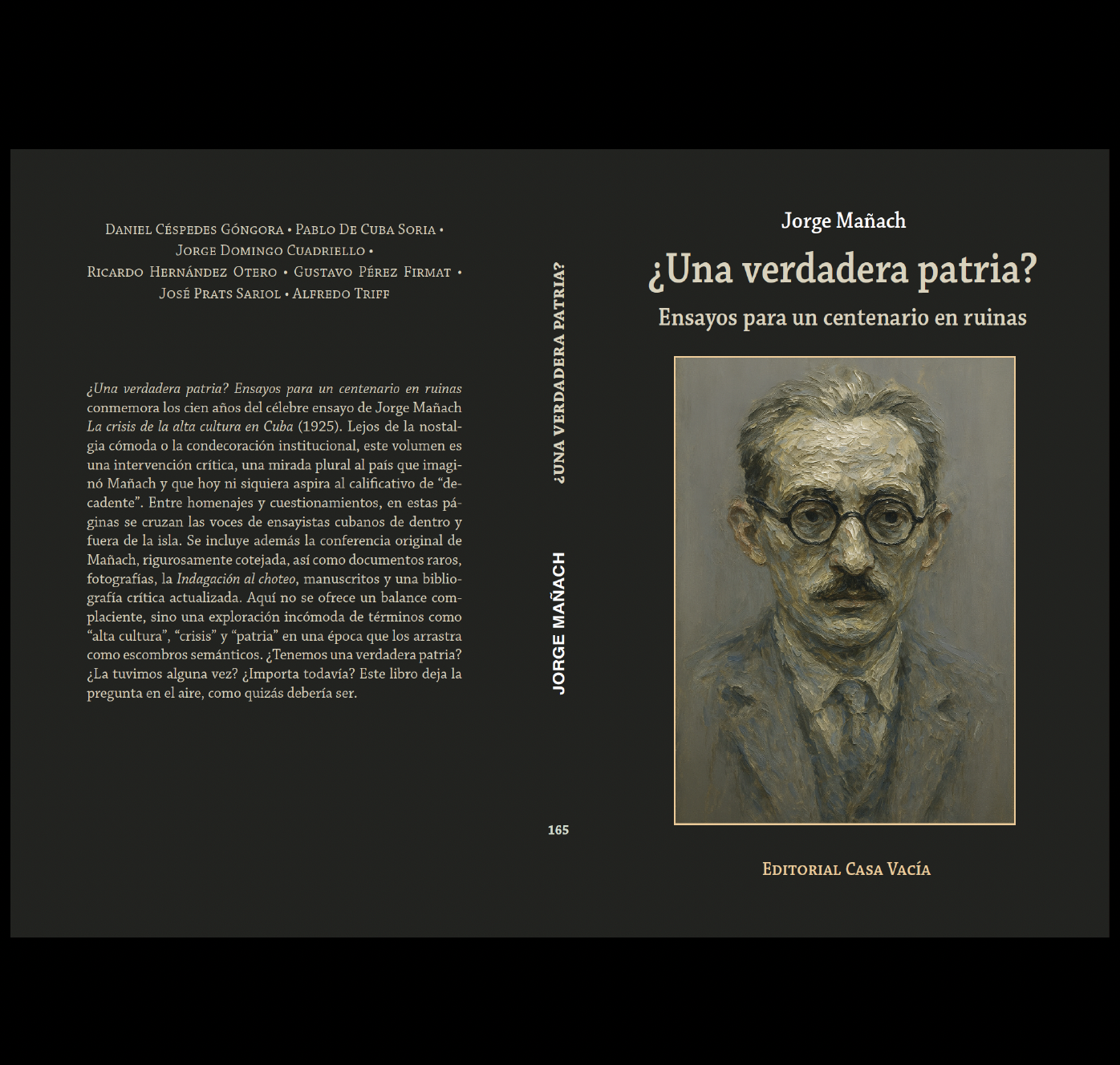
In Cuban culture, the cult of figures such as Jorge Mañach is more than a recurring theme, it is commonplace; it taints his undeniable historical importance with the banality of transcendentalism, without updating it. It is not, therefore, that there is a lack of references to him, but rather that these are often ineffective and banal, serving as a crutch for intellectuals who need to show off their intelligence rather than organize an understanding.
This is the flaw that the publisher Casa Vacía seeks to correct with this compilation of essays on Mañach, in an edition that is far from critical but achieves sufficient dignity to offer an interesting product. It is not a critical edition in the strict sense, because it does not offer sufficient criteria on his general work, but rather recreates it, which is what makes it interesting, as a partial update that shows its relevance in culture.
Of course, it is not a question of filling a void, in a gesture that many have already attempted, but without this effectiveness; for although with uneven results, it brings us closer to what is probably the most attractive personality in the Cuban sphere. This is extremely daring, given that Mañach grew up at a time when intellectuals were interesting as a principle; but unlike all the others, he maintained his dignity in the face of the decadence that the rest ignored.
The result is uneven, because although the book is dense, it does not maintain the freshness of the prologue and becomes conventional, when one of its successes—or its luck—is the freshness of the compiler, due to the type of references he uses. In this sense, the prologue makes use of all the keys to contemporary Cuban French-style aestheticism, removing the antiquity of our critical tradition with elegant and efficient gestures of affectation.
It is not until the first third that the book becomes pleasant again, thanks to Alfredo Triff’s stylistic wit; but between the two, they manage to create enough tension to make all that conventionalism digestible. With this, the book breaks through the barrier that prevents the transmission of culture, in the egocentrism of its promoters, becoming a rare object of worship in itself, for its own value, beyond the object to which it is dedicated.
Triff’s stylistic play is, however, unbalanced in its affectation by Prat Sariol’s spontaneity, which, in its excess, displaces the central figure with his own, mapping the crisis of culture as current events. The error is not new, and recalls the appropriation of Martí’s catharsis in the simplistic ideology of the centenary, which in this case does not address recurrences but rather a continuity that is impossible in cultural rather than historical terms. That, of course, is a matter of criteria and perspective, but it adds to the problem of the lack of a Mañachist hermeneutics, which yields its objectivity to the subjectivity that investigates it, as if it were not Mañach himself who were important but rather the criteria that weigh him down.
Also, as a flaw, almost all the essays focus mainly on La crisis de la alta cultura cubana (The Crisis of Cuban High Culture): which, while a major essay, is by no means the best systematization of Mañach’s thought. Even in this essay, the sobriety of style is important—as Pérez Firmat points out—which surpasses journalism in its subtlety, to the point of concern, reflecting an organized and existential cosmology rather than a conviction.
For all these reasons, perhaps the title of the compilation is not accurate in its allusion to the homeland, which is political rather than cultural; it does not matter if in this duality the terms are not separable, because they are separable as a priority of analysis. Hence the importance of works such as Triff’s, which pushes for a systematic, even technical, approach to his thinking, as if wanting to guide explorers beyond the commonplace—which is actually recurrent—nature of his criticism. That is why we must not be mistaken: the rest of the book is well worth a mass that was worth Paris, only more calm in its reverence; and it even reaches a glimpse of exegesis, which is now necessary due to the distance from the culture of origin.
The book also places its weight on Mañach’s work itself, compensating for any shortcomings in the approach, because it allows the reader to establish their own relationship with the author, especially in the perfect framework of his development. Particularly important in this book is the dossier that provides the perspective of the moment, highlighting that of the era, especially the question of Minorismo, with that political ambivalence that characterizes Cuban culture.
The book thus presents itself as a moment of singular maturity for Cuban culture, projected in exile, in an exhaustive—albeit incomplete—understanding of national culture, in the hustle and bustle with which it is updated. Here it should be remembered that Mañach was a man of his time, participating in the decadence he criticized, starting with his very belief in intellectual specialization, and unaware of the problem of his elitism as specialization.
It should be noted that Mañach’s elitism is not mannered (mannerist?), but serious and admonishing in its criticism, retaining the grace and nobility of its authenticity, but as a personal virtue, his own and not that of his class. That is why Mañach becomes a reference point, allowing for the weighing of the national in the context of the Western world, taking on special importance now that the predictions seem to be coming true, without yet understanding what they were diagnosing.


