
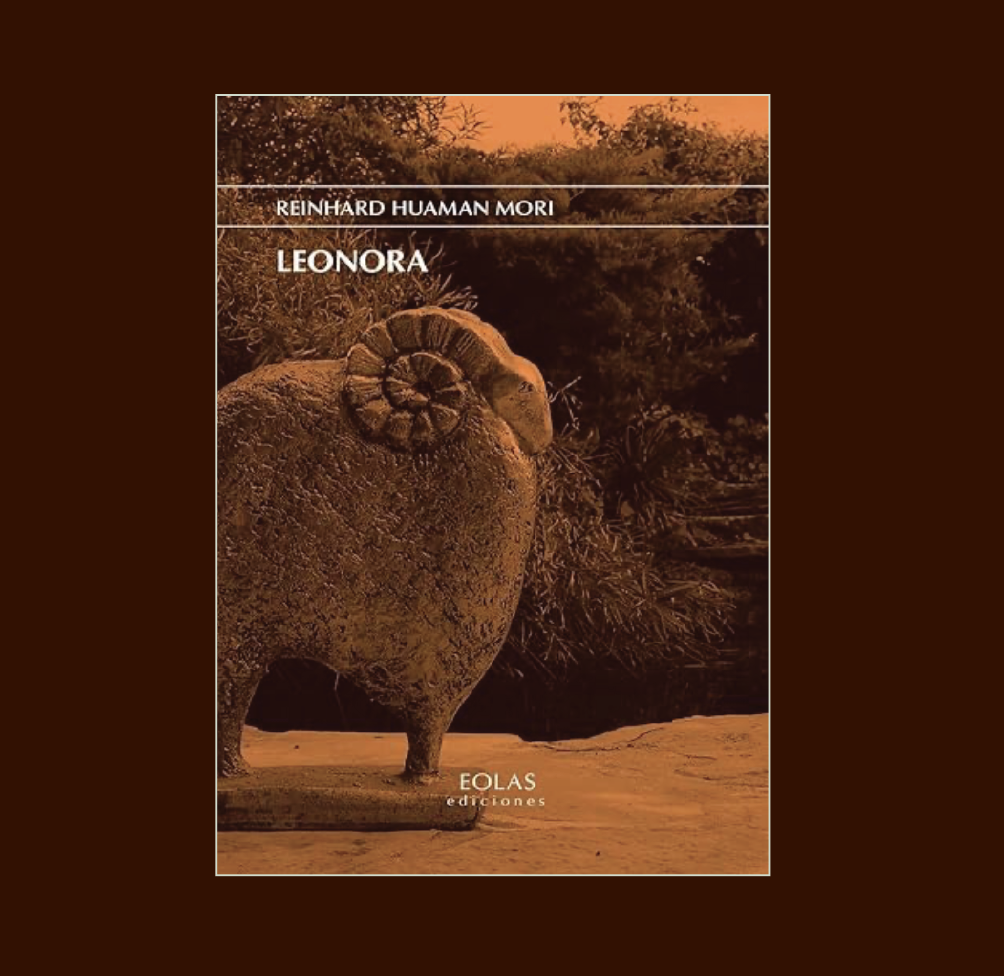
Poetry—this I learned from Antonio Cisneros in his San Marcos classes in the late 1970s—must dispense with clichés in expression. I was reminded of this when opening the book Leonora, by the poet Reinhard Huamán Mori, recently published in Spain by EOLAS Ediciones. In the poem titled /prólogo/ (interesting, incidentally, that the prologue itself is a poem integrated into the book), the poet says: “Habría que prescindir / de aquellos lugares comunes”. This would seem to be the apothegm governing the entire collection. That is, throughout our reading we encounter a mode—style and language—highly original and creative, in which the cliché is conspicuously absent.
Let us now turn to the language of the book itself. The poet addresses Leonora, announcing a path to be traversed, by no means an easy one: “y apresurar el paso sin detenernos / por estos famélicos caminos / de tierra calcinada, / entre estas arenas gruesas, / colosales… / removidas por el viento y sus berridos”. Here—in this last line—the originality of Huamán Mori becomes clear: it is not the sound of the wind nor the poetic breeze, but its berridos, that is, its discordant shouts. This striking and compelling mode of poetizing continues through very particular images: “Llegaré a ti en cualquier momento. / No importa el viaje. / No importará el tiempo, / ni tampoco los estragos de luz”. Note the oxymoron: estragos de luz. This is followed by a reflection that borders on the metaphysical: “el día sucede a la noche, / el amor abarca la culpa, / y el tamaño que de a pocos / me abandona”. For—in truth—it becomes increasingly clear to us that “Todo ese inusual apego a lo sedentario, / a la familia, hacia los gatos… / no son más que espejos rotos. / Caleidoscópicos”. That is, shattered into pieces. Living is a kind of condemnation: “Aquí siempre ha sido así: / un largo invierno sobre el campo arado / y los árboles que aguardan su momento. / Los residuos de una historia que nos traiciona / en secreto”. There are no exits, then. And yet, in her—that is, in Leonora—there would be a hope that allows one to continue: “Solo a tus caminos obedece nuestro rumbo”.
All of this constitutes the prologue. Now the concrete journey begins. The condition of precariousness is announced from the opening lines of the poem “Cincuenta”, which read: “después de todo, / nada sobrevive eternamente”. Something has happened in the relationship with Leonora: “todo eso que fue nuestro / y que apenas retuvimos”. Everything is reduced to “El viejo truco de la repetición y la memoria”, and to the admission that “Habremos de asumirlo, / apenas si somos un largo cúmulo / de promesas rotas y vilipendio;”. Yet in this battle of love the poet goes so far as to say: “Leonora, / no existe verdad más absoluta / que la que hoy te cuento”, phrasing that recalls Antonio Cisneros’s line “Escribir el poema me da derecho a la versión”. And this is how we proceed. The malaise continues in “Enero”: “el día también empieza / con el minuto más oscuro de la noche”. Things become dire: “nos será más fácil acumular / fatiga y escarnio”, but contradictorily, “esa será nuestra mayor belleza”. In the end, the solution will be poetry: “Escribir es ocultarse todo el tiempo”. That is, to remain in a kind of clandestinity. And in love, the poet tells us: “estamos aquí porque / no tenemos otra cosa, / salvo el uno al otro”. The contradictory reflections that sustain this book define a kind of poetic relativism: “Todas las respuestas son siempre válidas, Leonora”. We note Huamán Mori’s effective use of colloquialism: “nosotros, los que nos encogemos de hombros / y nos contentamos con morir / debajo de un árbol”, even as it leads us to the precipice of existence and to the inexorable end that awaits us. Another notable element is the juxtaposition of voices, forming a kind of collage in the treatment of family relationships, as interwoven narratives that question the family as the basic cellular unit of the system, from a radical position: “Ama al Padre /NO/ Ama al Hijo, /NO/ y así verás tus jardines florecer por el resto de tus días”.
In the poem “Cero”, the nihilistic proposal is sharpened: “No me queda mucho por decir, / ni por hacer”. And with even greater force and beauty in this tercet: “Nada en esta torpe esfera es necesario; / ni siquiera la escasa luz / que se acumula en las pupilas”. The same tone continues in the following lines: “Antes de que caiga la noche, / antes de que se desplome entera / con cada una de sus estrellas, / antes que la luz descienda / para desvanecerse entre nosotros, / habremos de apropiarnos / de una respuesta u otro argumento / que nos justifique”. There is a clear achievement of poetic beauty here, and poetry itself seems to be the only possibility of salvation—or at least of justification—which ultimately defines itself as a matter between solitary lovers: “Todo lo demás, Leonora, es algo entre tú y yo”. The intrusion or use of poetry—of poetic concepts—is evident, for example, in the poem “En el nombre del padre”, where we read: “Como si la distancia entre nosotros / pudiera medirse / entre pulsiones, / fracciones y hemistiquios”. Poetic forms also become the measure of things. And the critique of the family institution is uncompromising: “Cada familia es un baile de máscaras”. But it appears that it is not only the family environment at stake, but life or the world in its entirety: “Para entender de una vez / por todas / que no pertenecemos aquí”. The honesty and sincerity of this poetry are radical: “Los límites son solo otra excusa / que tenemos para tocarnos. / Para agredirnos. / Para sentirnos predilectos, / prematuros o presagio”.
The irresolution of existence continues in the poem “A”, where we are apostrophized: “Un eterno nudo que tensamos / hasta sofocarnos. / No sabemos hacer otra cosa. / Nunca lo hemos sabido”. Yet Huamán Mori is capable of achieving high poetry even in this ocean of darkness: “Nadie, excepto tú, / ha visto realmente brillar una estrella / mientras agoniza”. And as the Spanish poet Garcilaso de la Vega once said, hope rises for a moment; if not, let us look at the poem’s closing line: “Desprovista de sentido, la felicidad es / I N M I N E N T E”.
We now enter the final section of the book, composed of two prose poems: one titled /epílogo/ and the other “claroscuro”. Here we are told of a departure: “estoy a punto de abandonar esta isla”, but there are problems: “A cada paso descartamos una senda, un metro más es otro naufragio que evitamos”. Worse still: “A nuestro alrededor nace una distancia que jamás entenderemos”. The ending is fierce—we are in /epílogo/—there is a rust that corrodes us from within, “pieza por pieza, como una prótesis que nos perfila el cuerpo hasta deformarlo totalmente”. This deformation is forewarned in the following poem, with prophetic overtones: “Tú eres la Piedra. Tú eres el Templo. Cetro Celeste, ilumina desde hoy nuestra tormentosa partida”. We enter realms of unreality: “La luna no es necesariamente una esfera nocturna”, and once again pure poetry—one might say—is what saves or guides the subject: “Estrella de cinco puntas canta solo para nosotros. Atrás quedarán los puentes y cada uno de sus nombres. Ahora cuento con el brillo de tus ojos”. The contradictory ending leaves us suspended in midair (like the horizontal and vertical ellipses that appear after the final line): “Ante nosotros las puertas comienzan a cerrarse. Nos están esperando. Tu reposo es mi destino”.
But there is still an addendum, that is, an appendix consisting of a long poem and a pair of poetic prose pieces. The poem is titled “Familiae Domi” and begins with rain, leading the poet to meditate even further on what we already know: a radical protest against life and its concomitants, extending to a questioning of the aesthetic even at the conceptual level: “Toda la Belleza desplomándose / sobre la idea de belleza”. In this progression we find lines that recall Washington Delgado: “los caminos del Señor nunca existieron / solo el destierro”. Everything is so wrong that we can barely see: “El aire enrarecido enturbia la mañana / fuerza la vista / empobrece el ojo / difumina”. The home is described as follows: “La casa grande y vacía / como un cuerpo cóncavo sin eco / que jamás olvida ni consuela”. And then: “El desvarío del viento sacude / viejos recuerdos / heridas abiertas / alimenta anhelos”, reaching an extreme—worthy heir of Rimbaud—in these terms: “La belleza es una carga. / Mera cuestión de perspectiva”. It is an inner journey that concerns us all: “un sentimiento de culpa compartida”; however, there is a final resolution that entails hope: “No descansaré hasta tomar el cielo por asalto”, a phrase by Karl Marx that would symbolize—simultaneously—both personal and collective salvation.
The two prose pieces constitute short fantastic tales, inclined toward children’s literature, attributed to Leonora, moreover, and they appear to us as pleasant diversions by the poet, whose purpose seems to be to bring his book to a close with a playful and intimate beauty. A little bear who desires snow but obtains only white flowers that eventually become the snow he seeks; and a rabbit with his siblings who get lost in the forest, muddying themselves during the night of their perdition, and who will do so again despite their mother’s prohibition. This can be read as a homage to the obstinacy of doing what one loves, beyond obedience to authority. A simile for poetic vocation, which—when it is true—continues, persists, and will persist, no matter how much the savage and violent system that currently governs our world might wish to prevent it. This is the reading with which I close this beautiful book by Reinhard Huamán Mori, who, with it, places himself in a position of expectation within the new poetry of our language, on both sides of the Atlantic.


