To André Jolles and Javier Gomá, masters of the Einfache Formen, of the simple forms.
I – Doomed to die twice over
After returning from Hades, Circe receives Odysseus and his companions with these words:
“Ah my darling, reckless friends! You who ventured down to the House of Death alive, doomed to die twice over (δισθανέες) —others die just but once!”
[Trans. Robert Fagles]
The list of immortal men in Greek mythology is short but illustrious: Heracles, Ganymede, and a few others whose names I prefer not to recall. Christianity has its own list as well, with the variation that mortal destiny, in this case, is merely a parenthesis in a story enveloped in eternity before and after. Though one cannot deny the strangeness of a God who decides — if only for three days — to become food for worms.
Odysseus and his companions embody that rare bird of double mortality: they have descended into hell and returned. If immortality is a divine gift, double mortality is a literary one. Only Odysseus and his men, Aeneas, and Dante have been granted this privilege.
Frankenstein does not count: he is an assemblage of corpses granted a reprieve that ends, like all reprieves, in an individual death.
The gods may bestow the gift of eternal life; only the pen grants that other ambiguous gift: the gift of a double death.
“To philosophize is to learn how to die,” said Socrates. One might object that there is little merit in learning what is inevitable, what will happen whether we know it or not. Double mortality may be perceived as a blessing or as a curse, but no one can deny its exceptional character.
One lives and dies twice only in the word.
II – The Song of the Sirens
“The Greek word harmonia describes the way strings are tied to be tightened. The first name of music in ancient Greece (sophia) designated the skill of building ships.[…] Odysseus never said that the song of the Sirens was beautiful. Odysseus — the only human who ever heard the song of death without dying — says, in order to characterize the Sirens’ song, that their song ‘fills the heart with the desire to listen’” (Pascal Quignard, The Hatred of Music)
With the Sirens comes another mode of song, one that seduces and kills. The melody that flows from their mouths is fascinating and lethal, yet what annihilates is not the song itself. It can be heard, provided one is properly protected, bound to a mast. The song is the trap, not the guillotine. Those who die are the ones who, seduced by it, end up in that meadow from which only souls escape; bodies are reduced to bones and putrefying flesh. The Sirens reveal a form of beauty that can be enjoyed only if its effects are neutralized. Their beauty may move us emotionally, but it cannot transport us, carry us off as the Muses do.
When one hears the voice of the Sirens, this is what they promise:
“Come closer, famous Odysseus—Achaea’s pride and glory—
moor your ship on our coast so you can hear our song!
Never has any sailor passed our shores in his black craft
until he has heard the honeyed voices pouring from our lips,
and once he hears to his heart’s content sails on, a wiser man.
We know all the pains that Achaeans and Trojans once endured
on the spreading plain of Troy when the gods willed it so—
all that comes to pass on the fertile earth, we know it all!’
The Sirens’ song offers the gift of wisdom: they know everything about the most important event men have lived through — the Trojan War — and everything that occurs in every corner of the earth. This “all” has a poetic structure: quality takes precedence over quantity; first they know what matters most, then everything else. This has clear consequences for what we hear in the Homeric songs, both we and their original listeners. To them as to us is presented what forms the prow, the arché, of that total knowledge — knowledge of what is most important. Through Odysseus’ own mouth we also learn what happens at the edges of the earth and even in the underworld, in the land of the dead. Yet this knowledge arrives fragmented, arranged according to an artistic will that promises the whole but never delivers it.
This, rather than cause for sorrow, should be a source of relief; knowledge of the whole kills. Odysseus, like us, hears the promise of that total knowledge and its seductive melody, yet he passes by it — as we do — unable to stop and listen. Knowing that the price of lingering to hear absolute knowledge is death.
From total knowledge we receive only its seductive melody and the warning that forbids us from approaching it.
We are as protected as Odysseus and his companions. Homer shields us in both ways: at times he binds us to a mast and lets us glimpse and overhear, in passing, that song that bears the whole. At others he is even more drastic, filling our ears with wax, for there is much that, for our own good, he does not tell us.
Epic hides the whole within itself, but the whole, if it is not to destroy, must remain concealed — promised, but never delivered.
It may also be nothing more than an enchantment. The Sirens’ reputation as deceivers is legendary. The force of pseûdosmay reside in the song itself. One must not forget the warning the Muses gave Hesiod at the beginning of the Theogony:
“We know how to tell many lies that resemble truths; and we know, when we wish, how to proclaim the truth.”
Plato had a point: those inspired beings called poets lie.
And that is not the worst of it. Fascination with the whole does not stop at the song; it reaches those who comment on it as well. A discourse that seeks to explain the seduction of the outside runs the risk of reproducing it. One need only read the passage Maurice Blanchot devotes to the Sirens in Le Livre à venir: there the commentary comes dangerously close to what it describes — pure sound and fury.
Do not forget Circe’s warning: one must be very careful with the song of the Sirens. And with their commentators — not excluding, of course, the one writing these lines.
Note to the Reader
This diptych is a preview of a book I am preparing on epic as a literary form. The volume will include three extended essays on The Iliad, The Odyssey, and The Aeneid, as well as shorter reflective vignettes like those presented here, addressing nuances that cannot be fully developed in the longer pieces.
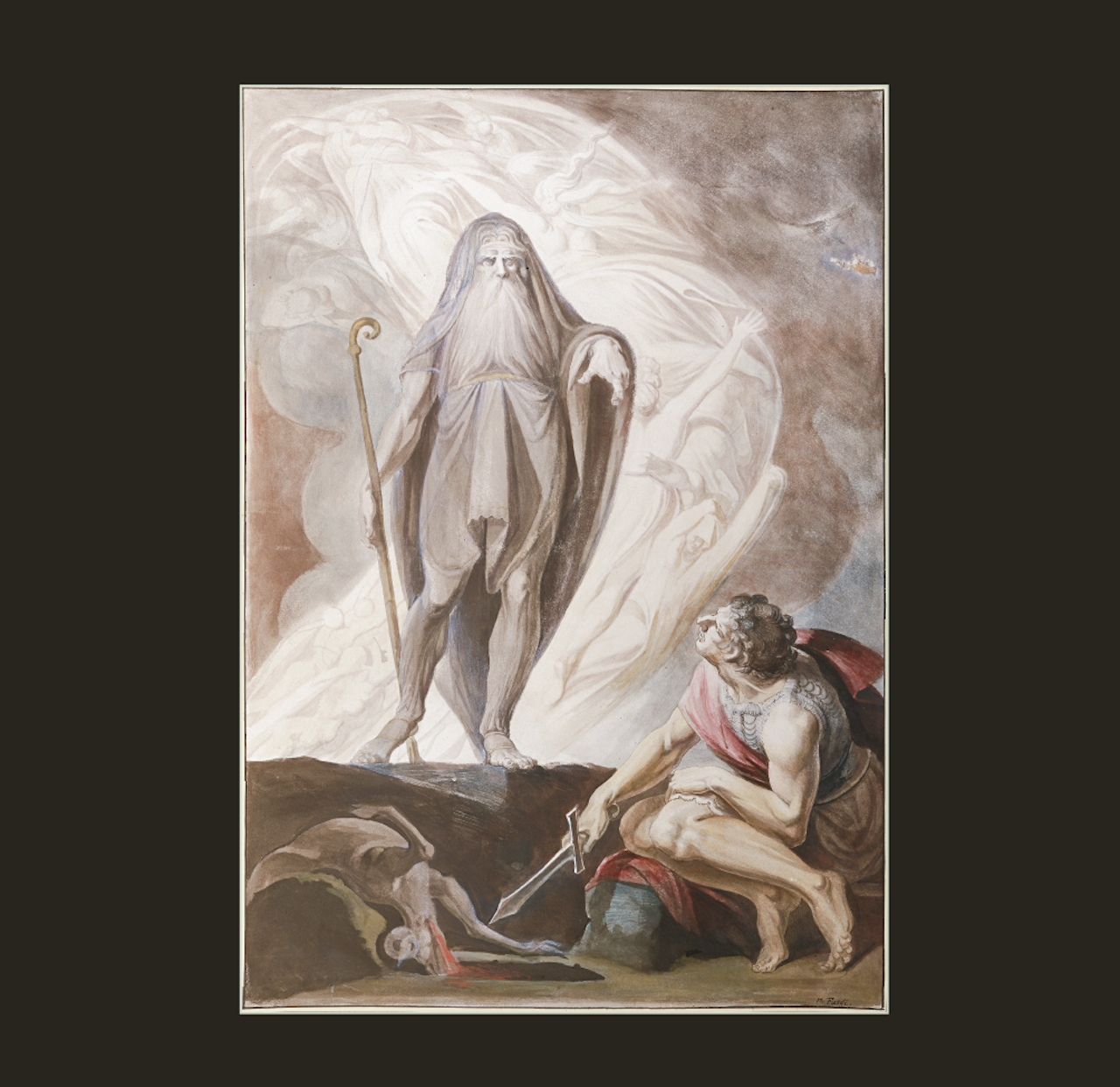
Image: Teiresias Foretells the Future to Odysseus (1770 and 1785), by Henry Fuseli.