
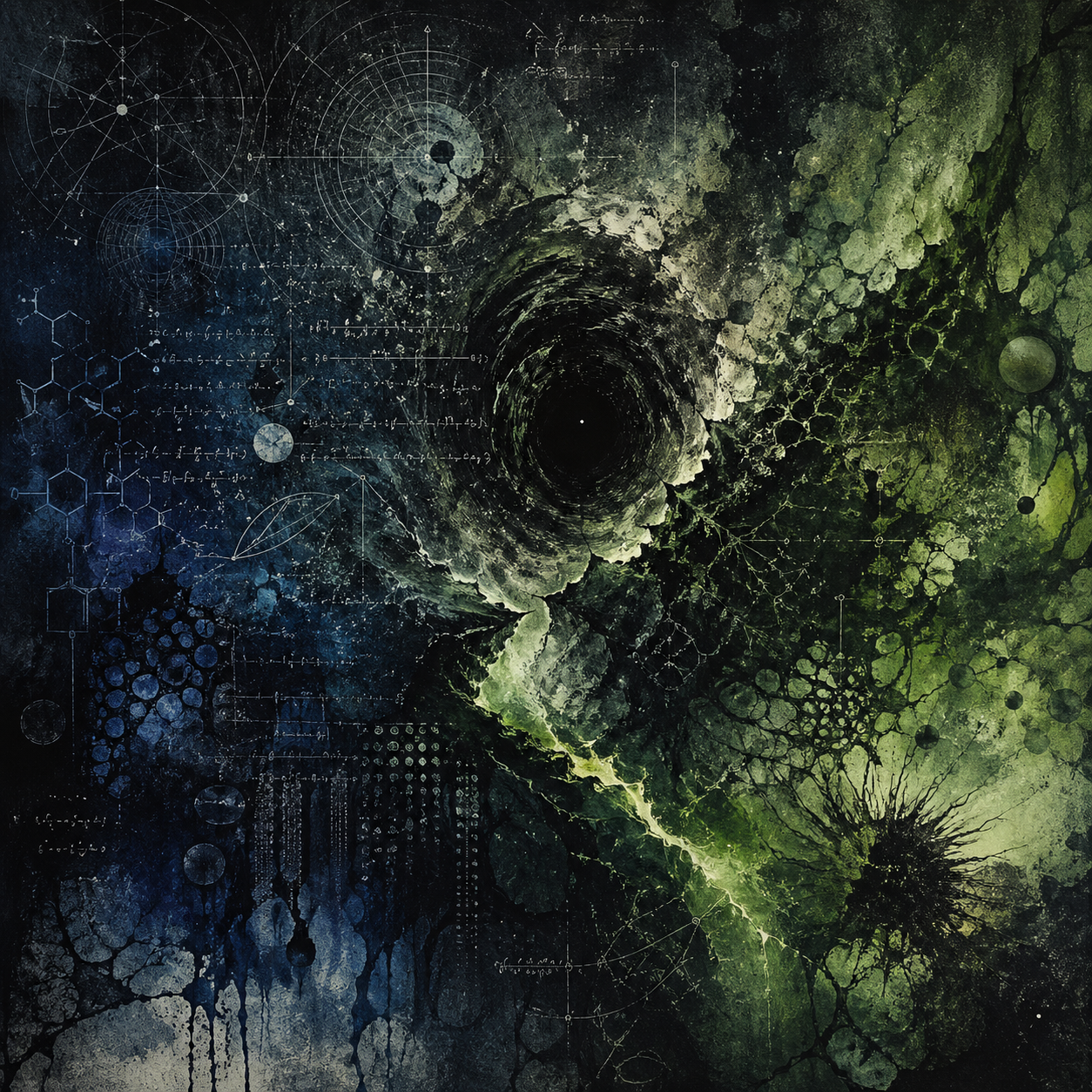
As a hybrid genre, and within the artistic avant-gardes, the novel reached its highest degree of sovereignty in the first decades of the twentieth century. A century later, with several authors—a kind of avant-garde within the avant-garde—it takes a further step. One of these “rare” writers, in whom fiction assumes its tensest and most productive forms, is the Chilean Benjamín Labatut. Far from the attempt to close off the narrative space by making it self-sufficient, as was typical of the classical avant-gardes, his writing settles in a hybrid and unstable territory where history, the hard sciences, the essay, and literary invention mutually energize one another.
When We Cease to Understand the World —Un verdor terrible in Spanish—, his third book, confirms this. That is to say: not merely the absence of any desire to classify or delimit genres and themes, plots or characters, but rather the use of that productive indeterminacy to approach objects supposedly resistant to fiction—science, the internal processes of matter, mathematical and physical knowledge applied to the space-time continuum. These are objects that, by virtue of their own “uncertainty” within human knowledge, resist any single and totalizing form of representation. For that reason, in Labatut, hybridity is a demand, not a formal ornament. Only through it is it possible to brush against a “reality” increasingly blurred within human consciousness; a reality that can no longer be organized without leaving behind a remainder that resembles, more and more, a dangerous black hole.
It is at this crossing point, in this necessary hybridity required to grasp a reality ever less gravitational and expressed through binary numbers, that the novel has ceased to be an ordering “machine” of reality and has become instead a field of exposure—and more than that, a minefield. There—as the most lucid consciousnesses have understood—materials can no longer be arranged from a demiurgic consciousness that produces a meaningful totality, since the world has lost all certainties.
Now the novel—let us keep calling it that by convention—does not strive to display a coherent totality, but rather to show the fissures, the zones of shadow we inhabit. Thus, since form yields and no longer contains, fiction has ceased to be one object of knowledge among others. It reveals holes that show the plurivalence, and no longer merely the ambivalence, of the real. And it is in this yielding that something appears which cannot quite be integrated and which produces terror: an opacity consubstantial with the world, with matter, with science, with the human being; an opacity that, once absorbed by the narrative, cracks it from within.
It is in that opaque zone—in which human knowledge no longer guarantees truth and is transformed into risk—that the writing of Benjamín Labatut seems, without declaring it, to touch an older tradition linked to gnosis, hermeticisms, and esotericisms: the tradition of knowledge that drives one mad. Madness, of course, not in the clinical sense of the term, but as a deviation from any moral measure: a form of knowledge that breaks the human frame meant to contain it.
This is the same intuition that runs through a good part of the work of the North American writer H. P. Lovecraft—from the readers of the Necronomicon to figures such as the protagonist of “The Dreams in the Witch House”—where mathematics ceases to be an instrument of order and beauty and becomes instead an access point to other dimensions that exceed and disorganize “the human.” Without needing to establish a direct lineage, one may read in When We Cease to Understand the World a resonance of that same atmosphere: a point at which knowledge, far from illuminating in the Enlightenment sense, introduces a form of sharp, energetic, irreversible darkness.
In the little I have read about the Chilean writer, or heard from him in interviews, there is no reference to this lineage. And yet this opacity is the point of contact between the two authors. Although their registers differ—one relying on history and science, the other on the fantastic mingled with cosmic horror—both converge in the same fundamental intuition: there are irruptions in reality—which is not the same as the real—that do not destroy the world immediately, but merely make it a little stranger. The world remains, but at times it ceases to be fully habitable. A reference to Freud and his concept of “the uncanny” would not be out of place here.
In H. P. Lovecraft’s “The Colour Out of Space,” what is unsettling is the way that indeterminate color—one never quite knows what color it is—alters matter. In this sense, it is not a sudden catastrophe, but something that penetrates, or rather sprouts, from within matter itself. At first, the soil appears more fertile: a gravid mother bearing a multiple pregnancy. The plants develop with unusual intensity; the fruits grow beyond proportion. But it is within that exuberance, which breaks with an ancient pattern and norm, that all subsequent corruption is already contained. Something in that unstoppable life exceeds normal and familiar forms, deforming them from within. The problem, then, will not be the disappearance of reality for whatever reason. It is the persistence of an “anomalous” life under altered conditions of reality. The field, the earth, nature itself remain “the same,” but they no longer offer reliable ground.
A hundred years have passed and, of course, Labatut no longer needs to resort to Lovecraftian fantasy, to cosmic terror—the reflection of his social phobia, if Michel Houellebecq is to be believed. In his novelistic work, with its smooth, ascetic, clean prose, there are no extraterrestrial poisons, submerged cities, mountains that produce madness, or witches who cross dimensions of space-time. There are chemical processes, scientific hypotheses, and discoveries within matter, documented through physical formulas. And yet both writers generate a similar sensation in us: the world acquires a strange consistency in that becoming for which we too are responsible, as though, by delving deeper into matter, human intelligence had opened a fissure it cannot close.
Proof of this is “Prussian Blue,” the first story in When We Cease to Understand the World. It recounts the history of a pigment that saturates and even shapes nineteenth-century European painting. Over time, this chemical base will become fundamental to the manufacture of pesticides and fertilizers that increase harvests, multiply the human population, and end famines. But at the same time, and paradoxically, it will poison hundreds of thousands of enemy soldiers in the trenches of the First World War. Thus, in “Prussian Blue,” Fritz Haber, the German chemist of Jewish origin who fixes nitrogen as fertilizer, is also the “father of chemical warfare” with poisonous gases. In other words: the same operation that feeds and saves millions of people from hunger is the one that causes death. There is, or there seems to be, no contradiction between the two operations, Labatut tells us—only continuity.
What is unsettling in both Lovecraft’s and Labatut’s texts is not the damage itself, but the ambiguity that precedes that damage. The soil in Lovecraft’s tale does not become sterile immediately. First, it produces more, in an uncontrollable proliferation of forms that already announces its degradation. In the same way, in the Chilean writer’s fictions, scientific advances initially appear as scientific successes that function effectively. And it is precisely for that reason that they are disturbing: they show that the problem lies in the very logic of scientific development and research, not in an error of knowledge or in a deviation of human intelligence. Intelligence does not fail; it succeeds completely. And it is within that success that something opens, something that becomes uncontrollable for the human being himself.
Another point of convergence between the two writers is temporality. In Lovecraft, degradation is slow, almost imperceptible at first, distilled drop by drop. The monstrous does not erupt spectacularly; it infiltrates the internal processes of matter and of human communities. In Labatut, scientific discoveries are linked in a progression that seems natural. Only at the end, retrospectively, do we see the shadow, the destructive tumor that had been there, concealed, from the very beginning. The lethal gas that kills the enemy in the trenches is not an anomaly in the human process of science; it is the result of a series of reasonable steps and of a logic that chains itself together in brutal fashion.
But there are also decisive differences between them. In the North American writer’s Gothic fictions, the alteration of reality comes from an “outside”: something alien to the human world bursts in and contaminates it. In the Chilean writer, the distance between the horrific exterior and the human interior disappears. That is to say: there is no threatening exterior. What deforms reality and turns it into something terrible arises from within human activity itself, specifically from science and its processes of research and knowledge. Horror has already occurred in an ordered world and no longer needs to be imagined as an irruption from an “outside.” It is inscribed in the history—genetic?—of the human being: it waits for the precise historical moment in which to manifest itself.
Perhaps Maniac—for me his best work—is the most radical development of this displacement, from exterior to interior. In the controversial Hungarian-American scientist John von Neumann, the central figure of the novelistic triptych—Paul Ehrenfest, von Neumann, Lee Sedol—knowledge, scientific knowledge, does not merely open a fissure through which to observe the internal processes of matter; it becomes a principle of organization generated, almost, from the brain of a malignant Demiurge. Abstraction, mathematical calculation—pure, innocent, playful, detached from consequences—organizes scenarios of development, anticipates behaviors, even calculates destruction in war. With von Neumann, this knowledge that drives one mad—in the sense of deviating from every moral measure—ceases to be an intuition and becomes a system that attempts to model the world from a place alien to all ethics, to all humanism.
The use of science for good and evil; the “morality” of the scientist bound to precise historical conditions; temporality; the outside and inside of matter and of life—all this will also modify, of course, the position of the human subject. In Lovecraft, man is witness, plaything, and victim of an excessive, cosmic force he cannot comprehend. In Labatut, he is a spectator, but also an active agent of transformation. That is: from something that springs from his almost infinite capacity for research and invention, he produces what overwhelms him—and destroys him. And it is in that double condition of spectator and naïve demiurge, manipulating forces that exceed him, that every possibility of innocence is lost. If we still see something of this innocence in the chemist Fritz Haber, every trace of it has been erased in the mathematician and cyberneticist von Neumann. But in both, Labatut’s message is forceful: catastrophe is not something that happens to the world from an “outside”; it is something the world itself carries out through man. Here, the coincidence with ancient forms of wisdom and cosmogonies of Gnostic origin is no accident.
If, despite the temporal distance between them, both texts may be read with some continuity, it is because they share a fundamental intuition: there are forms of knowledge—or of matter—that, once they appear, irreversibly alter our relation to reality. It is not that they destroy it immediately, but that they render that relation unstable and controversial. The world remains, will remain there; in a certain sense recognizable and even familiar, but pierced by a strangeness that cannot be dispelled, ready to transform a reality, so often sweetened, into chaos, darkness, and catastrophe.
One image to conclude: in Lovecraft, the field, the earth, the natural world—human affections?—can no longer be cultivated without unease. Labatut takes one step further: it is the world itself that can no longer be thought without, and from within, the fissure of a chemical substance transformed into lethal poison. And in Maniac, that same process—of fissure and fission—reaches its coldest and most demonic form: knowledge not only reveals the entrails and produces destabilization; it organizes chaos as a process of destruction, conceived and controlled.
In all three cases, like an uncontrollable tumor, something has grown unstoppably—an undefined color from outer space, the discovery and application of a gas, a mathematical model that organizes destruction; something that, although it exceeds human forms, in one way or another springs from the very entrails of “the human.”
It is not an excess that illuminates: it leaves the heart of the world exposed, and us inside it, like that principle of fertility within nature that has broken all limits and become an intense and terrible greenness: a greenness in which life itself begins to appear suspicious to us.


