
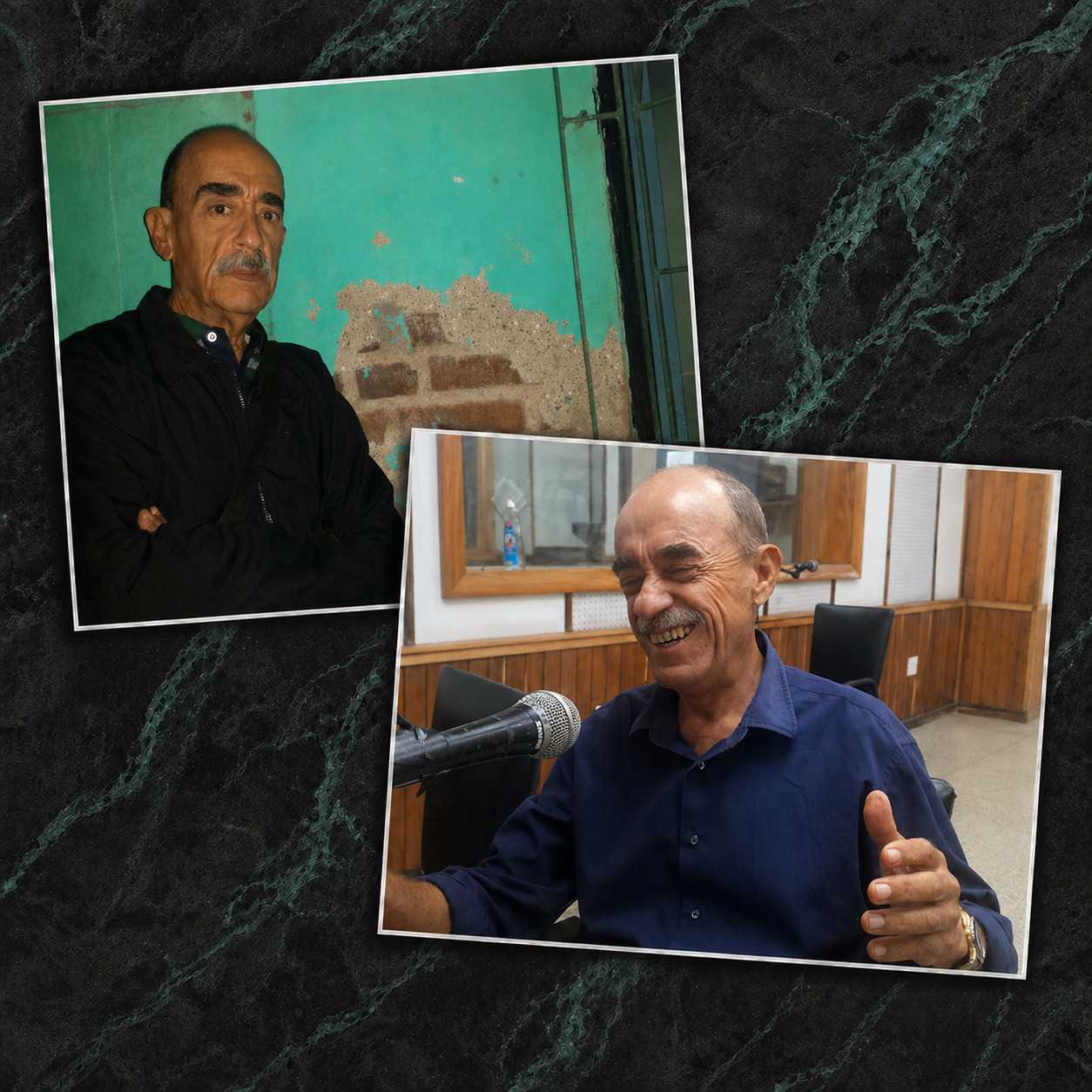
Terrible things could be said about José Luis García; several were said to me, and he himself said several about others. But at that moment, in the late nineteen-nineties, all I knew was that he was a writer of short stories and plays that had won prizes, and that he lived alone. I remember having been to his apartment a couple of times, not far from where I lived, near that market of broken streets where I bought vegetables and the scarce meats. His apartment was frugal, emptied of the trivialities of living: few pieces of furniture, few books, and so on. There he showed me his writing projects, broken down into strips of paper. There I understood that a writer lived there.
Ours was a cyclical and municipal life, as most lives are, but José Luis believed he was meant to accomplish certain forms of greatness. That is why he wrote as if despising the small, trying to keep himself away from so much worldly mediocrity. One may have various trades, but writing is breath, and it must not be stained.
I was newly graduated when he invited me to collaborate on his radio programs, and we shared many moments in those cold glass-walled booths and deserted corridors that smelled of dampness and fear of political error, the terror of censorship lodged in the bones of every day. Outside, some girl was almost always waiting for him, a girl I imagined he had seduced with the maneuvers of an older man, knowing the small power that writers, artists, radio directors, and other specimens of the jungle of sex grant themselves over the candor of youth, like wolves of the Cuban night.
I worked at Ediciones Holguín and had edited his novel Apuntes de un cazador, with which he returned to bookstores after several years. It was a book unlike anything one had seen in that place: Chekhovian and at the same time anti-Chekhovian, sprinkled with a sparkling phraseology, sometimes coming from the cold, like that “Thackeray, you scoundrel, envious of Swift!” which appeared in the final section, in the protagonist’s diary, and which I never forgot.
For me, the different writer that José Luis was remained marked in that diary from the second half of that book. Cuban literature knows little of diarism; it is too opaque and cowardly, stupid and closed like a militiaman and a jailer, or like a party official or the lean radio censor. Diaries are written by solitary people, and they are written in the most absolute isolation, but some free spirit is required. In those pages there resonated a genuine voice that knew what had to be spoken of. It knew that to mature was to grow old, and that this was an excess of past, an assault of memory that writing somehow had to help exorcise.
After I left Cuba, I learned that he had continued writing and had managed to win the Alejo Carpentier Prize for the Novel, one of the most important prizes on that unfortunate island where we were both born. And I was glad, because if there was a writer disconnected from certain paraliterary circles, someone who wrote with dedication while having to earn a living hammering away at radio scripts and directing and hosting programs, it was him.
He was an acute writer, somewhat punctilious, demanding and respectful of his own manias. I think he liked his stories to remain open, but above all I think he did not deceive himself, that he wrote with an absolute commitment to literature and to himself, like someone who owed nothing and wished to owe nothing to anyone. He detested the world of literary magazines — I once heard him describe another writer as “a reader of magazines” — and he spoke of his literary fathers with devotion: Faulkner, Chandler, Hemingway, and his admired Norberto Fuentes, whom he seemed always to have present.
He was not an easy character, and I remember him as a solitary man, but he had a peculiar sense of humor. He was not a man of loud laughter; rather, he laughed under his breath, and I think that was how he slipped into radio. He was neither an announcer nor did he have the booming voice many demand of those who work there. But he had a nocturnal voice, and he always brought Martha and me into the new programs he added to the radio schedule, such as that interminable five-hour magazine show that covered the early hours of Monday morning when the provincial station in Holguín extended its programming.
I reread one of his stories, “Sobre la muerte de mi padre y la precariedad del amor,” in an anthology of Holguín writers that someone has sent me from Cuba: a dystopian story in which the city has been renamed and is now an unrecognizable place. The streets, parks, and hospitals have German and Asian names. There are Liberian refugees, mass graves with Slavic names, Dutch drivers, ill-tempered Filipinos, Iranian nuclear plants, North Korean mining colonies, brothels run by Swedish women, and dams built with American technology and Syrian and Afghan labor. Through Key West II, formerly Cayo Saetía, an old fiefdom of the military men of the former regime, immigrants slip in. I read it paying attention to certain details, such as those copper pots with wooden handles from which the protagonist and his Armenian chess-playing friend drink “coffee with pajonera grass.” The story has to do with the death of the father, run over by a car, and I remembered that among all the things we talked about he never said anything about his father or his mother, and that somehow, by always speaking of others — colleagues, friends, acquaintances — he kept from the conversation every trace that might reveal a family bond, a past.
I thought that in Apuntes de un cazador, whose details I remember only vaguely, and in Últimos días junto al mar, his 2014 novel, there is always a representation of authority in the figure of a retired soldier or an admiral. In the case of the latter, his name is Handke, and I think of the scaffolding of a mirror game between a military authority in a specific context of lifelong gorillas such as the Cuban one, and a literary authority who a few years later would win the Nobel Prize. In his case, those military men are veteran figures, retired officers or men fallen on hard times who retain a certain pride — they also keep their pistols — but who have been displaced or marginalized by a power they helped forge in the past, and which the author now turns into narrative material. The idea of dismemberment, of indefinition and uncertainty, lies at the very center of those stories, in which the other characters also seem to have few points of support, such as the young woman in the story mentioned above, who becomes an indispensable element in the protagonist’s journey toward the resolution of the case — if I can say there was anything of the sort — of the father’s death.
Life is a subtle gas, but memory weighs more. After many years, we exchanged messages again recently about I no longer remember what problem with the roof of the house where he lived. But we did not see each other again. I sense that I will not see many others again either. I have thought about all this precisely on an April day, eighteen years after I left Cuba forever, and I have remained staring fixedly at a photo of him that someone shared on social media.
Eternity is always light.


