I
I have to confess that I always thought Rushdie would not survive an Ayatollah’s fatwa. But once again books won: the one who issued the fatwa ended up dying first.
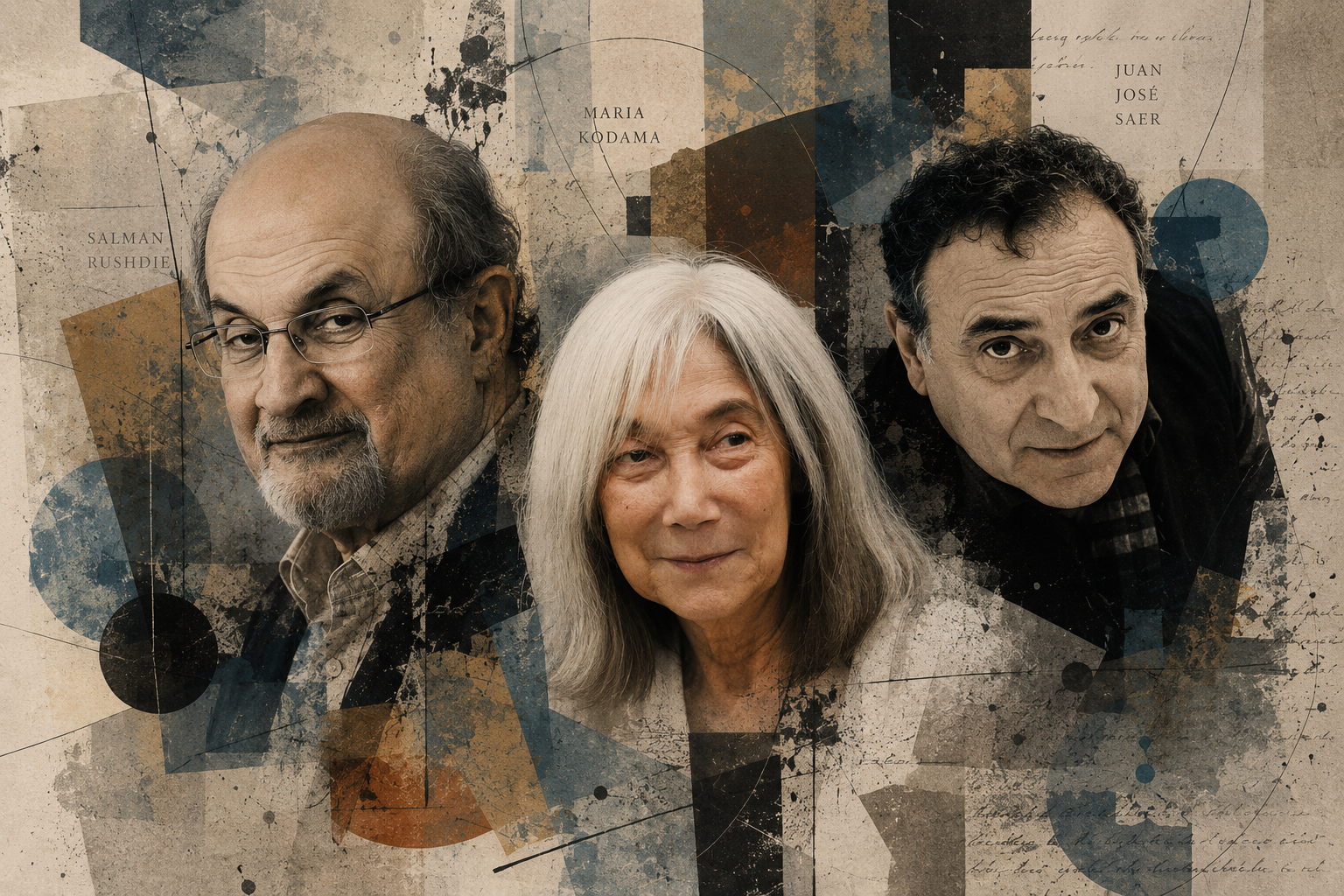
Rushdie reached the beginning of this year missing an eye, the mark of the infamous beast that stabbed him. ‘A knife had cut me out of the world clean,’ he writes in his book, where he recounts the attack he suffered and his recovery. He survived like those movie heroes who reach the end shot up, covered in dirt and blood, with a broken leg, a dangling arm, and a swollen eye, but the villain’s horse is so slow that he ends up defeated, even if squinting one eye to warn that there will be a sequel.
That fatwa did leave some victims behind, who knows if it is now expired. A Japanese translator of the novel, a Norwegian publisher, thirty other people in a hotel where a Turkish translator was staying—all dead because of the supreme creed of fanatics. And also a bit of our faith that there would be unanimity among writers in condemning the supreme leader of the Persians. It was not so. Wallowing in those muds, I remember John le Carré, Roald Dahl, Hugh Trevor-Roper, and John Berger. A handful of tame, foolish buffaloes dominated by a strange, superior force who only fell short of saying—contrary to that Almodóvar character: the Arab world hasn’t treated us that badly.
I can only rejoice at how events unfolded this year: Rushdie will keep doing his thing for a while longer, which is writing books in a world certainly with fewer readers, but also with one less ayatollah, while the promulgators of fatwas will have to be more careful about where they meet with their leadership—which is a plague—high command.
II
I have learned that María Kodama, after a life dedicated with extreme zeal to caring for Borges’s papers,
died intestate, and that after her death, a semblance of a family legal battle ensued. It has also come to light that Octavio Paz’s widow died without leaving a will, and because of this,
there is a dispute between the Colegio de México and the Mexican government to fulfill what Paz had left in writing: that his papers should rest in the vaults of ColMex.
These days, reading the
correspondence between Cabrera Infante and Néstor Almendros, it is revealed to us that we only have the filmmaker’s letters, but not the novelist’s. Almendros’s papers, as the prologue writer notes, have been lost after two deaths: his own and that of María Alvear, his secretary. All Cuban heritage is lost heritage, or on its way to becoming so.
As a reader who enjoys these trivialities of literary life, one cannot help but feel deep perplexity. Why didn’t Paz himself send his papers to the Mexican Colegio during his lifetime? What was going through Kodama’s mind when she failed to design the future of that legacy?
A few days ago, I received the new Alfaguara edition of Borges’s complete essays. It gives you a strange feeling to look at that copyright page and read the names of the five nephews and nieces who, I doubt, ever got to call the author of those books ‘uncle’—books for which they will now collect royalties until the year 2056.
It is understandable that a strict, by-the-book, and scissor-wielding Castroist—especially scissor-wielding!—like Lilia Esteban would place everything related to Alejo Carpentier into the hands of the most disastrous administrators that the wretched island of Cuba has ever known. It is understandable, I say, because behind those decisions there are always the epaulets of colonels and the eyes of henchmen. But you, María, and you, Marie-Jo?
III
Following a guideline mapped out by Juan José Saer in his conversation with Ricardo Piglia—’If we take the term Latin American as a geographical determination, I am evidently a Latin American writer, more precisely South American, more precisely Argentine, and more precisely from Santa Fe’—I am a Cueto-born writer. That is to say: Latin American, more precisely Caribbean, Cuban, from Holguín by way of the Customhouse and Carralero Street, a Cuetense, and from my neighborhood of Luis Beltrán, right across from the train station.
But I have now spent more time outside of Cuba than the years I lived in all those places: about seventeen years in Cueto, another seventeen in Holguín, and now eighteen between Texas and Arkansas. None of this should really matter too much. One would like to remain that reader who, upon seeing
a photo of a friend with Leila Guerriero at the Madrid Book Fair, writes ‘I love her’ underneath in the comment section. A writer who hasn’t set foot in his birthplace for three decades writes what is quite possibly the most important
biography of a Cuban writer ever written—a book conceived from freedom, but above all from the courage of not thinking about the failure such an enterprise could entail.
The neighborhood where one was born does not necessarily have to be inspiring or stimulating. On the contrary, it can be as castrating as poverty, poor education, rudeness, noise, and daily violence can graft and deform. It is a breeding ground where too many things reverberate in memory, from first friends to first love, first words, first possessions, and first fears.
In the first little book of poems I published, back in the year two thousand in Santiago de Cuba, it mistakenly stated that I had been born in Holguín. The first time I returned to the old town, someone threw it in my face. They looked at me as if to say: but I remember when you were born at the town’s maternity hospital. What do I know. The mistake hadn’t seemed like a big deal to me—that’s how you think when you are young. Seriousness, like forgetfulness, arrives with age. Afterward, I made sure the correct place appeared in all my books, while always keeping in mind what we once read somewhere, it no longer matters where: if Beethoven had been born in Tacuarembó, he would have been the director of the municipal band.
Post Views: 3