
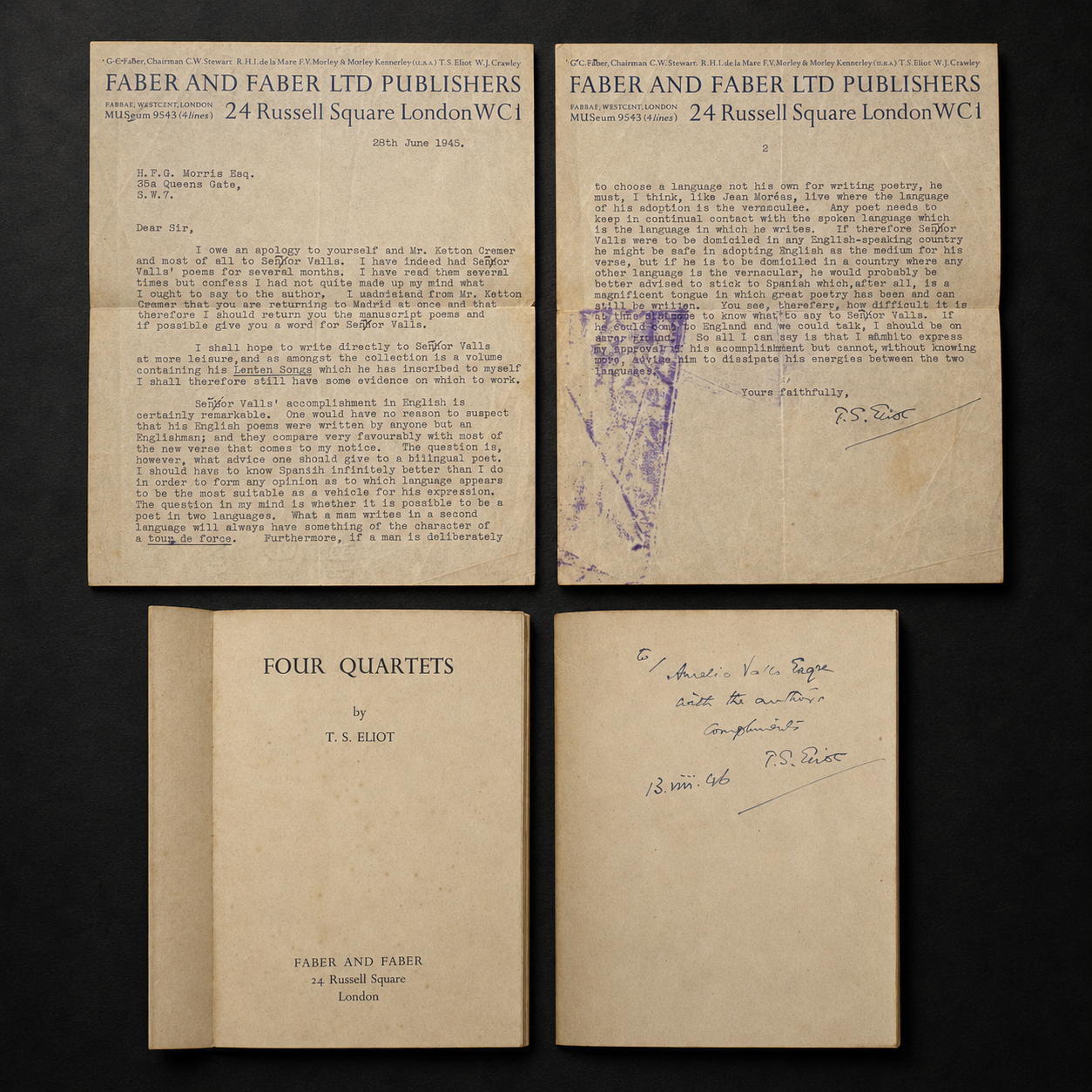
Sometimes used books are given a second life, running parallel to the printed text. That existence is revealed in underlines, dedications, coffee stains, a folded letter, an editorial note, or some remnant of memorabilia that transforms the copy into an archival artifact. In my Wunderkammer, I have a first edition—third printing—of Four Quartets, purchased at the London bookstore Peter Harrington. This copy preserves, alongside T. S. Eliot’s inscription to Aurelio Valls, a letter dated June 28, 1945, written on Faber and Faber letterhead, where the author of The Waste Land also worked as an editor.
The ensemble has something of a small literary scene. On one side, Eliot’s book, already placed at the center of twentieth-century poetry; on the other, the less visible figure of Valls, a bilingual poet and Spanish diplomat (1917–1988), to whom Eliot inscribed the copy. Between them, a letter that shifts our attention from the bibliographical object toward a perhaps more radical question: what is the language of a poet?
The scene could be reduced to a bibliographical rarity, an inscribed copy, a preserved letter, the comment of a major poet on another, almost secret poet. The real interest lies elsewhere. The letter makes visible a central tension of modern literature: language as insufficient homeland, choice, discipline, and foreignness. Valls appears there in an intermediate zone, between English and Spanish, between two ways of belonging to poetry.
Eliot reads from within that discomfort. What he has before him exceeds the manuscript, verbal skill, the picturesque case of a bilingual writer. A language can be learned, mastered, even imitated until almost every trace of foreignness disappears. To turn it into an expressive destiny requires another kind of intimacy, less visible than correctness, more difficult than fluency, bound to the ear —more than to meaning—, to daily use, to the changing matter of conversation.
That is why the letter matters beyond Valls. Eliot seems to distrust language understood as an available instrument. The poet writes within a verbal pressure, a sonorous memory, a system of habits that precedes and exceeds him. An adopted language may open an unexpected freedom, although it also demands constant vigilance. It may offer distance, precision, even elegance. It may also turn the poem into a demonstration, into that brilliance slightly removed from life which Eliot calls a tour de force.
The mention of Jean Moréas —a poet born in Greece who chose French as his literary language and lived within the French verbal space— introduces the decisive point. Moréas functions as the figure of an adoption carried to its ultimate consequences. To choose a literary language means, for Eliot, to inhabit the space where that language wears itself out, makes mistakes, gets dirty, renews itself. The language of the poem needs to rub against common speech. Without that contact, writing risks remaining in a zone too elevated, perhaps admirable, but still suspended.
Read today, the letter preserves a strange actuality. Our time has made common what for Eliot still seemed an exacting exception: writers formed in several languages, lives divided between countries, works crossed by translations, accents, displacements, losses. The question remains intact. What is the language of a poet? The first one he heard? The one he reads most intensely? The one that allows him to take distance from himself? The one that offers him a mask?
Here is the letter:
Faber and Faber Ltd Publishers
24 Russell Square, London WC1
28th June 1945
H. F. G. Morris Esq.
35d Queens Gate,
S.W.7.
Dear Sir,
I owe an apology to yourself and Mr. Ketton Cremer, and most of all to Señor Valls. I have indeed had Señor Valls’ poems for several months. I have read them several times but confess I had not quite made up my mind what I ought to say to the author. I understand from Mr. Ketton Cremer that you are returning to Madrid at once, and that therefore I should return you the manuscript poems and if possible give you a word for Señor Valls.
I shall hope to write directly to Señor Valls at more leisure, and as amongst the collection is a volume containing his Lenten Songs which he has inscribed to myself I shall therefore still have some evidence on which to work.
Señor Valls’ accomplishment in English is certainly remarkable. One would have no reason to suspect that his English poems were written by anyone but an Englishman; and they compare very favourably with most of the new verse that comes to my notice. The question is, however, what advice one should give to a bilingual poet. I should have to know Spanish infinitely better than I do in order to form any opinion as to which language appears to be the most suitable as a vehicle for his expression. The question in my mind is whether it is possible to be a poet in two languages. What a man writes in a second language will always have something of the character of a tour de force. Furthermore, if a man is deliberately to choose a language not his own for writing poetry, he must, I think, like Jean Moréas, live where the language of his adoption is the vernacular. Any poet needs to keep in continual contact with the spoken language which is the language in which he writes. If therefore Señor Valls were to be domiciled in any English-speaking country he might be safe in adopting English as the medium for his verse, but if he is to be domiciled in a country where any other language is the vernacular, he would probably be better advised to stick to Spanish which, after all, is a magnificent tongue in which great poetry has been and can still be written. You see, therefore, how difficult it is at this distance to know what to say to Señor Valls. If he could come to England and we could talk, I should be on surer ground. So all I can say is that I wish to express my approval of his accomplishment but cannot, without knowing more, advise him to dissipate his energies between the two languages.
Yours faithfully,
T. S. Eliot


